Crooked Creek
posted this
06 December 2021
GWarden,
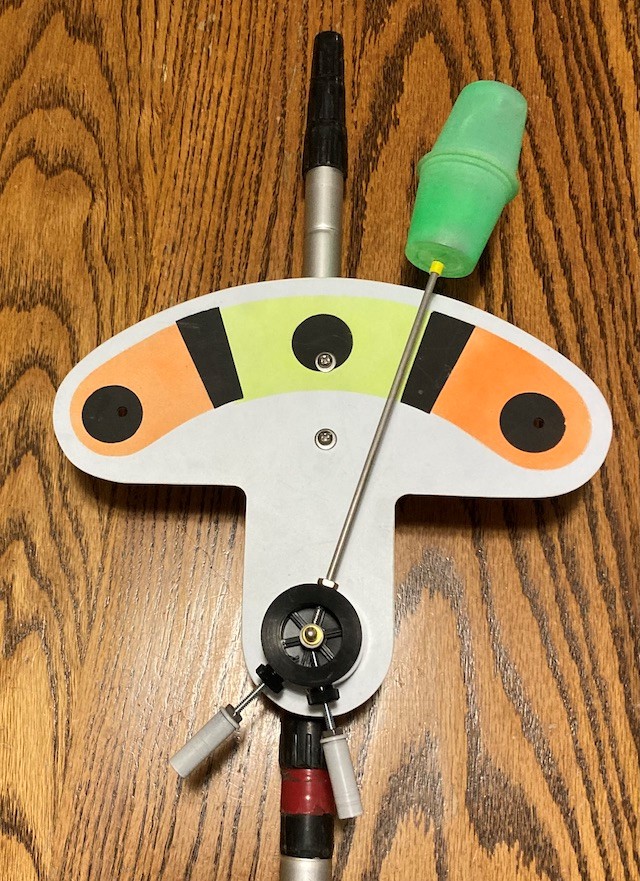
It is certainly an interesting approach to trying to cope with the winds, and thank you for giving me the image of it's purpose and workings.
When the CBA was sanctioning cast bullet matches at my club ( St. Louis Benchrest Club) in the 1980's, finding commercially available wind flags was daunting, at best. Most of us shooters had to make our own, sometimes copying what others had done or, thinking we had a 'better mousetrap', came up with and 'kitchen table' manufactured our own designs. Some 'interesting' flags showed up on the field, some worked well, some.....? My first attempts were, let's say 'educational'. I found early on that 'shapes and colors' go a long way in identifying whether the flag was angled toward you (head wind) or away from you (tail wind), especially the further away set flags when shooting the 200 yard targets. Aluminum vanes painted orange on one side and white on the other, and Styrofoam balls (tennis ball size) painted half orange and half white mounted on the back of the vane (in a slit between the colors) with the colors positioned opposite of the vane colors, readily displayed the direction the flag was facing. Posts were made from 1/4" (or 5/16", I forget) steel rod sharpened on one end for ground penetration. On the other end was mounted a 'standard' auto parts store telescoping radio antenna for vertical adjustment as the range conditions demanded. The 'ball' on the end of the antenna was cut off and the tip rounded off. A section of 1/2" diameter rod was epoxied to the vane with a hole drilled in the bottom end to accept the tip of the antenna rod. In the bottom of the hole a standard steel BB was glued in. The 1/2" rod (now a 'sleeve') with the round BB inside sat on top of the rounded antenna tip creating a 'point contact'. This allowed for the flag proper to rotate with the lightest breeze with a 'virtually' friction free (at least minimal with light lube) mount. Running through the vane (epoxied on) was a steel wire (about 1/16" to 3/32") extending several inches past the vane end. On that wire, I mounted a rubber core lead fishing sinker (3/16 -1/4 oz.?). The rubber core held the lead sinker on the wire, while allowing it to be slid along the wire for balancing the flag. I could probably get some photos, if there is an interest.
Some of the club members (the more serious ones!) would often simply set up a number of flags in their backyards and just sit and watch the flags for extended periods observing the reactions, and the consistencies of same, to the varying conditions at hand on any given day. The belief being that this was a much more in-depth learning experience by closely studying their flag's reactions without the distractions of shooting 'over the flags' at the range.
Another good way to understand the effects of wind (or try to!), if your home situation/neighbors allows for it, is to shoot an air rifle over wind flags in your backyard.
One last thought regarding the probe type wind flag and firing when the probe repeats a position. Just thinking out loud, and having never used a probe flag, it seems the approach might be more successful in group shooting matches where only group size, and not group position on the target, determine success. In score shooting, with the objective being hitting five separate bulls, would seem more of a challenge, to me anyway. Again, with time being a critical limitation. I know, you have to 'hold off' either way, and maybe my thinking is 'old school'...if not 'old dog' problematic!