A friend was obliged to consign a broken-legged cow to The Great Beyond. We did however ensure that she would have an afterlife. I rigged her with a Browning game camera and a solar powered security light, as described in a recent post.
https://forum.castbulletassoc.org/thread/a-shot-in-the-dark/
This is of course a story of shooting (more) pigs with hard hollow point cast bullets from the Savage 1899 .30-30. Mostly it happened at night with Oneleaf NV100 attached to Leupold scope.
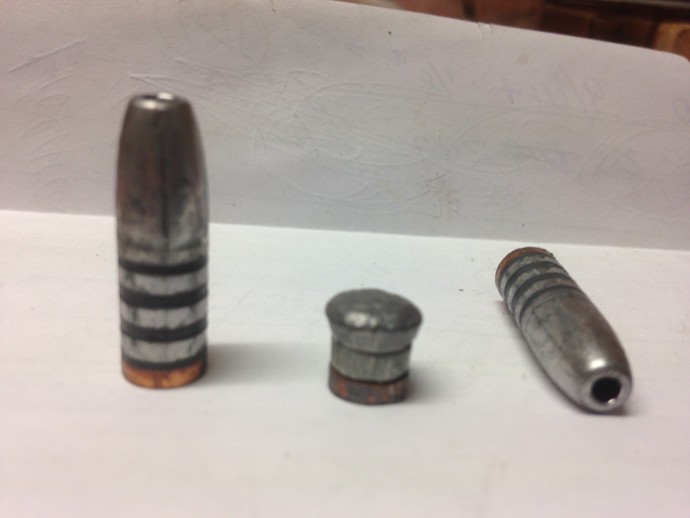
This is a continuation of a test using more tin and less antimony in the hunting alloy (earlier post). As near as I can get with the calculator, the new alloy is about 5% tin and 6% antimony, so just a bit harder than Lyman #2. Hardness as tested is still the same as the old alloy (16 BHN), but there is a possibility that the pattern of bullet breakup may differ. Casting is excellent, with very few seconds.
https://forum.castbulletassoc.org/thread/more-tin-in-the-hunting-alloy/
The aim this time was to clean up a bunch of pigs, taking note of bullet performance along the way.
A feature of shooting with NV is that there is a complete whiteout after the shot, mostly from IR light reflecting back off powder and bullet smoke. Movements of survivors after the shot are lost in the whiteout. One shot per arrival is therefore typical.
The mission began with a full moon, so the approaching hogs were clearly visible from the “blind” (Isuzu Dmax with camo netting) 60 meters away. As the moon became later and less, range was closed up to 35 meters.
The first night out, which was night four for the cow, produced five boars before midnight, and a total of nine pigs for the outing. Bullet performance was perfect when shot placement was correct. All boars went straight down with forward shoulder shots. This was with the full load of LVR (175 gns bullets at 2300 fps). The illustration shows four of the boars where they fell. The fifth was close by but not in the image. The largest boar was 60” from snout to butt of tail. A large sow shot later at the carcase was hit in the ribs and went about 100 meters.
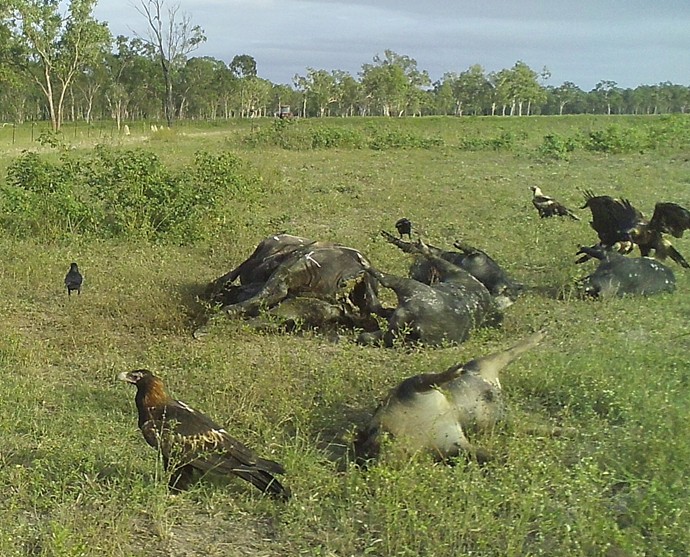
The birds are Torresian Crows and Wedge-tailed Eagles. The eagles are particularly adept at finding freshly shot pigs – I think they follow me around. Sea Eagles are occasional visitors as well.
The next image is of a sow from a later excursion, another one hit too far back – she ran 50 meters and piled up in some weeds. This is a reminder that not every shot is perfect, and not every shot is a knockdown. On pigs it is VERY easy to let the aim drift too far back. As rib shots go however, this one would have been acceptable in daylight when the run could be observed.
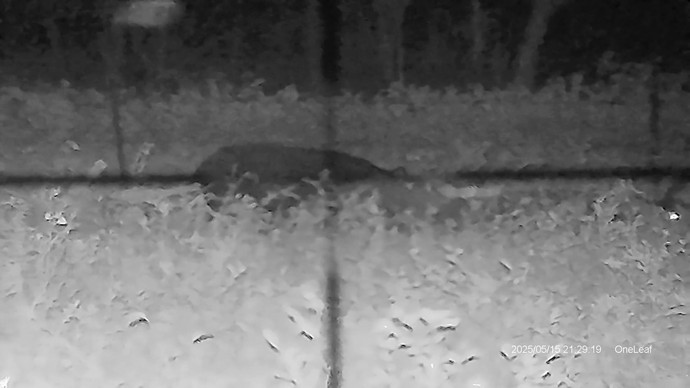
A few nights later this young boar came in. With this shot placement he went straight down. This is back to the 2200 fps load, but I doubt he noticed.
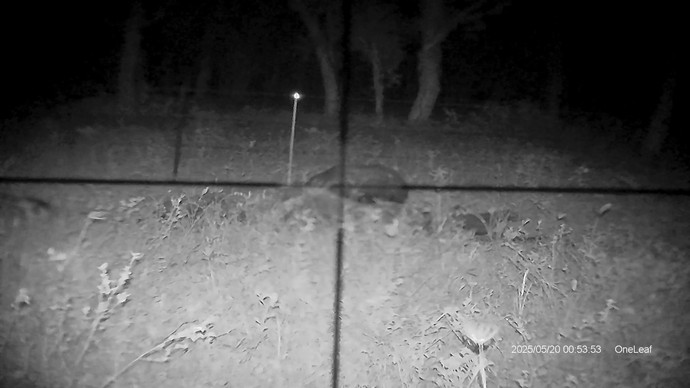
The last night of shooting on this cow was night 19. Tally for the night was three boars and two sows. The sows were a double (images). One went straight down while the other ran about 100 meters. That’s still a pretty good recommendation for these hard HP bullets. The boar on the left of the image was shot a week or so later at another site. The sow on the right is still at large.
Waiting for the double:
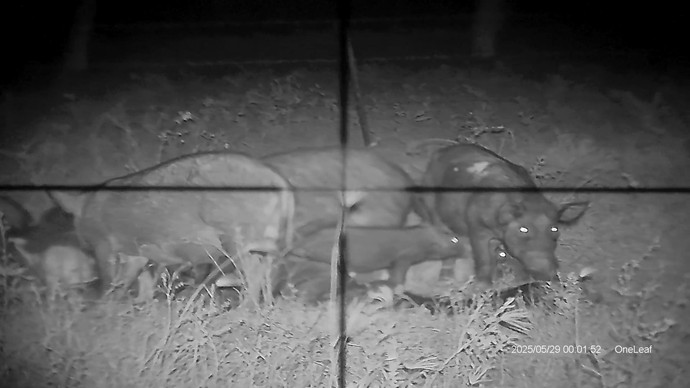
Lined up:
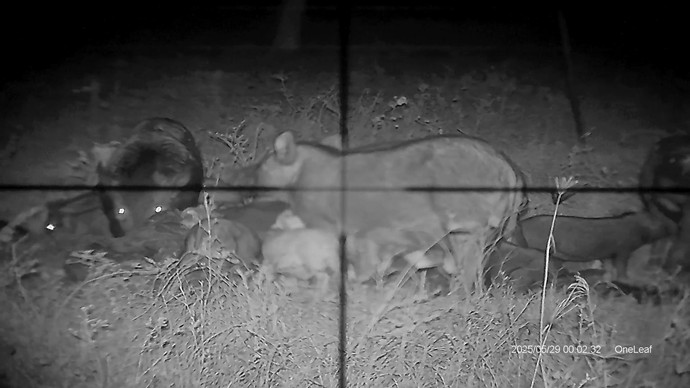
Blam:

Hog tally for the “life” of the cow was 24.
I still consider these 175 gn 16 BHN cast HP bullets better for pigs than jacketed bullets, whether 150 or 170 grains. As for increasing the tin part of “non-lead”, if there is a difference in effectiveness, then I am not seeing it.
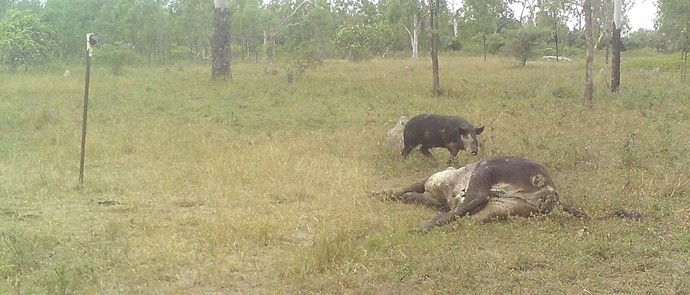
P.S. This is a better view of the boar at the other site where he eventually came undone:
You are only as good as your library.