Hard Cast HP 30-30 Bullets: Part 2

  • 717 Views
  • Last Post 30 November 2025
Aaron posted this 21 November 2025

Since the original post has become so lengthy, it seems efficient to break it up into a two part series now for efficiency. The original post, Hard Cast HP .30-30 Bullet a Big Sow, started by Wilderness, can be found here:

Hard Cast HP .30-30 Bullet on a Big Sow

It is a wonderful read with a lot of contributors and chock full of useful information. We begin this post with part-2 of my testing of hard cast HP bullets in a 20" Miroku Model-94 Winchester. I had planned to post shooting results today but it is raining quite hard today. Results will be posted soon.


With rifle in hand, I confidently go forth into the darkness.

Attached Files

Order By: Standard | Newest | Votes
Wilderness posted this 22 November 2025

Aaron - more thoughts on your bullet nose problem.

I have already said that I think you can fix nose diameter with nose first lubesizer sizing in .300" or whatever die. If you have a friend with a lathe, just follow the dimensions of the Lyman die but leave out all the grooves, O rings and lube holes and arrange for the sizing hole to have some taper - that will let you seat the finished bullet for a proper rifling contact. You will also need a flat faced "nose" punch to push on the bases of these upside down bullets. Once you have the tools, sizing the bullets will be a breeze.

As regards the nose being too fat and hitting the lip of the chamber, you might consider finding a lubesizer top punch intended for a pointed bullet, using that to change slightly the shape of your bullet nose. The method is to run the bullet into the lube sizer die and adjust the stop right down. Then bring the handle down until the top punch encounters the die and stops further movement. Move the stop (and the bullet) up until the right amount of squeeze is applied with the handle right down - go easy on this since you can break linkages if you go at it too hard. The hollow in the bullet nose will make it easier and the front end of that hollow will close up partially.

I have used this method with a RN top punch to turn FN bullets into RN for better feed in my 99 Savage. On another mould (#311407HP) I used it also to increase nose diameter. For current useage I have discovered that I can just lube and gas check with a RN top punch on a FNHP bullet and get the degree of rounding I want.

You are only as good as your library.

Attached Files

Larry Gibson posted this 22 November 2025

Aarron

As you've found with the LeveRevolution under a cast bullet lighter than 170 gr, the LVR does not burn efficiently.  Hence the large ES/SD you got with the lighter 147 gr bullet.  I definitely suggest a heavier weight cast bullet with LVR powder use in the 30-30.  

Doesn't the Miroku M94 have a 10" twist?

LMG

Concealment is not cover.........

Attached Files

Aaron posted this 22 November 2025

Thanks Larry. That single shot was to get a "benchmark" velocity reading with a lower listed charge. I'm going to bump up the charge under that 147gr bullet to see if I can get smaller SD with it.

Plan to go from 34.5gr to 37.0gr in half grain increments. The 38gr compressed charges listed simply won't work with the 147gr bullet deep seated to get them chambered in that Miroku M94 with no throat.

With rifle in hand, I confidently go forth into the darkness.

Attached Files

Aaron posted this 29 November 2025

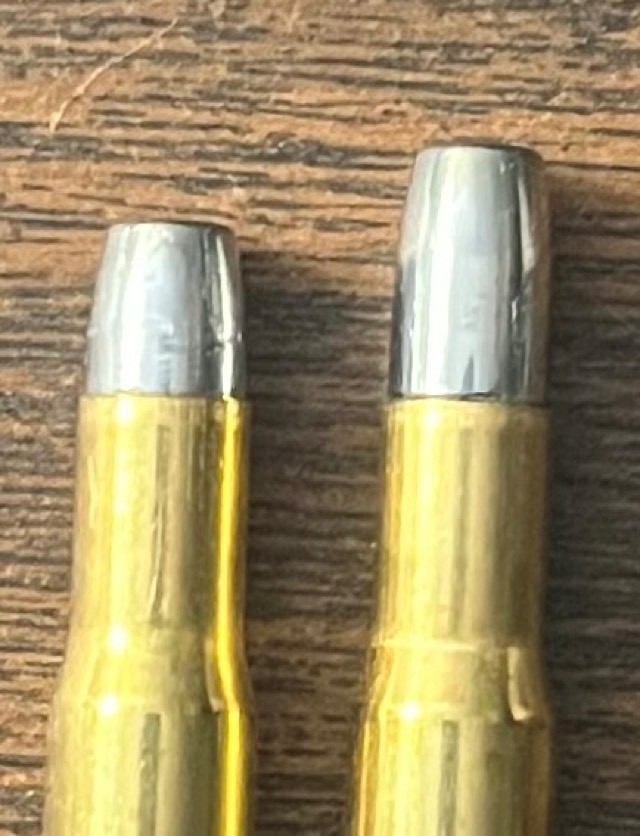
As promised, Batch-2 with the Deep Seated MP 147gr GCHP bullet in the Miroku (Winchester) 30-30 20" rifle. This bullet with its 308 nose will not chamber in a 30-30 rifle with a short throat or no throat. This bullet when seated out to 2.555" and crimped in the provided crimp groove will chamber in my T/C Contender barrel as well as my Winchester 30-30 Ranger. To get this bullet to chamber in the Miroku Winchester with its short throat, the bullet must be deep seated to 2.335" reducing case capacity for powder. Unlike the Lee 309-170 bullet with its bore riding .300 nose, this bullet has a full .308 nose and must be seated accordingly.

Seated to 2.335 on left and 2.555 on right.

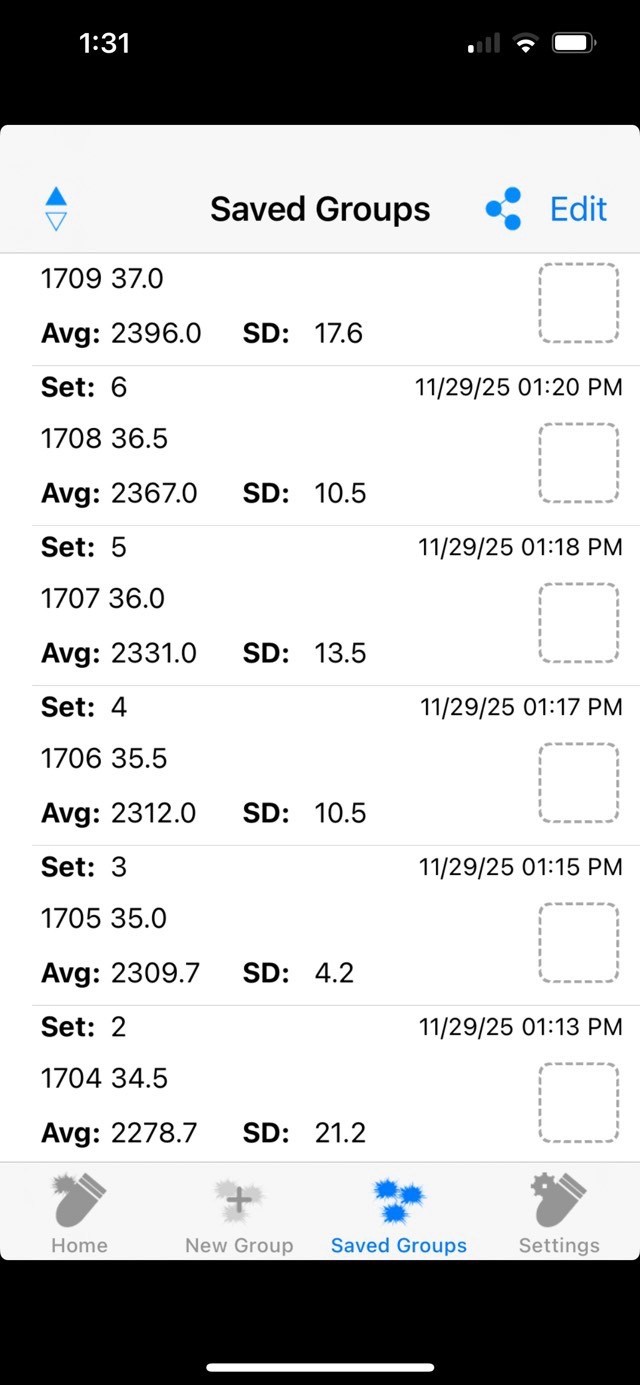
The results were surprising in that unlike the 170gr Lee bullet, the velocity increase was not as drastic with the 1/2gr incremental increase. What was surprising was the 95% load density charge of 35.0gr of LeveRevolution (Set 3 data) with a Standard Deviation of only 4.2 fps and a respectable MV of 2300 fps. It is a fact of life that 2500fps just aint gonna happen with this bullet deep seated and hogging a lot of case volume. I will repeat this batch with bullets seated out to 2.555" in the Winchester Ranger. That will allow up to a 38gr charge. Assuming no high pressure there, they may approach 2500 fps although I am very happy with 2300fps with this bullet.


Another great result was absolutely NO LEADING with 18 rounds down the bore, a wonderful muzzle flower, and bullet lubricant residue on the chronograph at 12 feet from the muzzle. Everything is working just great. Bore was immaculate after shooting session and LeveRevolution burns CLEAN CLEAN CLEAN.

No high pressure signs were present. Normal looking primers and very easy extraction.

The duplicate of this test with bullets seated out 20 2.555" for the Winchester Ranger is ready although charges run from 34.5gr to 38gr of powder. I will post those results after shooting them later.


With rifle in hand, I confidently go forth into the darkness.

Attached Files

  • Liked by
  • Wilderness
Aaron posted this 29 November 2025

Aarron

As you've found with the LeveRevolution under a cast bullet lighter than 170 gr, the LVR does not burn efficiently.  Hence the large ES/SD you got with the lighter 147 gr bullet.  I definitely suggest a heavier weight cast bullet with LVR powder use in the 30-30.  

Doesn't the Miroku M94 have a 10" twist?

Larry,

The test run today provided some exciting results with that 147gr bullet. At 2300fps with 35gr of powder, the SD was a stunning 4.2 fps. While I don't think I will see 2500 fps with this bullet/powder combo, 2300 fps will drop a white tail. That of course is the anticipated result. The deer are not cooperating this year however. Rascals.

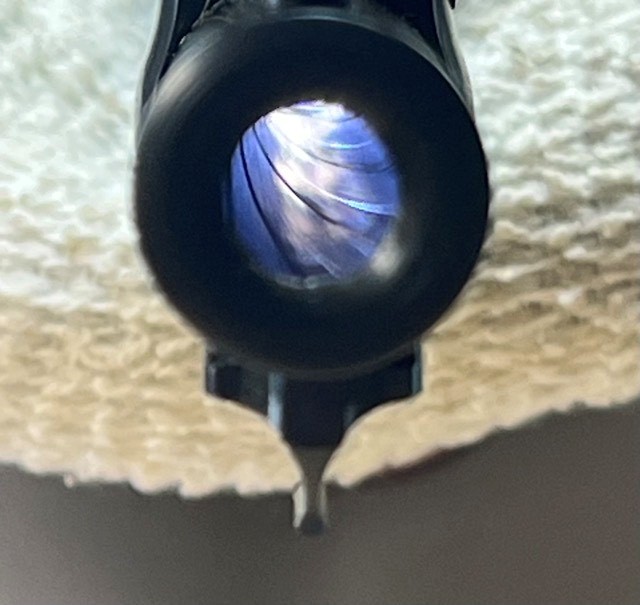
That Miroku has a listed twist rate of 1:12 BUT no kidding, I get 1:13 after 4 measurements. I use the cleaning rod with a clothes pin on it. Very easy to see the pin position during withdraw and insertion. I did it both ways to ensure nothing was unscrewing and sure enough - 1:13. Go figure.

I normally use the Lee 308-170 bullet but really wanted to get a HP bullet to see the difference. Hence this whole series of tests spawned by the data from Wilderness in his previous 30-30 Hollow Point Hog Hunting posts.

Aaron

With rifle in hand, I confidently go forth into the darkness.

Attached Files

Wilderness posted this 29 November 2025

Aaron, that's a great result, and I can feel your excitement from here.

Those are some pretty handy velocities out of a carbine. Good stuff this LVR.

The heavier loads and the reduced case capacity appear to be doing the job for you, despite the lighter bullet. The clean barrel might indicate that bullet-in-the powder is not a problem after all with the very progressive LVR.

Case weight and volume might eventually get into this experiment. Of the .30-30 cases I have weighed, PPU are the heaviest (least volume?) and R-P the lightest. If you go far enough to need more powder space, the R-P cases might give it to you.

The next test will be to check for satisfactory grouping at the higher velocities. I realise that these were three shot groups for velocity, but was there any indication of accuracy? Shooting for group will also give you a more reliable estimate of SD.

And then it will be on to the four-legged Ballistic Gel. The hollow noses will certainly break, leaving the solid bases to continue. The point at which the noses break, and the size of the pieces (big is better) will be influenced by bullet hardness. I understand that you are starting with #2 alloy, and this may turn out to be OK, though if you make any change I expect it will be to go a little harder. I am judging this on my experience with shoulder shots on pigs. Rib shots on deer, of which I have no experience, may be fine with the softer alloy.

If you need to slow down the nose break without changing the alloy, a pellet of shot in the bottom of the hollow can be used - a big enough piece that it needs to be punched in.


You are only as good as your library.

Attached Files

  • Liked by
  • Aaron
Aaron posted this 29 November 2025

I don't see the expanded case volume with other cases as being significant. Across the powder spread of 2.5gr, there was only a 116fps increase in velocity. Another grain or two probably won't impact the results. I think we are topped out with powder weight and velocity in the 30-30. It seems to be the nature of the beast with this powder. Compressed charges perhaps but I kind of think it is a moot point?

 Haven't put these on paper yet. Lost access to my range and seeking another.

With rifle in hand, I confidently go forth into the darkness.

Attached Files

Wilderness posted this 29 November 2025

Aaron - I expect you'll be wanting to get on with stages 2 and 3 of the testing, and I'm looking forward to the reports!

I'd say don't get too invested in 2300 fps and in particular don't get invested in that small SD. You'll need 5 or 10 shots (some would say a lot more) to get a more reliable estimate of SD. In my experience on 5 shot groups, anything SD 20 or better is good for LVR. Go for broke and take 2400 fps if it will group.

I'm expecting your groups to be good with the bullet presumably jammed up on to the rifling.

Velocity increase of about 50 fps/gn is pretty much what I expect from my .30-30s with proper rifle powders.

Case weight can be important for .30-30. When I was chasing velocity variation in my LAS loads I found 100 fps difference between lightest (RP) and heaviest (PPU) cases with the same load. That was about 8" on the Rams. Message to self: Don't mix headstamps.

You are only as good as your library.

Attached Files

Aaron posted this 30 November 2025

I'd say don't get too invested in 2300 fps and in particular don't get invested in that small SD. You'll need 5 or 10 shots (some would say a lot more) to get a more reliable estimate of SD. 

Having taught Statistical Process Control in corporate America, I am one of those "some" who hold that a larger sample size is more viable. The 3-shot sample does give a snapshot of the resultant data and since I do not have the purse of a corporate entity, smaller sample sizes will need to suffice as a comparative data set against the other sets. Once I see a performing load within the population, I will generate a larger set of cartridges to get a more viable data set with that load. That load will also be shot on target to evaluate the group size. For now however, I'll have to live with the 3-shot "taste."

I'm expecting your groups to be good with the bullet presumably jammed up on to the rifling.

I will address that later once a particular load has been culled from the population. Play with seating depth, primers, crimp force, etc....although I am not really seeking minute of gnat accuracy from a hunting load to 100 yards. Remember I have open sights on these rifles and hitting the barn door is wonderful. cool

Velocity increase of about 50 fps/gn is pretty much what I expect from my .30-30s with proper rifle powders.

I am seeing that too with these two sets of data. One more set across the chronograph will absolutely confirm that from what you report and from the data produced with my 3 sets of cartridges.

Case weight can be important for .30-30. When I was chasing velocity variation in my LAS loads I found 100 fps difference between lightest (RP) and heaviest (PPU) cases with the same load. That was about 8" on the Rams. Message to self: Don't mix headstamps.

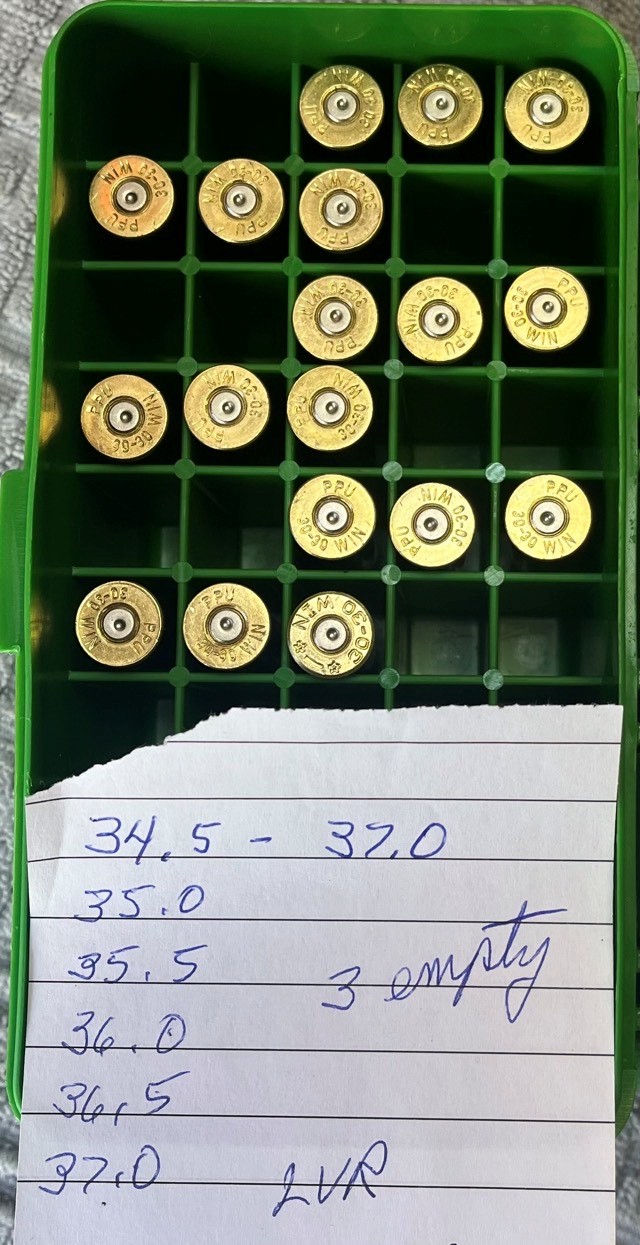
You probably saw those 3 WW cases in the ammo box. I ran out of PPU cases and figured the 3 WW cases would serve the intended purpose. Otherwise I do not mix brass unless it's for the 9mm, 38 Special, or other bulk loading for the range and an IDPA or bowling pin competition with ranges out to a whopping 25 yards.

The good news is that I have a Cimarron M94 arriving on Monday. I am extremely curious to see if it has the cursed freebore like the Miroku. Even if it does, the 26" barrel will be fun to compare with velocity numbers I have now using the 20" Miroku. Twist rate in that rifle is either 1:10 or 1:12 depending on which set of "details" one reads.


With rifle in hand, I confidently go forth into the darkness.

Attached Files

MP1886 posted this 30 November 2025

There is one and only one way to measure case volume accurately and is to cc the internal volume with a liquid either water or alcohol. With alcohol you don't have to bother with drying the water out of a case should you use water.  

Story: A gun industry visitor viseted Hornady brass manufacturing production. The Hornady representative there pulled some cases off the line (happen to be 308 Winchester cases) that were completely finished except for the headstamp and extractor groove. They weighed them and found them consistently weighing to the rigth of the decimal point, I forget the grains, I want to sat .3, but don't quote me.  Then they pulled them from the end of the line where the cases were finished completely and ready for loading. They weighed all way into the left of the decimal point.  That right there tells you why your weighing your cases is a total waste of time.  Sure it narrows the volume of the case down some, just some, but not as good as sorting them by volume. 

I have a good friend that has an extremely accurate match 22-250 Remington. He's done all the tricks to the cases to shrink his groups. None got him results he was satisfied with until he sorted the cases by volume. He then noticed a huge reduction in his groups.  He's the one that mentioned using alcohol instead of water. 

I don't shoot benchrest matches and I don't care to go that far to achieve the most accuracy. 

Attached Files

Close