Hard Cast HP .30-30 Bullet on a Big Sow

  • 1.6K Views
  • Last Post 21 November 2025
Wilderness posted this 14 August 2025

For those at the applied end of cast bullet shooting, this is another example of the successful deployment of a hard cast hollow point .30-30 bullet on a large pig.

By our standards, this is a big sow. Length from snout to butt of tail is 59”, and the weight estimate by the tape measure method is 180 lbs/82 kg.
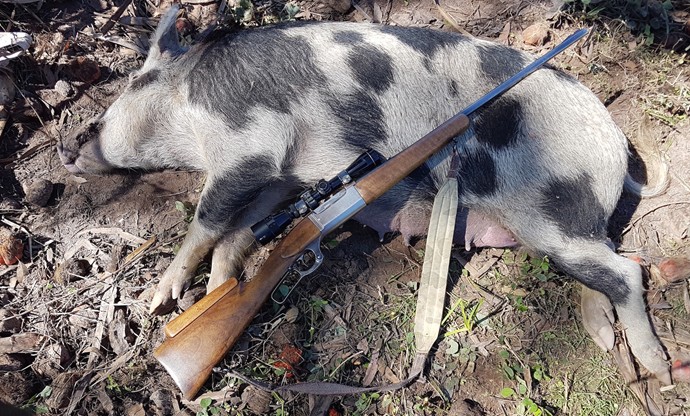
 

She was shot with a 175 gn cast HP bullet, about 16 BHN, from a Savage 99 .30-30. Powder was 33 gns LeveRevolution. Muzzle velocity of these cartridges is a little over 2200 fps. Range was about 50 meters.

Bullets are #U321297HP (.32 Special) sized down from .322” to .312”. Details and images are in previous posts under “Hunting with Cast Bullets”.

My criteria for hardness and hollow dimensions are that a bullet has to penetrate the shoulder of a big boar and continue into or through the second shoulder AND the bullet has also to churn up the insides of a hog on a soft rib shot. Inadequate penetration calls for harder bullets. Not enough churn calls for softer.

This sow would not be as tough as a boar, but she did stop the bullet. Entry was high on the point of the shoulder on the side away from the camera. The bullet did not break any bones on entry, but it did break the shoulder joint on the camera side. There was no exit, but the remains of the bullet could not be found amid the mush. She dropped to the shot.

Fears of these hard bullets “shattering” are ill founded. With proper balance between hollow and hardness, at full velocity these bullets penetrate and kill very well indeed.

I drive my .30-30s as hard as I can without blowing the groups. I am averaging about 2.5 minutes for five shot groups. Users of larger calibers will have the luxury of being able to load to less than full velocity.

You are only as good as your library.

Attached Files

Order By: Standard | Newest | Votes
barra posted this 14 August 2025

Nice keep up the good work.

 Like that shot placement.

Attached Files

  • Liked by
  • Wilderness
Idahocaster posted this 14 August 2025

Wilderness,

I know you have posted quite a bit about hunting with your cast hollowpoints in the past, so I apologize if I'm going back over ground already covered. Have you posted any photos of bullets recovered from pigs? How much breaks or rubs off and how much is left to penetrate?

Attached Files

Wilderness posted this 15 August 2025

Idahocaster - thank you for your interest. Yes, there is an image of a recovered bullet on a couple of those posts, but here is an update. Mostly I don't get to recover anything because the stubs go right through.

The first two are #U321297HP sized down to .312". Bullet length is 1.025". Hollow depth is .500", removing about 10 gns (6%) of bullet weight. In all instances the HP area has broken off and there has been some additional grinding down of the bullet.

The bullet on the left passed almost through a boar diagonally without hitting major bone. The bullet on the right went through both shoulders of a sow and appeared as a lump on the skin on the far side. I can't say whether it broke one shoulder or two but it bears the marks of a serious encounter with bone. From a starting weight (with gas check) of 175 gns, the first bullet has retained 71 gns, and the second 56 grains.


Before I stumbled on to the idea of sizing down the .32 Special bullets, I was using #311407HP. It was not as good, in part perhaps because the lube grooves went further up the nose, weakening that part of the bullet. I don't have a "standard" recovered #311407HP, but can show a couple of variations out of interest.

The first is from my experiment with hardened wheel weights. The note says that the bullet broke both shoulders of a young boar and retained 63 gns from an original weight of 168 gns as cast (173 with gas check).


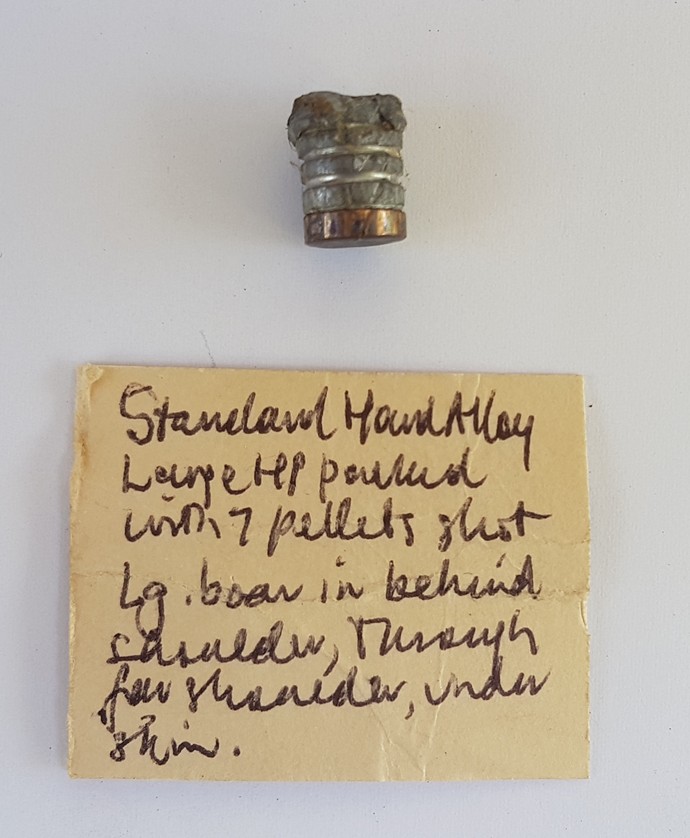
The next image is from an experiment to reclaim some bullets made with excessive hollow. A boar shot with the oversize hollow suffered a broken shoulder but no damage behind the shoulder. The solution to make the bullets usable was to pack the hollows with shot. The note says 7 pellets. That would have been around #6, #7 or #7 1/2 US size. The expedient worked. Note says "large boar, in behind shoulder, through far shoulder, under skin". No mention of broken bones, but bullet looks like it scraped some. Retained weight with gas check 78 gns.


You are only as good as your library.

Attached Files

Brodie posted this 15 August 2025

I would love to loan you my 9.3X57 with 280-gr. cast bullets just to see how many you could get with one shot. 

B.E.Brickey

Attached Files

Wilderness posted this 15 August 2025

Aaron

The dimensions of my bullets (#311041 in brackets) are length 1.025" (1.008"), bearing .700" (.566"), diameter .312" (.310"). I was also seating deeper to favour the Savage magazine - COL 2.500". My bullets and loading method require about 1.5 gns less powder for the same velocity that Larry Gibson achieved with #311041HP bullets.

I would expect your Lee bullet might also give a bit less velocity than my sized down .32 Specials, so you may need to increase the charge. LVR dislikes being downloaded. Larry's pressure tested load for #311041HP was 34.5 gns for a bit over 2200 fps (24" barrel). Suggestion for the Lee would be to work off the chronograph and settle for 2200 fps, or 2100 for a carbine. I've been to 2300 (24" barrel) with cast 175s and jacketed 170s.

Edit: I did some more shooting this morning with LVR & longer COL (2.530"). I pretty much confirmed what I had expected, which is that seating out another .030" has reduced velocities by 30 - 50 fps. So factor in COL as well.

This is Larry Gibson's work on LeveRevolution. It has pretty much been my Bible on LVR.

http://castboolits.gunloads.com/showthread.php?115657-LeveRevoltuion-Powder&highlight=LeveRevolution

My view of LeveRevolution now is that it's at its best with jacketed 170 gn bullets (2300 fps) or full throttle heavy cast. Larry had good results also from the RCBS 180 gn bullet (actual weight rather more). If top velocity is not the objective, then 748 is better and Varget/2208 may be better again.

You are only as good as your library.

Attached Files

  • Liked by
  • Aaron
pat i posted this 15 August 2025

Bill you really post some great stuff. You've become the resident forum terminal ballistics expert. A quick question to save me from searching past threads for the answer. How are you going about sizing the bullet down .010? I've sized plenty down .005 with one pass through a Lee die but never .010. A short explanation would be appreciated.

Attached Files

Wilderness posted this 16 August 2025

Pat

x = unknown, spurt = drip under pressure.

My process on the .32 Special bullets, which start at .322", is to lube and gas check in Lyman 450 with .323" die. Then run through Lee .314" die, followed by Lee .311" die. They come out at 312", or .3125" on the gas check.

Lubing first is essential to keeping the lube grooves intact. Otherwise they close up when bullets are sized heavily.

I also scrape the bases flat before gas checking. Just take the high spots, don't worry about the pits. Gas checks sized from 8 mm to .30 will dimple (concave). If there are high spots on the bullet base the dimple will be off center and misshapen. When the high spots are shaved off the dimple will be concentric and centered.

You are only as good as your library.

Attached Files

  • Liked by
  • Aaron
pat i posted this 16 August 2025

Good deal and thanks Bill. Guess you can bury another wife's tail that over sizing kills accuracy. I firmly believe lubesizers don't do a bullet any good but using a push through sizer doesn't seem hurt much.

Attached Files

  • Liked by
  • muley
muley posted this 16 August 2025

seems the sizing down is almost like "swaging" ????

Attached Files

Wilderness posted this 17 August 2025

Aaron - nice to see some action coming from the discussion.

LVR tends to be a bit loose on the velocity variation/SD. This is in part a function of pressure, which is pretty low at "normal" .30-30 velocity, or perhaps loading density - see Larry's stuff. I see your SD is 33, which I'd be grumbling about. Was that #1 shot (2091) a fouler or did you pre foul? I expect my foulers to be different, though usually they are faster. LVR seems to like being run at speed.

In tube magazine levers that variation translates into vertical dispersion. For instance in my Marlin 336A a 100 fps velocity difference moves POI by about 2" at 50 meters - so pruning that spread is important.

The groups I showed in another post gave spreads of 64 (32 gns LVR) and 46 (34 gns), though both came up at SD 20. POI in the Savage is not as responsive to velocity.

I agree with your observation about no leading. My rifle was absolutely clean after the 34 gn group. I think that's what you get from a more progressive burn and lower pressure. Probably related, when I tried some soft solid bullets with LVR - 192 gns about WW equivalent and 31 gns LVR for 2100 fps - the group was about the same as with the hard bullets and no leading with that either. LVR does seem gentle on soft bullets, although this was only one group.

Top loads of 748 and 2208/Varget show some muzzle leading, but less ES/SD.

The discussion has come a long way from killing a pig!

You are only as good as your library.

Attached Files

  • Liked by
  • Aaron
shootcast posted this 18 August 2025

I can’t argue with results . Dropping them were they stand. Most hunters want a bullet that will pass though leaving a blood trail. I have never hunted pigs. Must be harder to kill then deer. Your HP’s fragment and retain little of the original Bullet weight. I would imagine when butchering you throw away a lot of meat. I shot a facing doe at about 30 yards with TC Contender Super 14 in 30-30. Used the 041 Bullet mostly COWW . Bullet entered the front shoulder area and when skinning found the bullet just under the hide at the rear ham. Needless to say a pistol doesn’t have the velocity of a rifle. Penetration was certainly enough and yes the doe dropped were she stood. I admit that doesn’t happen often. Unless you really don’t care about meat damage I would think a softer alloy with HP that mushrooms and stays together would be more practical.

Attached Files

Wilderness posted this 24 August 2025

Aaron - good to see you off and running.

Some comments ..... 

I keep  my .30-30 bullets at .312". My reasoning is that in the absence of a decent throat to guide the bullet into the rifling, some solid neck guidance won't go astray. You can check max allowable bullet size by measuring OD of fired case neck, then size and load same case with bullet of known diameter. Measure neck OD again. Difference between fired and loaded neck OD is how much you can add to bullet diameter without running out of neck clearance. If cases are variable, a very light ONT, just getting the high spot plus catching the occasional thick neck, will keep you out of trouble with neck clearance.

Second point is bullet weight. Your bullets will be quite a bit lighter than mine. LeveRevolution goes well with heavier bullets, 170 gns plus. Larry Gibson did well with 150 jacketed bullets loaded right up (2500 fps), but I think I recall a comment in his writeup somewhere about LVR being not so good with lighter cast bullets. This will be to do with having enough pressure to get LVR burning properly. Your experience will be instructive.

Looking forward to the next instalment.

You are only as good as your library.

Attached Files

Wilderness posted this 24 August 2025

Aaron

My comment re .312" bullet size was not about the noses. It was a general statement of preference for bullets to fill the neck in .30-30.

As I'm sure you know, noses can be reduced by partial nose-first sizing in the lube sizer. The problem will be finding a small enough die - maybe ream out an unwanted smaller die, or get someone to make one. It doesn't need any lube holes or grooves since lube won't be involved - just a cylinder of the right diameter with a tapered hole and a bevel on the bottom to hold it in place.

Getting further ahead, I checked the MP website. Their specs indicate a 5 gn reduction in bullet weight, HP versus solid. In my testing, this was about the right reduction for a soft (i.e. wheelweight) HP bullet. "Right" that is to balance penetration and destruction. LVR may be more tolerant of soft bullets (based on one group!) than the stick powders. Another plus would be a little more weight in the WW bullet.

Keep at it!

You are only as good as your library.

Attached Files

Spindrift posted this 26 August 2025

I believe the MP 312-159- Hunter was designed around the typical .308 win chamber. It has worked very well for me in my .308, and several .30-06 rifles, never tried it in my 30/30 though.

My favourite MP bullet for my Marlin 30/30 micro-groove is the MP 311 "Sledgehammer". It shoots very well, and the crimp groove is in the right spot even after fattening up the nose with powder coat. It is only about 140grs, however, and maybe not relevant in a discussion about Lvr powder.

Attached Files

  • Liked by
  • Aaron
Boschloper posted this 31 August 2025

SAAMI is kinda like the pirates code “more like guidelines”.

Attached Files

  • Liked by
  • Aaron
Wilderness posted this 21 November 2025

Nice work Aaron.

I note that your Miroku has 20" barrel.

With your Lee 170 gn bullet, which lines up about with #311041, I see you got 2208 fps (and good SD) out of the Lee with 34.5 gns LVR. This is very close to what Larry Gibson reported from the same load with #311041 from a 24" barrel. Your shorter throat might be offsetting the shorter barrel, velocity wise.

Your 2300 fps from the MP bullet with 34 gns LVR is getting into useful territory though SD is still a bit much. In my 24" barrel I have happily pushed 175 gn (w/GC) bullets to 2300, which also happens to be the Hodgdon max for the 170 gn Sierra. My cast loads get that velocity with about 2.5 gns less powder than for the Sierras.

Out of interest, the Hodgdon LVR load for 150 gn Sierras is 38.5 gns. I've used that too, and got the claimed 2500. You've probably got some room to edge up the MP load, which might deal with the loose SD.

More points:

With my 1949 Marlin 336A, POI at 50 meters moves 2" for every 100 fps change in velocity, whether noting individual shots within a group or comparing groups with different loads. This can explain vertical dispersion with excessively variable loads, and is a very good reason to minimise spread/SD in levers. I have experienced this with other tube mag levers, though I did not then quantify the effect. This is an argument for sneaking that MP load a bit higher.

The second point relates to cast HP bullet performance on game at higher velocities. My bullets are a bit harder than #2 (16 BHN) though with more hollow relative to bullet weight (6%) than for the MP. I expect you'll be just fine for rib shots, but if the faster loads are too destructive you may want to season your #2 with a sniff of linotype. Your first few deer will give you some guidance.

Re your feeding issues, I expect you'll have a HP up the spout and something else in the magazine. Winchester and Marlin are very different as regards feeding. My old Marlin Model 1893 .32-40 would feed anything, even an empty cartridge.

Finally, how are the groups with the faster loads? They don't have to be MOA, just good enough for the intended application.

You are only as good as your library.

Attached Files

Close