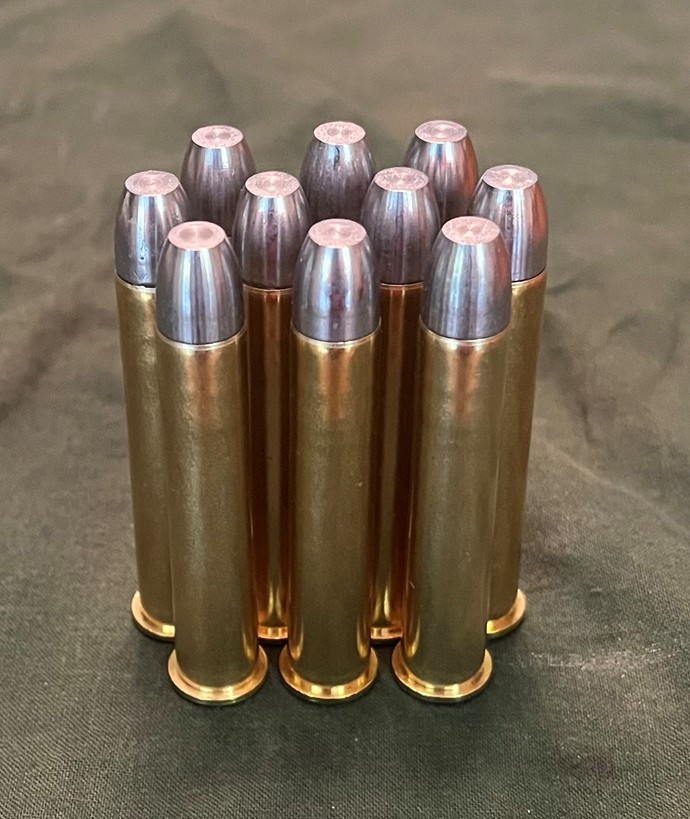
38-55 - Bullet recession in tube mag, smokeless rounds

  • 391 Views
  • Last Post 28 August 2025
SkinnerD posted this 27 August 2025

Greetings

I'm looking at getting a LA in 38-55 to go with my 1885 Hi Wall.

Loading also for 44-40 using smokeless, I'm familiar with bullet recession issues when smokeless powder is used in that calibre and the charge does not provide seating for the bullet as a full BP charge would.

The brass case is quite different between the two, a long taper in the 38-55 vs. a shallow bottle neck in the 44-40.

(I'm stuck with smokeless as the lungs object to BP smoke)

I gave up using the method of seating bullets in a fired unsized case for the 38-55 Highwall. My experience was that a significant % of the cases had too little grip from neck tension. Across say 30 loads there was no consistency retained in seating depth as the bullets would slip even stored singly in an ammo box. Did not seem conducive to accuracy. So I sprang for a Lyman M Die and used it after FL sizing followed by a standard firm crimp. Resulting in nice solidly retained bullets and an improvement in 100metre accuracy.

I'm wondering if this will be sufficient retention in a tube mag?

My current load is with ADI AR2207 (RL7 equiv), which only partially fills the case. I'm getting around 1400fps from the 30in Highwall with a 250gn PC bullet.

In the 44-40, the old (short-lived) Winchester Hi-Vel load had a crimp in the brass into the neck behind the bullet. I happen to have an old box of Kynoch Berdan Primed 32-20 with such a crimp. Following another NZer I experimented in 44-40 with making such a crimp prior to seating using a mini-tube cutter with a blunted cutting disk. That worked very well. Hardest part was indexing the crimp accurately from one piece of brass to the next - my jig was very rudimentary.

So, to wrap, do any of you have experience with 38-55 in a LA? (Prob a silly question but...) And from that experience, was bullet recession in the tube mag an issue? If so, how did you resolve it? Has anyone ever tried a seating crimp at the base of the bullet?

Thanks in advance. J.

John - New Zealand

Attached Files

  • Liked by
  • Wilderness
Order By: Standard | Newest | Votes
Wilderness posted this 27 August 2025

John - I sympathise with your fears on bullet recession. My first cast bullet experience was with a Winchester Model 92 .44-40. It was foreever collapsing the cartridges. With the benefit of hindsight I think the problem may have been the thin brass. Duplex BP loads or wads made of rolled up toilet paper pretty much solved that problem (eventually).

There was an Ideal tool for indenting the case behind the bullet - it made stab marks each side of the case neck. Maybe a collector/member has one. You could possibly make one from an old set of pliers with the closed jaws ground inside to .38-55 neck dimensions, then the jaws drilled for screws to apply the indentation. Screws would be better than pins, allowing adjustment for suitable depth. Use on loaded cartridges.

Edit: These indents may end up being pretty rough on cases, and will interfere with neck expansion.

With all that said, I have not had a problem with cast .30-30 in tube magazines and have never bothered to crimp them. The dynamics of cartridge weight and recoil shunt in .38-55 may be more severe. Cast may be better than jacketed in this regard.

Your bullet diameter and M-Die diameter (i.e. neck tension) will play into this, but there is another factor with cast bullets that gets zero air time. I refer to cast bullets bonding to case neck.

My experience has been that lubed cast bullets when loaded and allowed to stand for awhile will get a pretty good grip on the case neck. You may discover this if you try to collet-pull ammo that has been loaded awhile. You can more easily discover it by testing old ammo with the seating die set in a couple of thou extra - when the bullet moves it will do so under protest and make a loud crack. The extreme case is bare lead (an unlubed bullet) in a clean case neck. Lubed bullet bonding may just be a matter of bands wiped clean, or there may be some adhesion by the lube itself. The only bullet lube I have tested which does NOT exhibit this characteristic is beeswax and synthetic two-stroke oil. I suspected Lyman Orange Magic of being a bit less prone to bonding as well. Two lubes that get a really good grip are BAC and 2500+.

This bond appears to me to be every bit as strong as a mechanical crimp.

SO .... don't judge your ammo immediately after loading. Let it stand a few days or a week before putting it to the recession test. As a matter of course I now let my test ammo stand for a week or so before shooting it so as to even up this variable - and that's nothing to do with recession.

https://castboolits.gunloads.com/showthread.php?428729-Cast-Bullet-Adhesion-in-Case-Necks

My Grandfather had a Winchester 94 .38-55 carbine. They reloaded with jacketed bullets and smokeless (probably Dupont 17 1/2) - there was a big coffee jar in the old office of .38-55 soft points recovered from pigs. My Dad never mentioned bullets pushing in.

You are only as good as your library.

Attached Files

delmarskid posted this 27 August 2025

You might be able to make a stab crimp at the base of the bullet with a wire connector crimp tool.

Attached Files

  • Liked by
  • SkinnerD
Tom Acheson posted this 28 August 2025

Maybe not much help. For a few years I had Marlin 336 LA chambered in .38-55. The barrel was a heavy full octagon 1:12 twist Green Mountain. It had to be shot single shot, the loaded round was too long to use the tubular magazine.

I found that I had to full length size the cases so the bullet would not fall into the case as it was entered into case mouth. Maybe due to the slightly tapered “straight wall” case.

Tom

Attached Files

Aaron posted this 28 August 2025

For my lever action rifles, FL size, use an M die, crimp the bullet in its crimp groove. Never had a problem either with black or smokeless. Bullets are sized to .380"

With rifle in hand, I confidently go forth into the darkness.

Attached Files

Bud Hyett posted this 28 August 2025

I used .375 Winchester dies to get the short straight neck when loading for my 1893 Marlin in .38-55.

You have to play with them a little to get the maximum straight neck.

Farm boy from Illinois, living in the magical Pacific Northwest

Attached Files

  • Liked by
  • pat i
  • RicinYakima
Spindrift posted this 28 August 2025

I can not elucidate your main concern. But an idea, if you want to create a circumferencial impression on a case neck:

The Lee Factory Crimp will activate the crimping function without a case in the "normal" position. You can feed the desired amount of case neck into the top of the die, to crimp anywhere on the neck. A suitable spacer can make the process reproducible. I came up with this idea as I'm preparing to play with roundballs in my bottle-neck cartridges, and thought it might be helpful.

Attached Files

  • Liked by
  • Bud Hyett
  • Glenn R. Latham
SkinnerD posted this 28 August 2025

Sorry to be slow replying, currently driving around Ireland on hols.

The staking idea is interesting..I do collect Lyman-Ideal 310 dies and tongs, have never come across what you describe. I do have the little tube cutter setup which I trialed to good effect with 44-40. Since then most of my 44-40 loading has been for SA Pistol and the crimp has not been required. That may change. I have to make a budget decision soon between a '73 44-40 rifle for SASS and a 38-55 Uberti LA. This thread was intended as part of my research/decision making. Whichever one I get, eventually I'll also get the other someone nothing wasted.

The idea of cast bullets binding with time makes sense and I had not thought of that. My cast loads don't tend to sit around long enough I guess.. I know that in WWII era fmj military rounds the copper jackets almost weld to the case. So the principle is familiar. Good to know cast are a lot quicker lol. Thks.

John - New Zealand

Attached Files

SkinnerD posted this 28 August 2025

Good to know, thks. Lovely looking rounds. The M die is a game changer.

John - New Zealand

Attached Files

SkinnerD posted this 28 August 2025

Yes it was suggested to me that 375 dies might solve the problem of a cast bullet distending/bulging one side of the neck when seating. Having already got new Lee and Hornady die sets I was kinda loath to spring for another. I got the M die instead

John - New Zealand

Attached Files

SkinnerD posted this 28 August 2025

Now that is an interesting idea using the Lee FCD like that. Might try that out...

John - New Zealand

Attached Files

trapdoor4570 posted this 28 August 2025

My 2 cents

I have a 1892 rifle not carbine in 38/40.  Total rounds in the rifle is something like 16 rounds.  I did a test a few years ago using a Lee factory crimp die, crimping the cast bullet.  I think it was 2 or 3 full magazines fired except for the last 2 rounds.  At the end the last 2 were measured and the length hadn’t changed.

Attached Files

  • Liked by
  • Glenn R. Latham
  • SkinnerD
Close