Twenty years in the waiting Lyman mold 427098

  • 544 Views
  • Last Post 26 September 2025
  • Topic Is Solved
Lance Boyle posted this 04 September 2025

I just got this “used” mold yesterday from an Ebay purchase.  Hey $50 on a decent looking Lyman mold was an acceptible risk to me.


What I got in the mail was a new never used mold, it’d never been on a pair of handles, it’s been opened and removed from the plastic bag and put back in the box,  Inside the box lid was a sticker, Inspected by Cathy T. 4/26/05. 


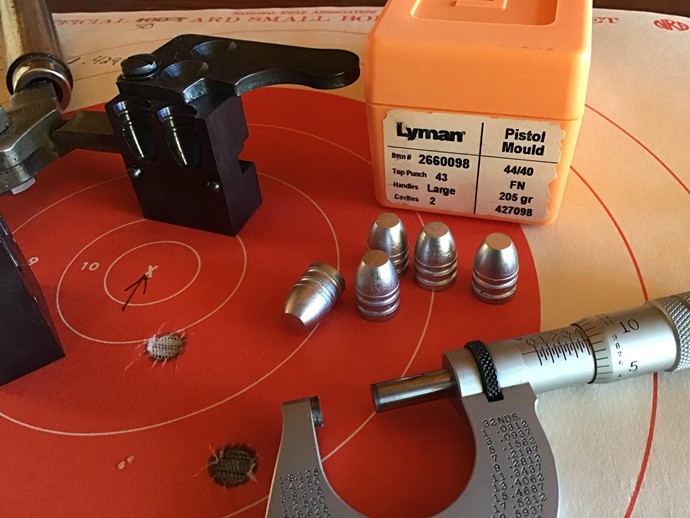
The mold model is the old standby 427098, a 205 grain RNFN for the .44-40.  

On top of the typical Ebay risk of buying someone’s junk is the oft stated risk of buying a Lyman mold that casts too small. Especially I think from ten maybe twenty years ago.  


Well I have zero complaints.  I had to use some Ed’s red as the old shipping preservative was tar thick and wouldn’t come off with dawn.  Then another dawn and hot water cleaning and installed on a pair of RCBS handles.  My pot was already warming up while I was cleaning.


I was casting bullets in about an hour after the mail truck delivered the mold.  A man’s just got to know!  Anyways the pot was full of WW so that’s what I test casted with.  About 15 casts before I got some bullets that weren’t wrinkly.  OK, so I was impatient and didn’t let the mold soak on the warming plate as long as I should.  My technique is often to cast hot and get frosty bullets and that is what I did for the test bullets.  About 765-770 on the pot.  With the 6” caliper I was measuring mid .429 to barely .431 while still warm.   This morning the handful I grabbed to measure and slap in an accompanying photo measured closer to 0.429” running up to 0.4296.   Oh and the bullets were round. I got a good mold. Half of the reason I posted is because Lyman often gets a bad name for sending out molds cut too small on a worn out cherry,  Apparently I got a mold cut with a good cherry.   This should pair acceptably with my 0.4285 groove in my new Winchester .44-40 model 92. 

I would have preferred a mold with a crimp groove but this mold has been around forever and a day so I will at least give it a go before getting a fancy custom mold. 

Now the proof in the pudding will be if this reloader can make high quality cartridges that are pleasingly accurate.  


Attached Files

Order By: Standard | Newest | Votes
SkinnerD posted this 06 September 2025

Good score. Looking forward to the range results

John - New Zealand

Attached Files

Lance Boyle posted this 07 September 2025

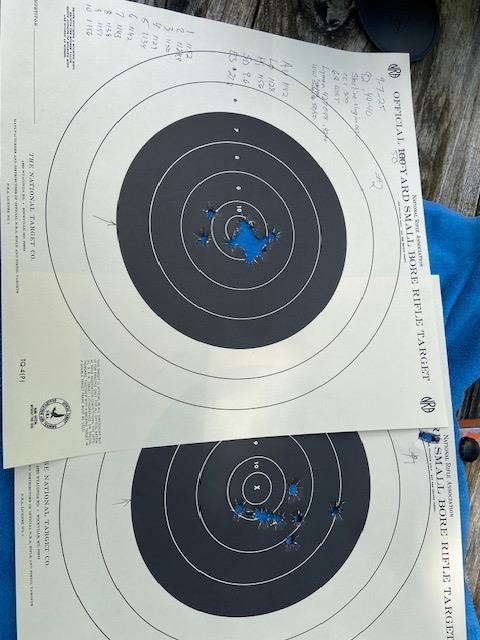
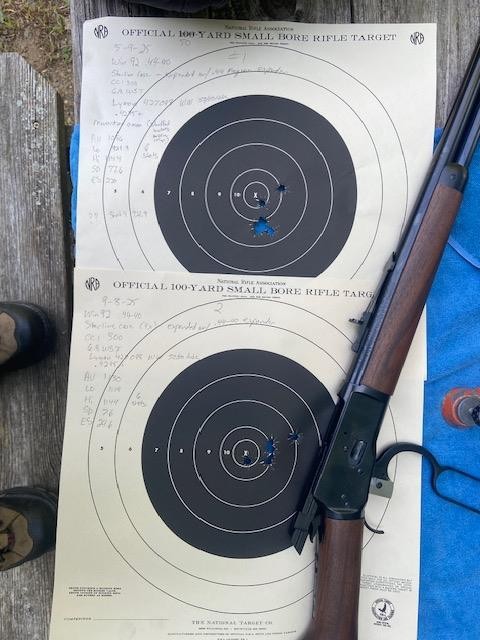
Will this do for now? :-) Going to post the details in the 92 .44-40 short rifle thread.  I did see a couple bullets begin to slip (when I remembered to look, shot number three on my 6.6 grains of WST was sideways and high, no idea and that’s a first!)


Attached Files

  • Liked by
  • Bryan Austin
Lance Boyle posted this 08 September 2025

Today’s casting session with 30:1 alloy at 750F was yielding bullets in the 0.4299 to 0.4304 range with the majority around 0.4303”. 


I was trying to cast at 700F but was getting poor fill out with rounded edge bottoms.  I upped the temperature and things got better. 


Attached Files

Lance Boyle posted this 09 September 2025

I don’t recall Who or on what site but it was Larry Gibson or Ed Harris that said the 427098 was a pretty accurate bullet mold.   They weren’t wrong even with my shabby shooting and casting. 

This was still with the wheel weight alloy.  The only difference is one is with the smaller .44-40 expander and the other is with the .44 magnum expander and I had to rebuild them.  I originally tried crimping with the Redding roll crimp but at first there wasn’t enough crimp and my thumb pushed the bullets in the case.  Break out the hammer puller and slip them forward. Seat them longer, roll crimp harder but now they got swollen enough to not want to chamber.  Ended up running them up the profile crimp die.  BTW I am getting away with .429+ bullets in the profile crimp die.  I did have one shot that was in the group but the chronograph gave an abnormally low reading like 200 fps slow. 

Attached Files

  • Liked by
  • Bryan Austin
Eddie Southgate posted this 19 September 2025

Looks good but I avoid anything that does not have an actual crimp groove in anything going in a tube magazine. I know there are work arounds but I just don't care to go that route when there are plenty of molds that have the crimp groove I want. Keep plugging and you will have them all in the same hole . That is a great bullet in a .44-40 revolver.

There has been some Unique on the market in the last week or so , high but available . 

Grumpy Old Man With A Gun......Do Not Touch .

Attached Files

  • Liked by
  • Lance Boyle
Lance Boyle posted this 19 September 2025

I agree on the crimp groove.  I am getting by and have thing set where I cannot shove the bullet in by pressing hard on it.  No more movement of bullet when shooting with the full mag tube either so that is licked at the moment. 


I’ll pick up another mold in a couple months for cold weather casting days.  My finances for shooting stuff got a little tapped out with some other house projects taking the majority of unallocated funds.   

Attached Files

  • Liked by
  • Bryan Austin
9.3X62AL posted this 26 September 2025

My '73 Winchester dotes upon the SAECO #446 mould; its castings run 202 grains/429"+ in 30/1 alloy and the design has a properly placed crimp groove for the application.

Lymans #311008,  #401043, #427098, and #452190 all lack crimp grooves.  The prevailing regimen during the days of The Holy Black was to seat the bullet on a compressed column of black powder--wrap a roll crimp around the ogive radius--and call it good.  The BP column served to prevent bullet setback as cartridges shunted down levergun magazine tubes.

HTH--CZ   

Attached Files

Bryan Austin posted this 26 September 2025

As long as the case neck is properly resized in regards to the the type lead/diameter of the bullet to be used, neither a roll crimp groove, nor a cannelure under the base of the bullet is needed.

Resizing the case neck small enough for use with .4255" JSP bullets is crucial. The crimp created by most modern dies is simply not enough to secure the bullet in place. Many modern dies do not resize the case mouth small enough, and a roll crimp may also not be enough to keep the bullet secure. 

Each specific diameter bullet must be loaded correctly to prevent issues....and it is all about the sizes and measurements.

  • .4255" JSP bullets
  • .427" soft lead bullets
  • .427" thru .430" bullets of either jacketed or hard lead.

A correctly sized case, using a small diameter bullet, will caress the bullet and hold it in place. Look at it like a woman wearing spandex pants (god forbid if you have to google spandex). Slim or fat, you can see every curve. Unlike a woman wearing her fat husbands coveralls.

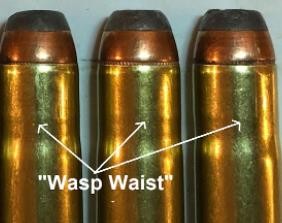
When the bullets sits in such a tight case neck, it creates what is called a "wasp-waist" (google it) around the base of the bullet. This takes the place of the case cannelure at the base of the bullet. The crimp here was also created with the Redding Profile crimp die. The die is basically a "two step" process. First step is for lead bullets, which squeezes the case mouth into the soft lead...pull harder and it crimps this "U" shaped crimp for the JSP bullets.

This type of case neck resize can not be made with a die cut too large. With dies cut small enough for such a small resize....is where you can crunch the case mouth when using a bullet with too large of a diameter. 

Using soft lead...this is where the case mouth will squeeze into the lead and create it's own crimp groove. This type crimp can be created with the Redding Profile Crimp die. This may not be created when using hard lead.

Both bullets in the below photo are the same, and cast with wheel weights. The bullet on the right has a smaller diameter at the case mouth (.422") where the case neck was squeezed into the lead and creating its own crimp groove, to help prevent the bullet from being pushed down into the case when used in a rifle mag tube.


Factory crimp grooves are not needed when the handloader correctly handloads for the 44-40....smokeless powder or black powder.


44-40 Website -https://www.44-40.org

Attached Files

  • Liked by
  • Bud Hyett
  • Lance Boyle
Close