
Could anyone share life lessons on living with cast bullets and suppressors? If possible talk about your insights including lead buildup, carbon buildup, alignment rods, cleaning solutions etc. Assume you’re talking to someone who’s just about ready to start using suppressors, and with them cast bullets. I think I’ve done about everything wrong that can be done wrong. I have three. Two can be disassembled and one is sealed. So far I’ve learned never to buy a suppressor that can’t be disassembled. Too late to correct that decision. Thanks for any help you can provide. Bill C.
Suppressors & Cast Bullets
- 2.1K Views
- Last Post 26 August 2024
- Topic Is Solved

gary0529
posted this
23 August 2024
My first rifle can was a sealed unit and without knowing any better ( it was 20 years ago, in my defense) and I shot a lot of cast .308 in a 300 Whisper, and yes I mean Whisper as it was well before Blackout was brought out. About the best I can offer aside from soaking in hydrogen peroxide and producing toxic lead oxide is to soak in Kroil for days to weeks and then plug both ends and shake the living s---t out out of it to hopefully dislodge whatever you can. If you have a borescope (Teslong) take a look after you blow it dry with lots of compressed air
Not a perfect solution but it seemed to help.
PS. Don't buy a sealed unit 
gary0529
Attached Files
- Liked by
-

Wm Cook
posted this
23 August 2024
I’ve used CLP for up to a week, then fired a half dozen jacketed through it. I tried CLP in a heated ultrasonic cleaner. I tried Breakthrough in a heated ultrasonic cleaner. It dissolves the carbon fine but the areas that are a blend of carbon and lead won’t budge. I soaked one of the baffles overnight in a 50/50 solution and it didn’t budge. The 50/50 mixture of hydrogen peroxide and white vinegar can dissolve lead to a degree but it’s not strong enough to dissolve lead build up. I’m gonna be able to write a thesis paper on this before I’m done.
And why is there lead buildup on one suppressor and not on the other? Can a lubed bullet leave an alloy vapor that can build up??
Lastely, was I the only one that didn’t know how important an alignment dowel was to living with suppressors? For an old man I can be really dumb at times. Hard headed and determined but dumb as a bent nail. Thanks, Bill C.
Attached Files
- Liked by
-

David Reiss
posted this
23 August 2024
Having done a considerable amount of gunsmithing (which involves a lot of gun cleaning and now suppressors) I can tell you to ONLY shoot cast bullets through suppressors with removable innards.
David Reiss - NRA Life Member & PSC Range Member Retired Police Firearms Instructor/Armorer
-Services: Wars Fought, Uprisings Quelled, Bars Emptied, Revolutions Started, Tigers Tamed, Assassinations Plotted, Women Seduced, Governments Run, Gun Appraisals, Lost Treasure Found.
- Also deal in: Land, Banjos, Nails, Firearms, Manure, Fly Swatters, Used Cars, Whisky, Racing Forms, Rare Antiquities, Lead, Used Keyboard Keys, Good Dogs, Pith Helmets & Zulu Headdresses. .
Attached Files
Wm Cook
posted this
23 August 2024
I can tell you to ONLY shoot cast bullets through suppressors with removable innards.
You're right there David. I continue to pay for past mistakes. On a positive note (by accident) I did get two of the three suppressors right. And in hind sight I wish I would have known about the need for an alignment rod.
Shooting cast with suppressors requires more frequent cleaning than with jacketed. And it needs bore inspections. It wasn't until I bore scoped my 30 cal can that I saw how big of a problem I had. If I can get the sealed can clean I'll have to live with special cleaning procedures beyond what a take apart can needs.
And how the heck can a cast bullet leave a vapor trail that builds up on the baffles?? Nothing softer than #2 was shot and all velocities were at pedestrian speed.
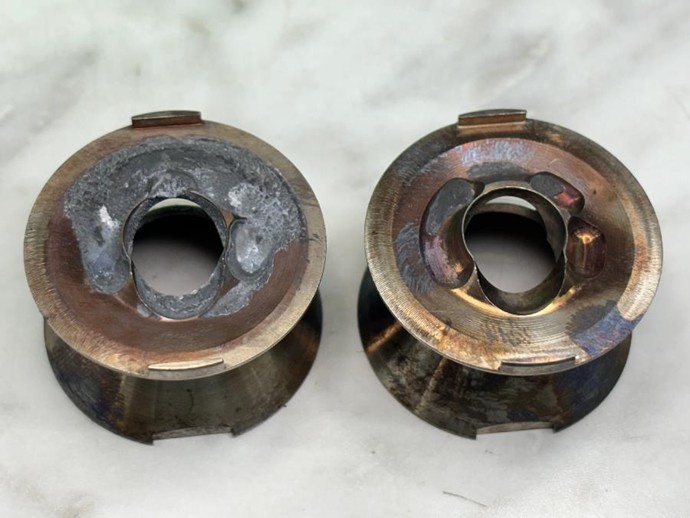
This is from one of the baffles on my 9mm can. The buildup was heavy on the first 4 of the 8 baffles. Come to think of it, 100% of this was shot sub sonic. Heat will remove the buildup (of course, its lead) but CRP and Breadthrough won't touch it. Protect me heaven above but this is moving towards a chemistry lab project. Complete with respirator, face shield, lab apron and all. Thanks, Bill C.
Attached Files

Ken Campbell Iowa
posted this
24 August 2024
if your suppressor is all steel ...
cant you just melt the lead out of it ?
somewhere just above a light blue steel ... just turning grey ....tint the lead should start running ....
maybe once the metal is hot you could even pour some old hot lead through it to get the lead/crud started to flow ..
ken
what could go wrong ?
Attached Files

Boschloper
posted this
24 August 2024
I think it was Townsend Whelen that wrote about removing lead from a barrel with mercury. Plug one end, pour it in and let it soak. Lead does dissolve in mercury. Not sure where one purchases mercury today. And how about toxic on top of toxic. Where you gonna dump that?
Attached Files
- Liked by
-
Wm Cook
posted this
24 August 2024
Rick: “If your suppressor is all steel ...”
Yep, the suppressor is stainless steel with a melt temperature of 2500 degrees.
Ken: “ what could go wrong ?”
😂. Like in the Dirty Harry movie; “So punk, do you feel lucky……”. I had considered trying super heat it clean. Lead melts but there are a lot of nooks and crannies in a suppressor.
Wayne: “…. removing lead from a barrel with mercury”. I heard that too but available and use is precarious.
Nitric acid with a concentration of 20% is supposed to dissolve lead buildup on stainless steel by converting it into soluble lead nitrate and at 20% concentration it’s supposed to be within the margin of error to be safe for the 17-4 PH stainless steel the Sig suppressor is made of. Like Rick said; “What could go wrong”.
Fine line here for sure. Using 90% strength will damage the metal. Adding water to the acid instead of acid to the water will cause a dramatic event. Splashing some on your skin will burn you. Doing it indoors without proper ventilation and a respirator will kill you. There are a lot of things that could go wrong. No one should come away from these comments thinking it’s the smart thing to do or that it will even work.
If there are any chemical engineers out there that can add to this conversation I would appreciate it.
I’m tempted to take the right precautions, do it outside and try a cleaning one baffle to see if it works.
I still can’t figure out how the alloy becomes vaporized for it to cling to the baffles. Thanks, Bill C.
Attached Files
- Liked by
-

Carl Pegg
posted this
24 August 2024
Could it be possible that gas blow-by inside the suppressor is causing the leading, similar to the way an undersized bullet will lead a barrel? In other words, while the bullet is traveling the bore everything is going ok because of the sealing of good bullet fit, but once the bullet exits the barrel and enters the suppressor all of that hot gas under pressure can blow by the bullet vaporizing a little each time? I don't know, just brain farting here.
Attached Files
- Liked by
-

-
Wm Cook
posted this
24 August 2024
Carl: “ Could it be possible that gas blow-by inside the suppressor”
That’s may be the answer. The last 200 rounds through the 9mm can was shot with a 22K Hornet (both 1/2x28). By design all suppressors have gaps and orifice. But your theory makes sense.
Another thing I found interesting is that the buildup on the baffles kept the same orientation. Since it’s screwed on the muzzle it’s impossible to reference which way it was positioned on the barrel. Possibly an alignment problem?
A positive out of this is that I have far greater respect for the housekeeping suppressors require.
I’m only half way through this but at this point my only recommendations for living with suppressors and cast bullets is 1) only buy units that can be disassembled, 2) clean every 200 rounds, 3) infrequent cleaning requires ultrasonic cleaning in a warm bath, 4) use Breakthrough as the cleaning solution not CLP, 5) frequently borescope those cans that can’t be disassembled or stop using them for cast bullets.
One last thing. An alignment rod is required.
Still in process, and always learning, Bill C.
Attached Files
- Liked by
-

Hornet
posted this
25 August 2024
Most of the individuals that I know that are playing with cast bullets and suppressors have gone strictly to ones that can be disassembled for cleaning and to using powdercoating instead of other lubes. They claim that it generates much less fouling. Might be worth trying.
Attached Files
Boschloper
posted this
26 August 2024
I have no experience with powder coated bullets in suppressors but they sure do leave less fouling in a revolver.
Attached Files
Categories
- All Categories
- General Polls
- Contact Us w/ Forum Issues
- Welcome to The Cast Bullet Association Forum
- General
- Bullet Casting
-
Guns and Shooting
- AR Platform
- TC Contenders & Other Single Shot Handguns
- Shotguns
- Informal Matches & Other Shooting Events
- Gunsmithing Tips
- Gun Cleaning & Maintenance
- Optics
- Benchrest Cast Bullet Shooting
- Military Bench Rest Cast Bullet Shooting
- Silhouette Shooting
- Postal Match Cast Bullet Shooting
- Factory Guns
- Black Powder Cartridge
- Hand Guns
- Lever Guns
- Single Shot Rifles
- Bolt Action Rifles
- Military Surplus Rifles
- Plinkers Hollow
- Muzzleloaders
- Hunting
- Reloading
- Buy, Sell or Trade
- Other Information & Reference
Search
This Weeks High Earners
-
 Glenn R. Latham
20
Glenn R. Latham
20
-
 Big Al
20
Big Al
20
-
 Bryan Austin
9
Bryan Austin
9
-
navair 7
-
 John Alexander
7
John Alexander
7
-
Lance Boyle 3
-
Lucky1 3
-
Mike H 2
-
Paul ragan 2
-
nubnshkr 2


