This post concerns penetration of hard cast hollow point .30-30 bullets on pigs, as measured by success in killing multiple pigs with one shot. In the past week I have experienced five multiple kills, two planned, three fortuitous. These have demonstrated the penetration of cast hollow point bullets of the correct hardness.
My bullets are #U321297HP (yes, .32 Special) sized down from .322” to .312”. Alloy is about 16 BHN, achieved by diluting Linotype with Hardball, wheel weights or range scrap, with or without some extra tin. Hollow tapers from .114” to .075", extends half way down the bullet (0.5") and reduces a 180 gn solid bullet to 170 gns HP.
Velocity is 2200 fps.
Alloy and hence hardness is controlled by bullet weight. In this mould my linotype casts 164.5 gns while my weight of choice is 170 gns. I believe this to be about 11% non-lead (antimony and tin). Hollow point cast bullets at speed shed their noses, doing a great deal of damage in the process. Further length is ground off the bullet as it passes through the pig, but a solid slug remains which can penetrate a long way without the drag of a “mushroom” hanging off it.
If the hollow dimensions are satisfactory, the balance between destructiveness and penetration is a function of bullet hardness. Penetration can be increased by hardening the bullet, while being mindful of the need to maintain destructiveness for rib shots. My penetration criterion is that the bullet must pass through the shoulder of a big boar and into or through the opposing shoulder. By trial and error I have determined that this is achieved, with my mould and 2200 fps velocity, with a bullet weight of 170 gns plus or minus a grain.
This degree of penetration has also proved sufficient for “twofers” and even a “threefer”.
My shooting is for pest destruction, so all sizes of pig get the treatment, and the more the better. Semi-auto firearms are restricted, so results per shot matter. And no, I don’t eat the pigs, especially when they have been feeding on carrion.
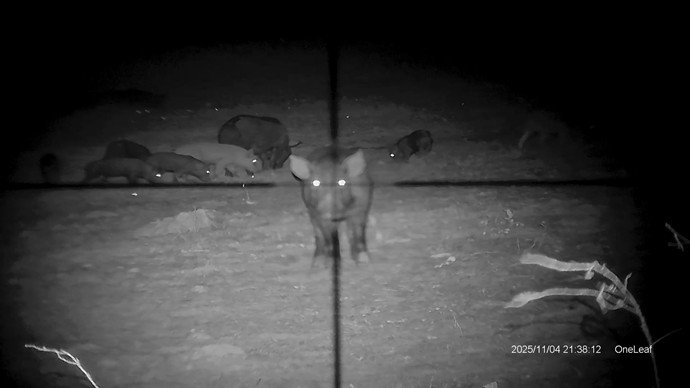
The shooting described in this post was all at night, with no moon, at pigs coming to carcases. I am using the Oneleaf NV100 scope attachment on Leupold VXI 2-7 scope and Savage 99 .30-30 rifle. A feature of NV shooting is that when the shot is fired the world goes white, mainly from IR light reflected back from smoke. The pigs are therefore well on their way before a second shot is possible. This whiteout can last 2 or 3 seconds, or less if there is a strong crosswind. This is a very good reason to try for two or more pigs off one shot. As noted already I have in the past week had a run of “doubles”, both planned and unplanned.
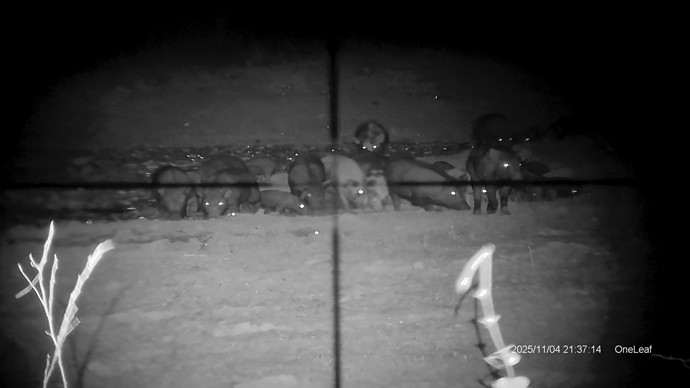
The first was a shot at a grey weaner pig with a black sow behind him. When the smoke and chaos cleared I had TWO dead grey weaners and no sow. The second weaner was in perfect alignment but unseen. A few days later in daylight I found the sow dead about 100 meters away. Penetration through the weaners would have been about 20” and there was still enough left to do for the sow.
Image is the last frame of the video before the big white flash.
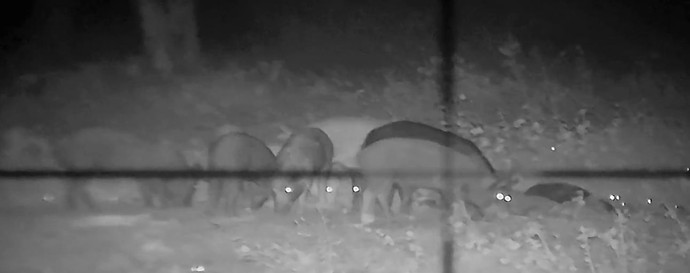
The next one was three doubles in one night, all fortuitous. The first shot was at a sow with a boar somewhere behind her but not in the calculations. The sow went down and a second shot at the running escapees got two weaners (again, about 20” of pig). I walked out in the dark to inspect and found a boar wandering about either lost or wounded. I fixed him up but didn’t get the chance in the dark to look for multiple bullet holes. He might (or might not) have been a double off the sow. The sow was in poor condition, so the bullet probably did about a foot through her. A while later the mob came back (!) and I shot a single then ANOTHER double on the weaners as they bolted.
The third engagement was intentional. I lined up on one sow and waited for another to wander into line. The first sow went straight down but the second was lost until I could make a return visit in daylight. She ended up just 60 meters away. These were both larger sows. The primary target was a rib shot, probably a bit over a foot through. The second was hit in the shoulder.
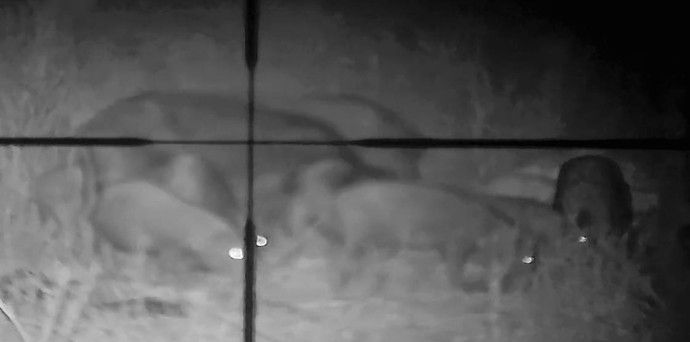
The game is not over yet. This mob is still to be trimmed, though the bait might give out first. We are well into the dry season so the pigs are hungry. I see from the video that they are also eating the pig carcases, which is not common behaviour locally.
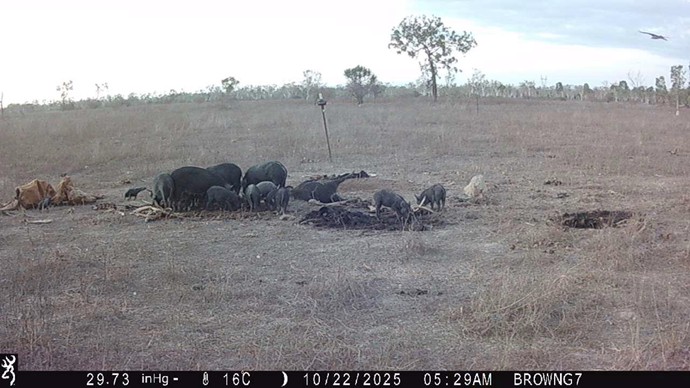
Meanwhile, the hard cast hollow points are doing the job.
Images from the NV are a bit dodgy I’m sorry, but they’re good enough for shooting the pigs. Without parallex adjustment on the scope, focus is a compromise between image clarity and crosshair clarity.
You are only as good as your library.