
Do you prefer bottom pour or dipper/ladle? Which do you think results in better cast bullets and why?
44-40 Website -https://www.44-40.org
Do you prefer bottom pour or dipper/ladle? Which do you think results in better cast bullets and why?
44-40 Website -https://www.44-40.org
Attached Files

Depends on the mold actually. Some of mine like ladle and some demand bottom pour. Off the top of my head, the larger cavities like bottom pour. My 44-40 molds (200ish grains) like the ladle. I cast them in 20:1 alloy.
With rifle in hand, I confidently go forth into the darkness.
Attached Files

I rarely use a ladle and then only with some of my old single cavity molds. The ladle is at a disadvantage with multiple cavity molds.
Adding small preheated ingots to the top of a bottom pour pot keeps the temperature and head pressure constant. This, with attention to mold temperature, makes the bottom pour pot competitive with ladle casting. By competitive I mean bullet quality. As far as quantity the bottom pour wins every time.
Attached Files

Casting is a form of relaxation for me, so when casting for the simple joy of it, my preference is for ladle pour and single or double cavity molds. Three cavities or more pretty much require the bottom pour pot.
Attached Files

Casting is a form of relaxation for me, so when casting for the simple joy of it, my preference is for ladle pour and single or double cavity molds.
I agree. Me too. Time is not a bother.
With rifle in hand, I confidently go forth into the darkness.
Attached Files
.jpg?width=20 "Urny")
Casting is a form of relaxation for me, so when casting for the simple joy of it, my preference is for ladle pour and single or double cavity molds. Three cavities or more pretty much require the bottom pour pot.
This is me now, casting less but better. I need to cast enough to maintain consistency through batches, but replacing quantity with quality.
I acquired a larger two cavity mold but that hinders mold tempt consistency.
44-40 Website -https://www.44-40.org
Attached Files
Kind of an interesting subject. Had a 20-pound Lyman bottom pour that went in the dumpster years ago.
Bought a one-pound Rowell ladle and have used it ever since. Works great on +400 grain single cavity molds and (4) cavity 350-grain molds. No nipple to line-up with a sprue plate hole and rotate. So not a true “ladle”. Use it like bottom pour, but filling all (4) cavities one a time, passing the ladle across the full length of the top of the mold/mould. Speed is faster than you might think but not factor for me.
Tom
Attached Files


I'm right in there with most of the others. Match bullets were always from a single cavity mould ladle poured. Four cavity moulds get the bottom pour work. Almost all of my moulds are singles so I do a lot of ladle casting.
Being retired and having cast thousands of 45 and 38 bullets that are in storage, I just cast bullets for current reloading projects in uncommon calibers.
Attached Files


That last target I shot, I weighed and measures each, separating them by .1gr. All ten shots I think were the 212.4gr.
Now to just work on a little better casting.
44-40 Website -https://www.44-40.org
Attached Files
Tom,
I had one of those early Lyman pots. Almost impossible but I don't know why. Wrote Lyman and got a hand written letter back from Killborn sp? (the guy who often gets credit for the 22 Hornet). The letter was more polite but essentially said, yes it hard to make good bullets with it.
I haven't cast with a ladle for sixty years, maybe more. When I get into a good groove, the bullets look pretty good to me. Being left handed may have something to do with it.
John
Attached Files
I hand cast my hollow based and hollow point bullets. They fill better for me.
Attached Files
If I'm using a 6 cavity gang mold, I use a bottom pour. Then I group the finished bullets by weight.
If I'm using a 2 cavity mold or a 4 cavity hp mold nd want consistent weight, I use the ladle. I think that the change in the weight/pressure on the lead on a bottom pour pot varies by volume and effects weight. There is cavity variation too so that's why I group finished bullets by weight.
Attached Files
What about mold block size, for retaining heat?
When is size too big for a ladle/dipper when casting for your precision shooting bullets?
44-40 Website -https://www.44-40.org
Attached Files
John,
I replaced the crappy BP Lyman with a (can’t recall exact name) Master Caster? A capacity of 40-pounds was requested, larger diameter to facilitate the Rowell ladle and bottom down low, close to bench top, easing my unfounded fear of the pot tipping over and…..no BP feature!
I like the 40-pounds because making lots of heavy (420 grains) single cavity black powder bullets of a consistent alloy is important (to me).
Tom
Attached Files
3 restored,lined up Lyman #61's here. Which I prefer,but can definitely hold my own with a ladle.
Attached Files
I guess my main problem with the bottom pour is getting the holes lined up for consistent fills. Seldom can I get a nice thick puddle on top...always tilted one way or the other,,,or the fill spits out the top. Never could get the hang of it.
Once I get the proper poor down...then I can start getting the mix tailored for a better fill (tin antimony etc.). I was just wondering if the ladle may help me with better pours, or if this is just the best this old man can do.
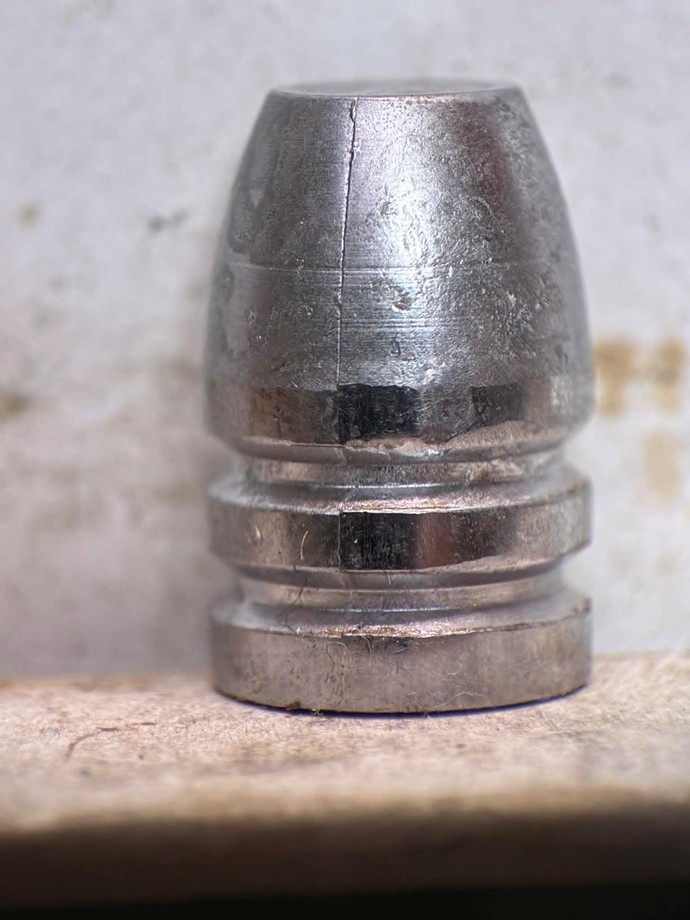
Okay, here are two photos of one bullet showing void filled areas. It is just starting to glaze, so the heat must be max. Of course we know this is more than likely from the melt-mix I am using not having enough tin for proper fill. I will adjust that later in a different topic so hold off on those tin mix ratios for now. First I just wanted to see if a ladle/dipper fill would be better...and if this is the best I can get for what it is. Baby steps.
Two cavity, large block mold from Accurate Molds. Basically a 45-70 size aluminum block, cut for the 44-40 43-214A. I know , I know, a lot of aluminum to keep hot!!! Enough information just on the mold choice for another topic!!
The last two bullets cast from the same fill weighed 219.2 and 218.7...with the one photo'd being the 218.7. There are some general flaws from using my batch of keel lead...but is what I am currently using for my groups at 300 yards. Still not bad considering the type lead being used.
It is more than likely that some of my outliers or fliers are caused by these flaws. My case, powder charge, and primers are all what they are and I don't think I can improve my handloading skills in that respect with those components.
Now it is time to begin making the casts better....I wanted to start with this topic of bottom pour vs ladle. My Lyman ladle came in today, so I will try this technique and see what happens. If all remains the same, or worse...I will revert back to the bottom pour and start with the lead mix issues.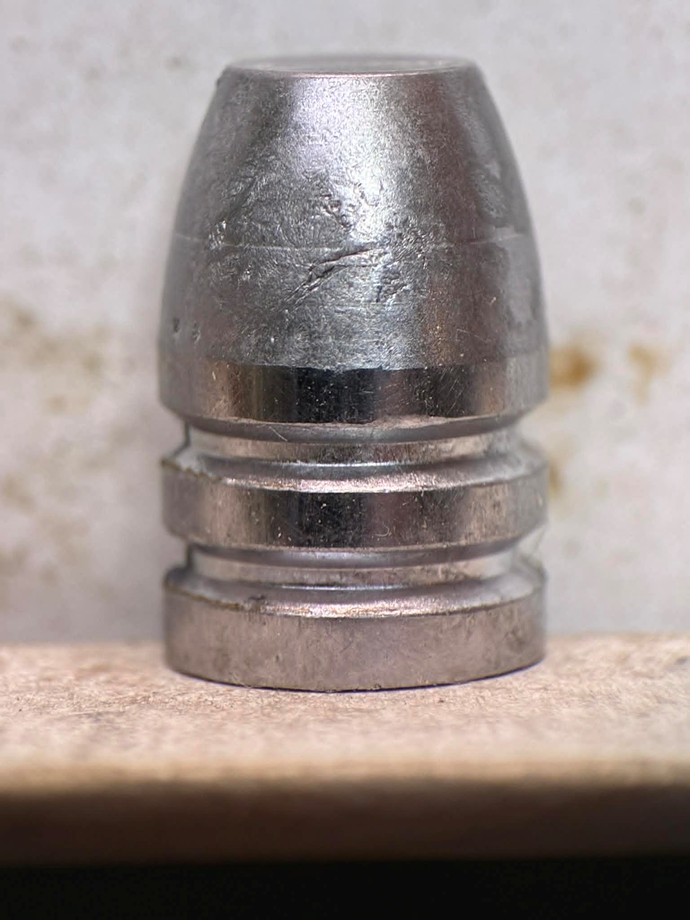
44-40 Website -https://www.44-40.org
Attached Files
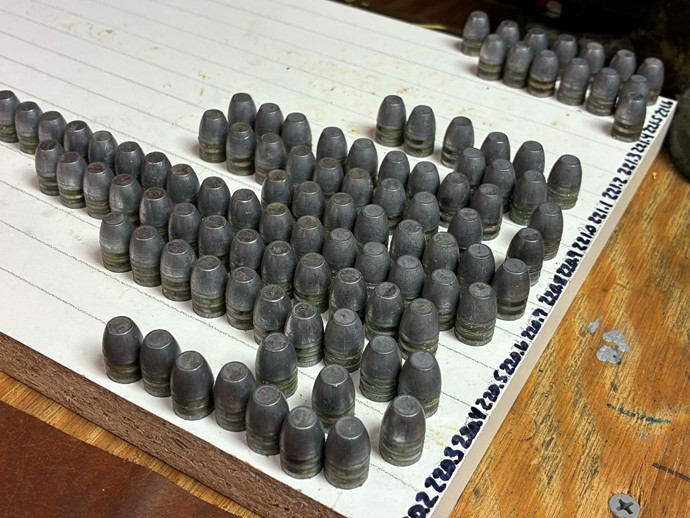
Also, this is how I separate them after a few weeks. As you can see, I already shot the 221.2 thru 221.4 and those are the ones that yielded 12" groups at 300 yards.
To be clear, the last target I used ten 221.4gr bullets, no variations in weight.
44-40 Website -https://www.44-40.org
Attached Files
Bryan....something for you to ponder with ladle pours. My Partner in Crime gave me an extra Lyman ladle he picked up somewhere (He lives for deals at auctions) which had been modified by trimming the spout and making the hole about twice as big. Since I do a lot of big bore bullets, this really helps get a good fill once things are right. Last week I used it to do NOE 227-79s as well and this is a triple mold that is hard to keep warm enough with that much aluminum and the ladle seems to work better. Like you, I can't seem to get the bottom pour to do it. I also overpour and let the extra lead run off into the pot to hopefully float any impurities out which is hard to do with bottom pours. Good luck!
Scott Ingle
Attached Files
Good advice and food for thought...thanks!!
44-40 Website -https://www.44-40.org
Attached Files
After using the pot and dipper method for a long time, I succumbed to the fiction that what runs out the bottom of a pot is cleaner than what is dipped from the top of it. I bought a little Lee pot but quickly discovered that slag builds up around the spout and some ends up in the bullets. When that pot died I went back to the open top pot and Lyman dipper. I use my Lee dipper to clean the crud off the top of the melt after fluxing.
To get absolutely clean metal I use the dipper to clear a patch on the top of the melt, fill the dipper, tip a little out to clear the spout before the pour, and then connect dipper and mould and rotate to pour. When the metal is fairly clean I just top up the dipper for each pour. When the level in the pot is down or the slag is building up I empty and refill the dipper each time.
This is for single and double cavity moulds. I make about 200 bullets at a time. I flux before I start the cast, then after about 100, and again before I turn the leftover metal into ingots. I finish with an empty pot which, being open topped, can be cleaned properly.
You are only as good as your library.
Attached Files
 RicinYakima
27
John Alexander
26
RicinYakima
27
John Alexander
26
 JohnH
24
JohnH
24
 Lucky1
19
Aaron
14
Bryan Austin
13
Lucky1
19
Aaron
14
Bryan Austin
13
 Ed Harris
12
Ed Harris
12
 shootcast
12
shootcast
12
 beltfed
12
beltfed
12
 Larry Gibson
11
Larry Gibson
11


.jpg?width=50&crop=0,0,50,50)


