
Further to my earlier post on lubed cast bullets bonding to case necks, I have continued testing with the following results:
- An unlubricated lead bullet seated in a clean case neck seats easily, and a short time later can be seated further without any change to resistance. Then, after as little as one day undisturbed, the bullet seriously resists deeper seating, and when it moves it does so with a pronounced crack. This is what I call “bonding”.
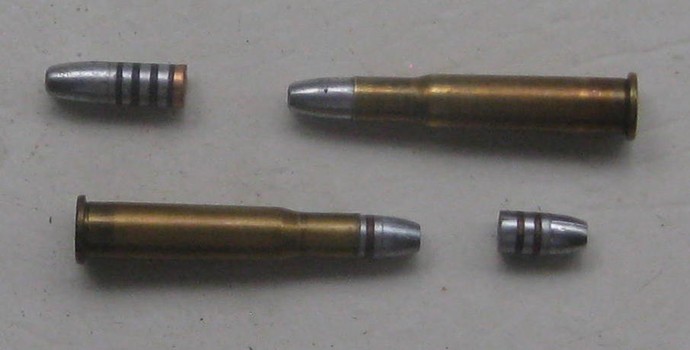
- A cast bullet lubricated in a Lube Sizer and then sized further in Lee dies will emerge with lube in the grooves, but with bands wiped clean. This bullet when seated behaves similarly to an unlubed bullet. This is the scenario that first caught my attention. My example was #U321297HP lubed in .323” die then sized in Lee .314” die, then again in Lee .311” die. Bonding occurred with BAC, 2500+, LBT, LSM and to a lesser extent LOM. BHN 16.
- Cast bullet #321297HP lubed and sized as per #2, then tumble lubed with LLA . At day 18 there was no additional resistance – ongoing, will update.
- Cast bullets #311008 sized and lubed normally with 2500+ in a .310” Lube Sizer die gave mixed results after a few weeks. Of five cartridges tested, one cracked, two made a bit of a sound, and two went smoothly. Bullets were seated to cover just one band. BHN 14.
- Cast bullets #311008 sized in the Lee .311” die, then lubed with 2500+ in Lube Sizer with .312” die, appear to have avoided bonding (normal resistance still to day 40). Bullets seated to cover one band.
- Cast bullets #311008, sized dry in Lee die (.311” die), then treated with LLA, and loaded to cover two bands, slightly increased resistance but no bonding to day 24. This does not preclude the possibility of some sort of adhesion further down the track from LLA, for which there is some suspicion.
In all instances, necks were expanded with Lyman 31M die.
Bonding appears to follow from sizing that wipes the bands clean, as in Lee sizing after lubing. The seated bullets then have direct lube-free contact between bullet metal and case neck. Type of lube may influence whether traces of lube remain on the bullet bands after lubing and sizing. Normally sized and lubed bullets remain as a maybe.
Bonding may be no bad thing so long as it is uniform. Indeed, bonding may be sought for automatic pistol cartridges or tube magazine rifle ammo, or for powders that benefit from extra resistance at start.
Where ammo is to be used over time and bonding is expected, testing for group, velocity, zero etc can be delayed after loading to ensure bonding state at test mirrors likely state at time of use. I leave mine at least a week before testing.
The ballistic effects of bonding were not pursued beyond the initial observations (previous post).
You are only as good as your library.


