
Is case head measuring a reliable way to observe high pressure? If so how much is too much and what is the best way to measure it.
Case head measurement
- 796 Views
- Last Post 12 November 2025
- Topic Is Solved

Wilderness
posted this
08 November 2025
I'll buy in with another can of worms. I have been running an observation on a batch of about 100 Winchester .30-30 cases, as posted here - partial size after each shot to headspace on shoulder, no trimming or crimping, measure length (snap gauge) after each cycle. Edit: Measurement is of case after resizing.
A casual observation is that the change in median case length with full power cast loads of 748 (2200 fps), or full power LVR jacketed loads (2300 fps), has been around .004", while 2200 fps cast loads with LVR increase median length about .002". Bullets are 170 gn jacketed and 175 gn cast.
Individual stretch within the group varies a lot, and varies from shot to shot, so it needs a whole batch of cases to see a consistent effect, and the observation is of median stretch, not of an individual case.
Mid-teens velocity cast loads with my case treatment (R-P cases, group of 200) give case stretch of .0005" as measured by the median.
Defacto pressure measurement? Comparatively anyway.
You are only as good as your library.
Attached Files
- Liked by
-

-

-


Larry Gibson
posted this
08 November 2025
Getting any expansion at the case head [That part of the case just in front of the rim or extractor groove] mean the pressure is very high. Probably higher than proof level loads.
However, measuring at the expansion ring {the expansion at the "web" of the case] can be a reliable measurement of pressure. It is a comparative measurement and not an actual measurement. It appears this is the method Wilderness is using.
Expansion ring measurement as an indication of pressure is best done with new, unfired cases. If you have a load of known pressure measurement [not guestimated or computer generated but actually measured] using that make of cases, then load 5 cases with that load and measure the cases at the web (where the expansion ring will be). Add those together then divide by 5 to get the average. Then fire the cases in the rifle and measure in 4 places around the expansion ring. Add all 20 measurements together, divide by 20 to get the average. Subtract the original measured average and that will give a good figure of the expansion. Then, using new, unfired cases from the same lot, you can work up another load. The same amount of expansion will be the same amount of pressure as the known load.
Another method to test your full powered loads is to buy a box (20 rounds) of Winchester, Remington or Federal "Premium" ammunition. I've found in pressure testing several of those they are loaded very close to the SAAMI MAP for the cartridge. Using the method I've described above pull 15 of the bullets, dump the powder, deprime and save the bullets for later use. Fire the five factory rounds having measured the case at the web and getting the average measurement. Then you can load 3 of you already developed loads (5 each) in the remaining 15 cases. Fire each load and measure the expansion ring at the web and get the average expansion for each load. Comparing the expansion of your loads to the factory if you have less expansion you have less pressure. If you have equal expansion you have close to the same pressure. And if you have more expansion then that load has probably exceeded The SAAMI MAP for the cartridge.
I have done this with factory 308W and 7.62 NATO while measuring the pressure and it works out pretty close though not exact.
LMG
Concealment is not cover.........
Attached Files
- Liked by
-
-

-
.jpg?width=20 "JBinMN")
-
- and 1 others
delmarskid
posted this
08 November 2025
Thanks Larry, that is an explanation I can use. I’m most interested in looking for over pressure signs. I don’t trust primer examination. To be clear where exactly is the expansion ring on the case?
Attached Files
- Liked by
-


lotech
posted this
08 November 2025
I think the second method Larry described may be a slightly more accurate indicator of pressure, but I have no scientific proof. I've used this method with factory 7x61 Sharpe & Hart ammo, then my handloads, taking all measurements just above the belt.
Attached Files
Wilderness
posted this
08 November 2025
Good stuff Larry.
You give me credit for being more sophisticated than I am.
My observation is just on used cases going through their life cycle with a standardised resizing treatment (partial FLS, reducing body very slightly while keeping HS on the shoulder). The measurement is increase in case length from one reloading to the next, measurement in both cases being of the resized case.
This began as an OCD project to see how long the brass would last and how that related to case growth.
You are only as good as your library.
Attached Files
- Liked by
-
Larry Gibson
posted this
09 November 2025
Wilderness
I resemble "This began as an OCD project to see how long the brass would last and how that related to case growth." as I went through the same with several cartridges over the years. Wanting 30-30 ammunition that was useful in all 3 of my 30-30 rifles required FL sizing. Having cases sized in regular FL dies (I tried numerous different FL dies over the years) to fit the TC barrel resulted in very short case life with lots of stretch, signs of incipient case head separation and an occasional separated case with the front of the case stuck in the chamber. Keeping cases separated as to specific rifle was my option to somewhat increased case life. I'm sure you've found pretty much the same thing.
Then I found RCBS X-dies really do prevent case stretching. I've 3 different 30-30 rifles and all have slightly different chambers, especially the shoulder headspace dimension and diameter at the expansion ring. The TC 30-30 carbine barrel has the tightest chamber all around so the FL X-die was adjusted and set so the Contender would just snap shut on the FL sized cases. The other 2 rifles are M94 Winchesters. The cases then fit all 3 rifles. Sizing the fired cases from all 3 rifles in the adjusted X-die produces no case stretch. I tracked 10 new Winchester 30-30 cases fired in all 3 rifles through a total of 20 firings with each case. No case stretch after the first firing. After 21 firings with my full power 311041 over LeveRevolution load and not losing a single case to incipient case head separation nor having to trim any of the cases I gave up the test, threw those cases back in with the rest of the batch and they are still doing well.
I suggest you might try the RCBS X-die if you can get them down there. It negates a lot of frustration, extra case prep and discarding cases prematurely.
LMG.
Concealment is not cover.........
Attached Files
- Liked by
-
-
delmarskid
posted this
09 November 2025
Those x-dies really do make a difference.
Attached Files
- Liked by
-
lotech
posted this
09 November 2025
I'm confused; some of these responses are about case head measurement and others are about case stretching. These are not the same thing.
Regardless, I'll second the use of RCBS X dies. I've used them for years in .220 Swift. Recently, I bought a .308 X die. Use them according to directions and they work, though the initial brass trimming is a bit of a headache.
Attached Files

MP1886
posted this
09 November 2025
Lotech I agree with you and I want to clear something up that may be going through some's mind about measuing the case head. Larry explained it right, the solid web portion of the case ahead of the extractor groove. Some think it's the "rim". Nope.
Attached Files
- Liked by
-
-
-
Larry Gibson
posted this
10 November 2025
lotech
I've seldom done the initial case trim as per the RCBS instructions. Reason being I found it just wasn't necessary. Assuming the cases to sized are new or once fired of the lame headstamp I just measure the oal of a few cases and pick the longest to adjust the mandrel to. Of course, that is assuming that length will fit the chamber okay. Also assuming there probably isn't but 2 to 3 thousandths difference in initial length.
The die body is adjusted and the lock ring set so the shoulder is just bumped back to fit the chamber (if the ammo is to be used in multiple rifles) with the shortest headspace. Then, with that case in the die I screw the mandrill down as tight as I can an lock it in place. All the cases will conform the that preset length on the next firing.
" I'm confused; some of these responses are about case head measurement and others are about case stretching. These are not the same thing. "
That is essentially correct. However, the case "stretches" on sizing when standard FL dies are used because die sized the case from the expansion ring forward. The brass is thus, pushed forward as the case is sized back to close to original configuration. The brass flows forward because that's the easiest way for it to go, the oal lengthens and trimming becomes necessary. The brass of the case body is not "compressed" back to its original thickness. The brass in the web thins the most because the expansion there is the greatest. Eventually, the case head can separate after just a couple firings.
The expansion at the web, the expansion ring, is caused by the amount of pressure the load produces. Its largest diameter is, of course determined by the diameter of the chamber at that location. If a load is milder than that necessary for the amount of full expansion the chamber will allow then the pressure of the cartridge is less.
LMG
Concealment is not cover.........
Attached Files
lotech
posted this
10 November 2025
Larry-
Thank you for the insight on the X die. I'll keep that in mind next time I start processing a batch of brass.
Attached Files
- Liked by
-

Premod70
posted this
11 November 2025
Back when I loaded full house jacketed loads I settled on using a chronograph to establish my max loads as it takes a certain amount of pressure to reach a certain amount of speed. Study and compare as many resources as you can that reach a certain speed at a safe pressure. Get out the chrony and start 10% or more below the listed max speed and increase the powder charge to the average max speed. Once the speed is reached you are at the max load. Use all the cautionary signs as you go as brass varies too much from one to another. Good luck.
Dale Flinchum
Attached Files
- Liked by
-
-

-
lotech
posted this
11 November 2025
Premod70- Good advice and that's what John Barsness, one of our best handloading writers preached as well. A chronograph, experience, and good sense is as close to accurate pressure measuring as most of us will ever get and it's plenty adequate for our purposes.
Attached Files
Wilderness
posted this
11 November 2025
Larry
I suggest you might try the RCBS X-die if you can get them down there. It negates a lot of frustration, extra case prep and discarding cases prematurely.
I checked the local scene - .30-30 X-Dies $170 plus shipping, actually similar price to standard dies.
But do I really need more dies? I have been getting rid of stuff for a few years, though am still not immune to Estate Sales etc.
Right now I've got about 450 .30-30 empties for full power Savage loads, which should be good for another 5,000 plus shots. It has taken me 45 years to put 7,000 shots through the Savage, and I can be absolutely certain that I won't last long enough to put through another 5,000.
Since my chambers are much longer than even the most stretched brass, and since I don't need to crimp, I don't bother trimming the .30-30s - just resize and clean the primer pockets.
Now, if we were talking say .218 Bee, for which brass is more precarious, then my response might be altogether different.
Premod70
Back when I loaded full house jacketed loads I settled on using a chronograph to establish my max loads as it takes a certain amount of pressure to reach a certain amount of speed.
I have been down this path as well. Hodgdon data for LeveRevolution in .30-30 with Sierra 170 gn bullets says 36.3 gns for 2300 fps. In my Savage 99 that's just about dead on correct. Same everything except 175 gn HP cast bullet, COL 2.500", that speed is achieved with just 34 gns LVR - and case stretch still OK. Had I just shovelled in 36 gns based on published data (with bullet substitution) I think I'd have cracked 2400 fps, pressure unknown.
Sometimes the chronograph can tell you when NOT to use the full load. Love the old Oehler, but can't deny the convenience of the Gamin and similar.
You are only as good as your library.
Attached Files
- Liked by
-
-

delmarskid
posted this
12 November 2025
I don’t always have published data for the cartridge that I am developing loads for. Having a way to observe dangerous pressure is a necessity.
Attached Files
Larry Gibson
posted this
12 November 2025
Wilderness
Last time I measured 30-30 psi 34.5 gr LeveRevolution under a 177 gr Lyman 311041 in Federal cases with Rem 9 1/2 primer ran 35,800 psi.. SAAMI MAP for the 30-30 is 48,000 psi. I doubt another 1.5 gr of powder under your 175 gr cast will pose any pressure problems.
I had no idea the X-dies would be that expensive. Obviously, you've done the math, and they wouldn't be beneficial.
delmarskid
The measurement of the case head and the expansion rings was a method to use pre commonality of chronographs. Measuring the expansion ring is usually a good way to tell if you're into higher pressures with your loads. When developing loads, using unfired cases, a .003 -.004" expansion at the expansion ring generally indicates the pressure is in the 56-60,000 +/- range. A solid .004" increases is just about a sure bet you've pushed 60,000 psi. Those are general figures and there's always exceptions so be observant to increasing bolt lift.
LMG
Concealment is not cover.........
Attached Files
- Liked by
-
-
delmarskid
posted this
12 November 2025
The pressure ring is just in front of the case's solid web correct?
Attached Files
Larry Gibson
posted this
12 November 2025
Yes, that's where the case begins expanding under normal pressures. On the top case the red marks the expansion ring, the black marks the case head.
The expansion ring is plain to see on the 308W bottom case. Both were fired with a 59,000 psi load as measured in my test 308W rifle. Expansion on the bottom case is .0035".
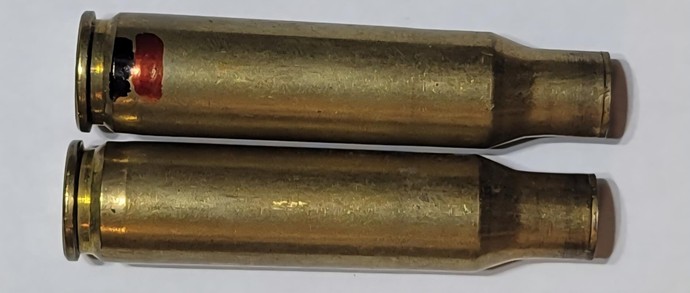
LMG
Concealment is not cover.........
Attached Files
- Liked by
-
-
MP1886
posted this
12 November 2025
You don't notice the pressure signs on the upper portion of the case because there is no nearby solid portion like the web to compare it too, but the whole case does expand from the pressure. The "pressure ring" is where case separation happens.
Attached Files
- Liked by
-
-
Categories
- All Categories
- General Polls
- Contact Us w/ Forum Issues
- Welcome to The Cast Bullet Association Forum
- General
- Bullet Casting
-
Guns and Shooting
- AR Platform
- TC Contenders & Other Single Shot Handguns
- Shotguns
- Informal Matches & Other Shooting Events
- Gunsmithing Tips
- Gun Cleaning & Maintenance
- Optics
- Benchrest Cast Bullet Shooting
- Military Bench Rest Cast Bullet Shooting
- Silhouette Shooting
- Postal Match Cast Bullet Shooting
- Factory Guns
- Black Powder Cartridge
- Hand Guns
- Lever Guns
- Single Shot Rifles
- Bolt Action Rifles
- Military Surplus Rifles
- Plinkers Hollow
- Muzzleloaders
- Hunting
- Reloading
- Buy, Sell or Trade
- Other Information & Reference
Search
This Weeks High Earners
-
Wilderness
23
-
 Ed Harris
19
Ed Harris
19
-
 Larry Gibson
14
Larry Gibson
14
-
RicinYakima
13
-
Cherokeetracker01 13
-
Aaron
12
-
shootcast 9
-
Willys2.8 9
-
 Bryan Austin
5
Bryan Austin
5
-
gnoahhh 5


