Bullet Sizing

  • 1.2K Views
  • Last Post 21 December 2025
Wm Cook posted this 12 December 2025

My lack of knowledge regarding cast bullet accuracy has been well established by now, so there’s little chance of embarrassing myself and further, so I’ll ask another.

This question regards “sizing” the base of the bullet. This is typically done in a lube sizer (Lyman 450, SAECO, RCBS), but often times casters will size bullets through “push through” sizers such as Lee or NOE. Which ever way you choose, the end result is meant to “size the base of the bullet. About a month ago I broke this into a two step process. I’m now adding the check & sizing with the push through Lee then adding the lube with an “as Lee already sized” diameter die in my Lyman.

In the past couple, three years I’ve seen post where casters refer to the base sizing diameter in the .0001 of an inch. Most commonly to the .0005”. Identifying the base measurement to the tenth of a thou is also seen in the equipment list for the BR Nationals.

When first pound cast in October 2021, my Savage’s freebore measured .3089/.3092. I could see skuffing on the front drive band when sized to a lube die of .308 so I stuck with a .308 die. When I recently switched to a Lee .309 push through die it resulted in a .3098 base and that’s where it’s at now.

So the question is, how critical is the fit between the freebore and the sized bullet base? Or said a little bit different, Is the fit of the sized bullet to the freebore dimension important to cast accuracy. Thanks, Bill C.

Attached Files

Order By: Standard | Newest | Votes
pat i posted this 12 December 2025

Billl is this a .308? SAAMI spec calls for a .310 ball seat. Best option if you ask me is to shoot the bullets you have prepped and see what happens. Worse that can happen is they dont shoot good then you can start trying to track down why. What gun are you playing with?

Attached Files

  • Liked by
  • John Alexander
  • RicinYakima
lotech posted this 12 December 2025

I run all .30 caliber bullets through a SAECO .311" size die. This has proven best in my .308 and .30-06 rifles and .30-40 Krags when I had those. Splitting hairs here ( I guess that's what this is all about), but a .310" bullet will do almost as well in most rifles. Shoot lots of groups. 

Attached Files

John Carlson posted this 13 December 2025

It has been suggested that sizing the base .001 over the throat (Leade) diameter is at least a good place to start.

If you're seeing scuffing on one part of the driving band rather than all the way around your round is likely entering the chamber slightly off center or your chamber is slightly off center from your bore.

John Carlson. CBA Director of Military Competition.

Attached Files

  • Liked by
  • RicinYakima
Idahocaster posted this 13 December 2025

I size my 30-30, 30-06, and 7.5x55 bullets to 0.310 and they all shoot great. I may have to try. 311 in my 1903 and see if I get better results.

Attached Files

Wm Cook posted this 13 December 2025

Pat, the rifle's a .308 Sav F10 and thanks for the offer.  I might take you up on that.

It has been suggested that sizing the base .001 over the throat (Leade) diameter is at least a good place to start.

John, that makes sense and since you said its a good place to start makes it sound like some shooters might go +/- for load development. Although there's probably 99 more important things more important things to work with when dealing with bullet to bore fit.  Maybe you just need a good squeeze fit.  One that keeps alloy from scrapping the face where the freebore starts yet show uniform skuffing.  Tomorrow I'll drive a few in base first and see what different sized bullets show.

My first thirty years of cast shooting was limited to revolvers, Mosin's, an old 30-30 and a nice Marlin 336 in 35 Rem that I have my arsch kicked for selling.  With those the freebore never came into question.  I assume they were all large.  Back then I was told to leave the diameter to as close to "as cast" as possible.  With this Savage .308 things went cat-e-wompus. 

The freebore was super tight at barely .309 and the bore was .3013 or there bouts.  I started shooting this rifle with a 311299 silhouette that dropped with a .3000 nose and was shooting solid 4 inch groups.  The bearing surface was limited to the base so I'm guessing that the bullet must have been rattling down the barrel.  It was only after a couple custom molds from Accurate that I started to make contact with the lands.

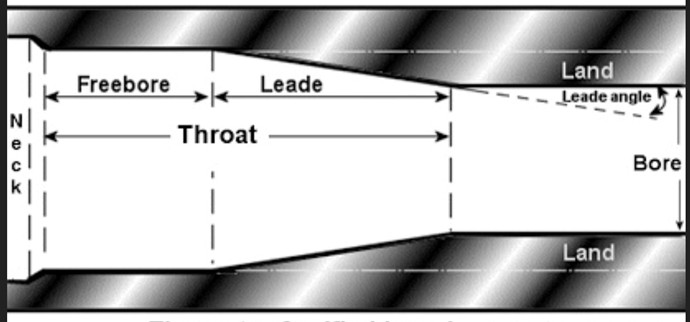
I had always thought it was the freebore (first contact with the bullet) that was the focus when sizing bullet bases.  And that the throat was made up of two parts.  The first being the freebore and the second being the leade where the lands began.  Thanks again for the help.  Bill C.


Attached Files

  • Liked by
  • RicinYakima
pat i posted this 13 December 2025

Bill the 30/30 and 35 Remington don't have any ball seat. Just the leade at the end of the case which explains why you didn't have any issues. The 06 is the same way but a more gentle taper. I have to ask have you tried shooting any of the bullets you're playing with? You can mess around with measuring, fitting, and pounding til the cows come home but until you shoot the gun you won't know what it'll do. Shoot the .310 bullets and see what happens. This ain't rocket science and sometimes things that logic tells you aint good has no bearing on results.

Attached Files

  • Liked by
  • RicinYakima
  • MarkinEllensburg
Wm Cook posted this 13 December 2025

I’m doing fair to middling with the rifle. Working on fliers, but that won’t be solved with the free-bore fit.

I think I was sizing too small and I’ve almost convinced myself that the heat/gas bleeding past the bullet base while in the free-bore might have been wearing on the lands. A lot of early wear for the number of rounds through the bore. It’s about .001 wear every 1000 rounds.

I’m just goofie picking on minutiae like that. Self inflicted fretting on things that don’t need fixing. Can’t believe I’ve made it to age I am.

Attached Files

RicinYakima posted this 13 December 2025

 "Working on fliers, but that won’t be solved with the free-bore fit."

Yes it will! That is why you have "fliers"; they are just outliyers to your group. Shoot 25 shot groups. 

Attached Files

  • Liked by
  • John Alexander
Wm Cook posted this 13 December 2025

Sorry Ric, meant to say that in the broad scheme of things the sizing of the bullet base to the free-bore diameter is less important than the bullet nose to leade fit.

Or did you actually mean that the sizing of the bullet base is a key components of bullet to bore fit?

That was the intent of the thread. Asking whether the fit between the bullet and the free-bore is critical to accuracy. Thanks, Bill C

Attached Files

RicinYakima posted this 13 December 2025

Not an issue with me. I only shot military rifles CBA matches from 1996 to 2018, no experience with commercial rifles in match shooting.  

IMHO, the base and the bands all need to be the same diameter of what your illustration calls "free bore". The top driving band should just touch the "leade" and be slightly marked.  If the nose fits on top of the lands, that would be great. 

If you want to shoot a bore riding bullet, then the nose must be slightly engraved, but the band and body still have to be "free bore" diameter. 

Attached Files

  • Liked by
  • Bud Hyett
  • Wm Cook
Wm Cook posted this 13 December 2025

“IMHO, the base and the bands all need to be the same diameter of what your illustration calls "free bore".”

Thanks Ric. That’s what I thought going into this conversation. What brought up the question were those that called out their sizing spec to the tenth of a thousands. Again, thanks to all. Bill C.

Attached Files

  • Liked by
  • RicinYakima
pat i posted this 14 December 2025

Bill the reason I say .3095 is the sized diameter is because the reamer I cut my HVY rifles throats with and the taper die I cut for it is 310x1 1/2 degree included so I size slightly below .310 so theyre not sized by the taper die. They're not all exactly .3095 but none are below .3095 or over .310. I'm not a fan of bore ride bullets and I could be wrong but think the only reason for a bump die is to increase the diameter of the nose ride portion of a bore ride bullet so it gets some taper for guidance. I start with a full diameter bullet like an LBT or the NOE bullet I'm using in my 06 so the bump is already accomplished in my humble opinion.

Attached Files

  • Liked by
  • RicinYakima
Wm Cook posted this 15 December 2025

Pat, I’m comfortable asking questions that everyone else already knows the answer to, so here goes. Help me understand what you meant when you said:

“The reamer I cut my HVY rifles throats with and the taper die I cut for it is …………… so I size slightly below ….. so they're not sized by the taper die.”

I use taper dies for 9mm and I used to use crimp dies for lever guns. But I can’t visualize using a taper die on a bench gun.

I think you’re right about bump dies primary purpose is for bore riders and throat wear. Thanks, Bill.

Attached Files

OU812 posted this 15 December 2025

Have you tried softer alloy 10bhn and under.

Attached Files

Wm Cook posted this 15 December 2025

The 20-1 I cast had the nose @ .3022 and showed no land tracks. That will need a bump die if I ever figure how to do that.

Linotype drops at .30270 - .3030 & shows .0080 to >.001 out of round 90 degrees from the mold face. Setting it out any further caused pushback. I’m using minimal neck/bullet squeeze. I appreciate the help. Thanks, Bill.

Attached Files

  • Liked by
  • pat i
pat i posted this 15 December 2025

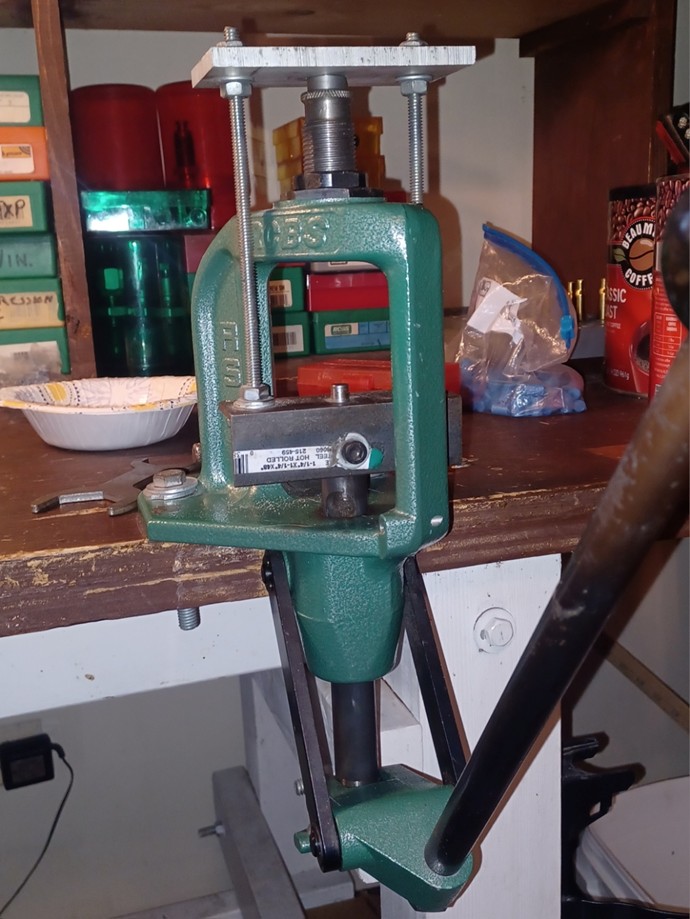
Bill the taper die I'm talking about is used for tapering the bullet before loading it. You use the same throating reamer to both throat the rifle and cut the die. Nothing's perfect but it should fit about the best you can have it. Think of the fit as a Morse taper in machine tooling.

I don't know what lube yiure using but another thing you could try is cutting back on the amount you're putting on the bullet. Try filling the spot over the check and one lube groove. On some of my bullets I just filled the spot over the check and it helped too. This was with mold quenched WWs and LBT Blue lube. Tom Gray wrote about lube purging flyers years ago and I tend to agree the animal exists.

Attached Files

Wm Cook posted this 15 December 2025

Thanks for the response Pat.

“ ….tapering the bullet before loading it”

Am I right in understanding that you cut a blank die (example being any 1” round stock) using the same reamer you used on the throat.

Then you insert a lubed bullet into the newly cut hand die so that the bullet better fits the shape of the bore?

Thanks, Bill.

Attached Files

pat i posted this 15 December 2025

Bill I've posted this picture before but this is my press set up for bullet tapering. I put it together with scrap I had laying around the garage. The die in the press is a PPG die blank but a piece of 7/8×14 threaded rod works as well. I turned a pin that goes in the die to eject the bullet. And yes you use the same throating reamer to cut both the throat and the die. This isn't a bump die since there's no stop but since I don't shoot bore ride bullets there doesn't have to be. What you're trying to accomplish is fitting the bullet to the throat not the bore. Maybe someone that bumps their bullets will chime in on what they're changing when they bump a bore ride bullet but this is my way.


Attached Files

  • Liked by
  • Duke_M
  • Ken Campbell Iowa
Wm Cook posted this 15 December 2025

With the adjustable 7/8x14 die you can adjust to have consistent pressure with each lubed bullet when the press cams over.

I’m sure you’re using this with more than one mold. So how much movement can you effect. Remind me again what alloys you use. I think I remember you saying around 18bhn.

Attached Files

pat i posted this 15 December 2025

With the adjustable 7/8x14 die you can adjust to have consistent pressure with each lubed bullet when the press cams over. I’m sure you’re using this with more than one mold. So how much movement can you effect. Remind me again what alloys you use. I think I remember you saying around 18bhn.

I don't understand your comment and question but I've used air cooled WWs at around 10 bnh. Mold quenched WWs at around 20 bnh. And oven treated WWs at around 32 bnh. All tested with Saeco, LBT, and Cabine Tree hardness testers. They might not have shown the same exact results but they were more than close enough for horse shoes and hand grenades.

Attached Files

  • Liked by
  • Bud Hyett
Show More Posts
Close