
Assuming the lands are touching the nose, how much effect does seating depth, cartridge overall length +/-, effect accuracy? Thanks, Bill C.
Bore Rider Seating Depth
- 891 Views
- Last Post 11 February 2026

John Carlson
posted this
30 January 2026
Ideally it seems that a bore rider should be seated such that the front driving band is in the leade, just touching the lands. The bore riding section should slide, with some resistance, into the bore.
As always, try it different ways and go with whatever works.
John Carlson. CBA Director of Military Competition.
Attached Files
- Liked by
-

-

Wm Cook
posted this
30 January 2026
I didn’t know that. I thought all that was needed was to have the front drive band seating/sealing into the start of the freebore. That might answer the question I asked about those that refer to sizing diameter to the fourth place (.xxxx).
I’m shooting a production 30 cal & it’s a tight freebore of about .3088. Even sizing down to .308 I can see some scuffing on the front drive band since the seating depth is such that I wanted it to have the front drive band supported/touching the freebore. Thanks, Bill C.
Attached Files

OU812
posted this
30 January 2026
I had Accurate moulds cut me a undersized bore ride section so that I could bump it to fit any .308 bore. After bumping (squeezing) the bore ride section is enlarged more perfectly round and gas check is seated square. Round and better fitting bullets shoot more accurately.
Attached Files
- Liked by
-
Wm Cook
posted this
30 January 2026
“ I had Accurate moulds cut me an undersized bore ride section so that I could bump it to fit any .308 bore.”
I think Keith has a point about the nose fitting the bore. But I’m not aware of any data that can prove it. It sounds right, just don’t know if it’s been proven in competition.
And the definition of bumping is all over the map. Some of the early NRA articles went into length on how to structurally reinforce a Lyman sizer so you could randomly bump (mash) the bullet when sizing. That’s 180 degrees different than what Keith is doing.
The biggest obstacle to bumping is that you either have to have a custom chambered rifle and use that throater to make a bump die, or, you have to have a lathe in your shop.
But getting back to freebore fit and +/- COAL manipulation to tweak accuracy, I need to wring out more of what John suggested.
The concept of advancing the front driving band into the leade and then +/- that COAL to help accuracy is new to me.
In the past I always tried to have three fixed points to stabilize the bullet. 1) case mouth, 2) the front band into the bore enough to give it stability, and 3) the bore rider nose touching the lands.
The neck length on a piece of .308 brass .303. I’m jumping ~.040 from case mouth to freebore wall, I have a freebore length of ~.367. So the distance from the juncture of neck/shoulder of the brass to the leade on my rifle is .719.
The 200 grain bore rider I’m using measures .418 from the gas check to the front driving band. If I cheat the seating depth half way up the neck the closest I can bring the front driving band to the leade is ~.250. It’ll be interesting to see how far into the freebore a .308, then a .309 sized bullet base will chamber.
Hopefully no later than Monday I should have an answer to that. Thanks, Bill C.
Attached Files
- Liked by
-

John Carlson
posted this
31 January 2026
I approach it from the other direction. NOE 311202 to 314210 will drop bullets just a bit too fat for my bores. I size the noses down to fit, usually .3005 to .3015 but I have had some rifles that took .304. The NOE bullets are just a wee bit hourglass shaped so sizing less than .002 does not leave a bulge ahead of the driving band
John Carlson. CBA Director of Military Competition.
Attached Files
Wm Cook
posted this
31 January 2026
“ I size the noses down to fit..”
John is that using the NOE nose sizer?
Attached Files
Wm Cook
posted this
31 January 2026
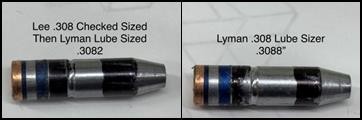
Well this was interesting. I took a couple 200 grain bore rider bullets from a lot I was using to look at bullet to free bore contact. The reason for doing this was to see how far up the free bore I could put the driving bands and whether or not I could reach the leade like John suggested
From this I drew two conclusions.
- Regardless of who makes the sizing die you are using there's a +/- tolerance built into the manufacturing process. If I was the one producing sizing dies I would be tickled pink if I could hit +/- .0005. Just because the die is stamped ".309" doesn't necessarily make it so.
- Now I understand why some competitors indicate the bullet sized dimension to the fourth decimal on the equipment list when shooting a competition match.
The bullet on the left was checked and sized with a Lee .308 and, following this, was run through a .308 die on a Lyman lube sizer. With the Lee Lyman combo the base came out as .3082. The bullet on the right was run through the just the Lyman lube sizer, skipping the Lee sizing step, using the same .308 size/lube die. The Lyman die sized the base to .3088. Repeating the process by using the the Lee .308 confirmed that the Lee was tighter than the Lyman sizing die.
I used a magic marker to better see scuffing / lands marks and chambered each bullet. I increased the COAL I had been shooting another .040 to see how far I could get it into the free bore. The Lee/Lyman combo .3082 sized bullet made no contact with the free bore. The bullet that was only run through the Lyman lube sizer showed the first scuffing where the bullet base was making contact with the free bore. Tomorrow, or more probably Monday, I'll repeat with .309 dies in both the Lee and the Lyman to see what the dies actually size the bullet to.
In my opinion, like pound casting, this should be a standard practice for competition rifles and one of the first step in load development. I say this with the understanding that load development begins in the shop determining bullet to bore fit. For clarification, this will not bring a 1.25 aggregate to sub MOA, but if you're starting out a new rifle, you might want to to size the bullet to fit the free bore. I have pictures somewhere on my computer that shows what happens if a bullet isn't sized enough. The free bore face gets a buildup of alloy that looks like a ramp. Short of mercury this is impossible to get off.
If anyone has any suggestion on how to get this buildup off the chamber wall I'll l buy you a cold one if I get to the Nationals this year. Thanks, Bill C.
Attached Files

Hornet
posted this
01 February 2026
I did pound slugs on several throats a couple of years ago (fun while snowed in) and found that a lot of freebore- type throats can also hate .001"-.002" taper in the steel. Same for the case neck portion of chambers. Sometimes you've got to do a bit of tricky measuring and guessing. Frank Marshall seemed fond of sizing the base section 0.0005" under the throat diameter for target work and a little smaller for hunting. Staying just a touch small also helps if you get a bit of burned powder/ burned lube fouling. My .30 Herrett demands doing so to avoid misfires after about 8 rounds (picky bugger)
Attached Files

MP1886
posted this
01 February 2026
Many military cartrdiges back in the old days has tapered neck sections of the chamber. There would be no doubt that the throats of some of the taper.
Attached Files

pat i
posted this
01 February 2026
Most if not all standard chambers will have a bit of taper on the neck section, 1 or 2 thousandths. I assume it's for easing extraction of the fired case.
Attached Files
pat i
posted this
01 February 2026
This is good website to add to your screen.
https://www.theballisticassistant.com/saami-rifle-cartridge-catalog/
Bill of your ball seat is that small it might be an added bonus for shooting jacketed bullets but might not be optimal for cast. Only way to tell is try different things and see what you can come up with. On a barrel with a freebore I like a half thousandths under that diameter. But that's just my way and not necessarily the best way for everyone. And I'm not a fan of bore ride bullets but think I'm in the minority on that one.
Attached Files
OU812
posted this
01 February 2026
One Cold One...is that all? I'd have to have atleast 5 shots of good whiskey. Drinking with all my buddies.
Attached Files
- Liked by
-

MP1886
posted this
01 February 2026
Most if not all standard chambers will have a bit of taper on the neck section, 1 or 2 thousandths. I assume it's for easing extraction of the fired case.
That is definitely the reason in military arms.
Attached Files
- Liked by
-
John Carlson
posted this
01 February 2026
Yes I use the NOE nose sizer, I hone the bushings out in .0005 increments.
John Carlson. CBA Director of Military Competition.
Attached Files
OU812
posted this
02 February 2026
I've tried the noe nose sizers and sometimes it can take a LOTS of force
Attached Files
Wm Cook
posted this
02 February 2026
I think NOE’s intention was for the user to take the nose down no more than half a thou at a time. I have a mold that drops with a nose that’s ~.3034 cross direction and ~.3025 in line of the mold face. The NOE .303 nose sizer takes down the high side so it’ll fit in the bore.
When I started thinking about the .222 for accuracy, and with its aftermarket barrel and all, I went on line last week and found he still had a .219 nose sizer available.
In the grand scheme of things their nose sizer has its place. Bill C.
Attached Files
OU812
posted this
04 February 2026
here's that picture of before and after bumping bullet to fit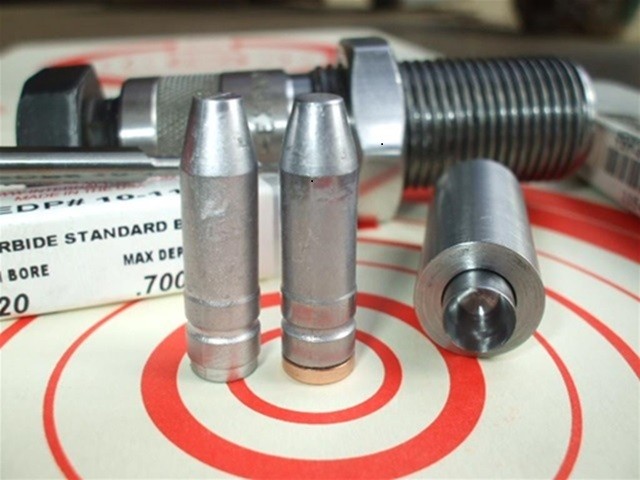
Attached Files
Wm Cook
posted this
04 February 2026
That looks terrific Keith. If the user has everything else is in order, and I’m sure you do, I would have confidence that it would help accuracy. But I don’t have a lathe in my shop, and even if I did I wouldn’t know how to use it. Best case is to make this achievable for the every day accuracy seeking shooter.
And I think there’s a need to prove the concept with a formal trial. Maybe six 10 shot groups with three bumped and three not bumped. I saw the two targets you posted a while back and that was impressive. And I’ve read all your post and for the life of me, in my head, I can’t put together how you do what you do.
Maybe if you put together a few paragraphs it could be used in a FS?
Thanks for keeping my hopes alive & well. Nice job. That bullet sure looks like a lot of the molds from Accurate. Bill C.
Attached Files

Larry Gibson
posted this
04 February 2026
"pat i posted this 3 days ago
Concealment is not cover.........
Attached Files
- Liked by
-
-

pat i
posted this
04 February 2026
Larry a lot of reamers used by guys that neck turn their brass don't have tapered chamber necks so I don't know if I completely agree with your assessment.
Attached Files
Categories
- All Categories
- General Polls
- Contact Us w/ Forum Issues
- Welcome to The Cast Bullet Association Forum
- General
- Bullet Casting
-
Guns and Shooting
- AR Platform
- TC Contenders & Other Single Shot Handguns
- Shotguns
- Informal Matches & Other Shooting Events
- Gunsmithing Tips
- Gun Cleaning & Maintenance
- Optics
- Benchrest Cast Bullet Shooting
- Military Bench Rest Cast Bullet Shooting
- Silhouette Shooting
- Postal Match Cast Bullet Shooting
- Factory Guns
- Black Powder Cartridge
- Hand Guns
- Lever Guns
- Single Shot Rifles
- Bolt Action Rifles
- Military Surplus Rifles
- Plinkers Hollow
- Muzzleloaders
- Hunting
- Reloading
- Buy, Sell or Trade
- Other Information & Reference
Search
This Weeks High Earners
-
 John Alexander
3
John Alexander
3
-
Aaron
2
-
SuperxJeff 2

