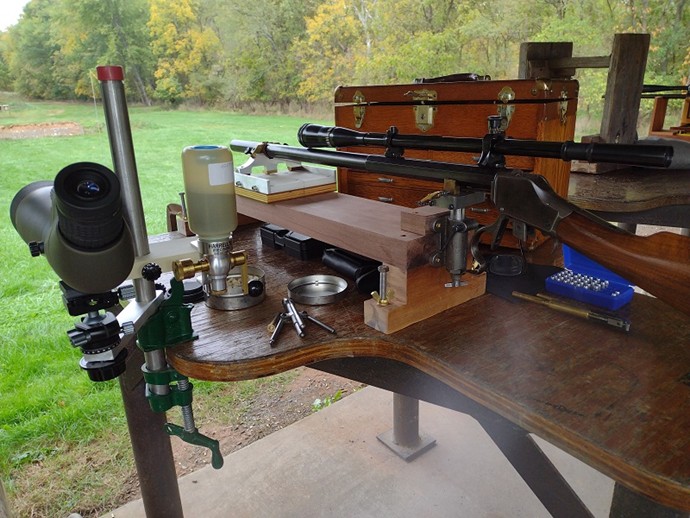
Barrel clamp for match shooting

  • 744 Views
  • Last Post 12 August 2025
Tom Acheson posted this 08 August 2025

My CBA match activities changed in the 2025 season to focus more on a rifle than my long standby of s handgun. Not that I no longer have an interest in my XP-100, it’s that I’ve developed a new interest in the Scheutzen side of shooting. Many of those old, long ago discontinued single shot rifles, are extremely interesting in their design, workings, performance and appearance.

So I’ve been shooting a new CPA chambered in .38-55 and….trying for my first time breach seating.

An interesting aspect of the PBB (Plain Base Bullet) category is that the only difference between it and the UNR (Unrestricted) category is the no gas-check bullet restriction. Otherwise no weight and barrel length limits, action or component or rest restrictions for either category.

One odd thing that some of the ASSRA (Amer. Single Shot Rifle Assn.) match shooters are doing is the use of a “barrel clamp”. The clamp is fairly wide on the bottom and rests/slides on a flat hard surface on the front rest during recoil. This limits barrel “flip” and rotation during recoil, especially when using a rounded bottom forearm. The ASSRA and CBA match rules allow its use.

I have an article about my CPA single shot rifle, a modern replica based on the late 1800’s Stevens single shot rifle, for the Fouling Shot, about 90% done. I’m waiting on the conclusion of our local match season to finish the article.

So…..I’ve been wrestling with two barrel clamp subjects. First, where on the barrel is a good location for the clamp AND second, what material works good between the exterior of the barrel and inside surfaces of the clamp?

Some will opine that the null point of the barrel is a good location for the clamp. For the material between the barrel and clamp, I’ve seen old bike inner tubes, an old belt, strips of deer hide, thin cardboard or maybe a strip of an old target sheet, as materials to protect the barrel and keep the clamp in place.

Any experiences here to add to the discussion?

Thanks!

Tom

Attached Files

Order By: Standard | Newest | Votes
RicinYakima posted this 08 August 2025

The original barrel clamps were brass and clamped just behind the front sight. However, these were not the sliding sleds you are referring too. They were large "A"'s and shot firmly held back on the shoulder. FWIW

Attached Files

  • Liked by
  • pat i
muley posted this 09 August 2025

I have heard tell , the use of a stethescope on the barrel and move it up and down the barrel as u tap the barrel. when u hear the "dead spot" u are probably best for harmonics .

Attached Files

Tom Acheson posted this 09 August 2025

Correct, the stethoscope is one way. For my CSA Model 74 Sharps, I hung the rifle from a ceiling joist with a piece of clothes line, and then tapped the barrel, listening for an almost singular different sound. This was about 7” from the muzzle and that's where the barrel is rested when shooting off cross sticks.

So if the clamp restrains the barrel, unlike cross sticks, does the clamp location mean anything?

Tom

Attached Files

rhbrink posted this 09 August 2025

Experiment with it moving the clamp up and down the barrel to see where it shoots the best. I personally have not seen a lot of difference shooting 25 and 32 cal rifles maybe your 38-55 with a heavier bullet and more recoil might be different. 

Attached Files

  • Liked by
  • Bud Hyett
  • pat i
Tom Acheson posted this 09 August 2025

Richard, That’s what I’m doing,thanks! Scheutzen match tomorrow and I have the clamp about 10” from the muzzle. Previously I had it 6” back from the muzzle.

Tom

Attached Files

gnoahhh posted this 10 August 2025

Here's my setup. Barrel sled made of aluminum, by a gentleman who's since passed. Bottom of the sled incorporates feet made of Delrin. Interface with barrel: cardboard, thin soft deer hide, doesn't seem to matter. Placement: I do the "hang it upside down with the forearm off and tap the barrel with a small brass hammer, and where the 'ding' becomes a 'thunk' that's where I attach the sled" technique. Seems to work ok.

Note the rig in the pic is an adaptation of Pope's machine rest, with V-rest to support the rear of the barrel. I don't use it in competition, only for experimenting. I have used just the sled in competition though. In both instances the sled rides on a 6" square of 1/2" Delrin with side rails to keep it from sliding off the side by accident. Note: I always remove the forearm of a rifle in competition, and rest the barrel on the node either via sled or sandbag/rest - one less possible fly in the ointment.

You gotta make doubly sure the sled is perpendicular to the axis of the bore and also the vertical centerline of the action or the rig will twist under recoil.

Consistency is key as with anything else in our sport. I found that consistent shoulder pressure against the butt is crucial, that or leave it recoil freely in the V-rest and gently as possible"pinch" the trigger to fire it.

Breech seating is a pain in an original Stevens 44 1/2, somewhat better with the CPA repro 44 1/2 because they lowered the hammer spur. I love Stevens, but dislike having to push-seat with a plugged case. I have a Weber breech seating tool for CPA that I haven't given up on making work in an original. If I throw in the towel I'll let you know! For now I'll stick with High Walls and Ballards - so much easier to breech seat!

My pard and I are experimenting with making traditional style barrel sleds, a la those used by Pope, by sand casting molten aluminum beer cans. Stay tuned!

Attached Files

John Alexander posted this 11 August 2025

Are there shooting results that confirm the theory that the dull spot (node) is usually the best place for the sled, or is it just believed on faith, or because it seems "logical".

If not, what Richard and Tom are doing needs doing. Maybe they will find that the dull spot is always the best place for precision.

 shooting results. Or maybe not.


Attached Files

Tom Acheson posted this 11 August 2025

Ah yes, testing to confirm a practice!

At our CBA Regional in late July, during the 200-yard stage, I had the clamp/sled 6” from the muzzle. When deciding on that location, it was influenced by a couple of Scheutzen match shooter’s rifles photos that I saw on the ASSRA forum, with the clamp in that general location.

At yesterday’s Scheutzen match I changed the location of the clamp to be 10” back from the muzzle. This Scheutzen match involved 200-yards off the bench, just like a CBA match.

There were (4) of us using a clamp @ the match, all of which were back from the muzzle at least a foot.

In comparing the group sizes of the CBA mach vs. the Scheutzen match, the latter groups were a bit smaller. However….to respond to John’s comment, this was not a bonafide test, too few rounds fired. In each case it was (2) 10-round groups.

I did not quiz any of yesterday’s shooters on what they did to determine their clamp location.

I’ve only done the “check the barrel null location” once, as noted in the opening post, for a different reason.

This fall I’ll try to find the “null” location on my CPA barrel.

Tom

Attached Files

Tom Acheson posted this 11 August 2025

Footnote….if you are using a front rest to set the clamp on, as you navigate your elevation changes during matches, the farther out you place the clamp/sled, the longer your arm needs to be!

Reaching out in front of you to adjust the elevation becomes more challenging….try it, you’ll see.

Tom

Attached Files

  • Liked by
  • Bud Hyett
  • Glenn R. Latham
Tom Acheson posted this 11 August 2025

One more footnote and fuel for the fire…from a fellow Scheutzen match shooter..,.

“I've heard shooters speak of barrel harmonics and all sorts of technical things as to where to place a muzzle clamp so it is most efficient, to be honest with you, I'm not convinced all that makes that much of a difference. Cover the basics as you best know them, after that it is about managing the rifle itself and learning how to read the wind & mirage conditions properly.

Here are my thoughts about muzzle clamps: Visualize the area where you place a muzzle clamp as if it were the fulcrum point on a lever. Think of the teetering effect of a lever. Your rifle barrel is the lever. If the fulcrum, (muzzle clamp) is placed nearer the muzzle should it not follow that you will have less vertical stringing on your taget? (The lever being much more rigid on the front rest and back rest rather than a pivot on the center of the barrel, or just forward of center)?

Back when I shot muzzleloaders, the heavy bench rifles had barrels 38" long or more. They were heavy octagom barrels sometimes as much as 3" across the barrel flats and weighing 40lbs and more. The shooters provided their own benches. These were as long as the barrels themselves. Muzzle clamps were used, and the clamp was always placed no less than 5" from the muzzle. The resting points of the rifle were near the muzzle & them supported by the shooter in the back. The purpose again was to avoid the possible teetering effect of a rifle balanced at mid length. Those heavy rifles became stable shooting platforms.

It makes sense to me that the same concept follows with what we do with our Scheutzen rifles. Place the clamp out far enough on the barrel so you can still reach the adjustments on your rest when it comes to adjusting sight position. Most of us have a 24" reach, so with a 28" or 30" barrel, the clamp will about 5-6" from the muzzle.”

How’s that?

Tom

Attached Files

rhbrink posted this 12 August 2025

My thoughts on that are those 3 inch muzzleloading barrels have a massive amount of steel hanging out there. That equals a whole lot of stability and a whole lot of weight. Your Schuetzen barrel is maybe one inch in diameter or across the flats out toward the muzzle, that's give you a lot more flex. 

Still the bottom line is what combination shoots the smallest groups, and the highest scores is best for you and your rifle. There is no short cut to find this at least I have never found one. Shoot and experiment and shoot some more and keep good accurate records. Eventually it will come together, and to me that's the fun part of it!

Attached Files

Close