Alloy Temperature When Casting 20-1

  • 570 Views
  • Last Post 08 November 2025
  • Topic Is Solved
Wm Cook posted this 05 November 2025

I've never cast with an alloy softer than #2 and most of what I've cast in the past three years has been Linotype. 

I'm setting up a 20-1 vs Linotype trial with my .308, gas checked, 200gr bullets @1700 to 1780fps.  Today I cast the first half of the bullets needed and as with most of the Linotype sessions it dropped about 95% +/- .1 grain.  This was ladle cast with the alloy ~ 710 and the mold at 400 degrees.  It doesn't need to be +/- .1 grains for accuracy. I believe it could be +/- .4 and it wouldn't matter.  Linotype is just that easy to cast that they come out that close.

Next I'll be ladle casting 100 pieces using 20-1 from RotoMetal. 

I have two questions:

  • What alloy temperature would give me the lowest rejection rate when I cast using the 20-1?  
  • Do you ever manipulate your pot temperature based on the alloy you're using? 

Thanks, Bill C.

Attached Files

  • Liked by
  • RicinYakima
  • Bud Hyett
Order By: Standard | Newest | Votes
RicinYakima posted this 05 November 2025

I always change pot temperature depending upon alloy and mould. I cast Linotype at 690 on the PID and 20/1 at 725 and I am almost always using Ideal one cavity iron moulds. Bronze moulds almost always at 700 regardless of alloy. 

Attached Files

  • Liked by
  • Bud Hyett
Lucky1 posted this 05 November 2025

I just finished some 20:1 plain base bullets this weekend and I agree with Ric about adjusting to the alloy but especially to the mold. I will add a 3rd variable with the outside temperature. I had to adjust to the 40 degree Temps compared to the 70s of a few weeks ago. It also affects my pacing too. Maybe that's why I consider casting an art as much as a science some days.

Scott Ingle

Attached Files

  • Liked by
  • RicinYakima
  • Glenn R. Latham
Bud Hyett posted this 05 November 2025

I've been all over the temperature scale in this quest. I started casting years ago running as hot as the RCBS Pro-Melt would go; using two molds casting as fast as I could. Then weigh and sort to piles that were all within .5 grain range. This worked until the competition got better.

Then I started going with a lower and lower temperature ending at 775 degrees to support this approach. This was with the RCBS Pro-Melt II with the supposedly better temperature control. Slowed my casting rate and bumped the mold when setting down to assure the base filled out. This gave mor uniform bullets, but still a long weighing session after casting.

Serious experimenting starting when I began shooting plain-base. Using a PID controller, this now has me at 745 degrees for both Linotype and 20-1 alloy. I may go a little higher for wheelweight alloy in aluminum molds for gas-check bullets as an experiment. I also use this temperature for a four-cavity aluminum pistol mold.

I've also limited the molds I am using; custom molds for the Plain-Base and Springfield rifles with several standard molds for the others. I still want to work with the 7mm BR Heavy Rifle with the RCBS And SAECO heavy bullet molds.

Farm boy from Illinois, living in the magical Pacific Northwest

Attached Files

  • Liked by
  • RicinYakima
  • Glenn R. Latham
RicinYakima posted this 05 November 2025

Scott,

It is Art and not Science!

Where I live, I only cast November through March, so the shop is 40 degrees to 60 degrees. Can't cast in the summer at 110 degrees. 

Ric

Attached Files

  • Liked by
  • Bud Hyett
Wm Cook posted this 05 November 2025

“ I cast Linotype at 690 on the PID and 20/1 at 725 and I am almost always using Ideal one cavity iron moulds.”

I’m PID controlled and 690 looks absolutely appropriate with Linotype. I’m running Linotype at 710 & I have got no good reason to explain why. I know 690 would work fine.

I had heard that 20/1 has to be run a little hotter, better flow for fill out? So 725 seems like a good compromise of being hot, without being so hot (750?) that it’d create problems of oxidation & excessive dross.

I didn’t realize the need to make alloy temp adjustments based upon mold material. Again, you taught me something.

The one I’m working with right now is a single cavity iron mold. I probably have 10 single cavity molds. All but the last two were brass. Not sure if I’ll ever go back to brass for single & double cavity molds.

This latest iron mold is the first from Accurate since Tom sold the business. It came in on spec & it’s running pretty good. Thanks, Bill.

Attached Files

  • Liked by
  • RicinYakima
  • Bud Hyett
lotech posted this 05 November 2025

I usually check the temperature of the melt; not critical in most instances. 750 - 800 seems fine. I leave my mould or moulds on top of the pot until they heat enough to work well, but don't measure mould temperature. I do have one tempermental mould, an Eagan, that require a bit more heat than other moulds to get perfect base fill out.

I also use RotoMetal 20:1, mostly for .38 Special and .45 ACP, but plan on trying it for .32-20, .32-40, and .38-55 when my present supply of bullets is depleted. For .30 caliber rifle loads in the 1600-1700 fps range, I've been using a mix of about 12-13 BHN, a little  harder than 20:1 with good results. I've experimented with RotoMetal's Lyman #2, but have not done extensive work. For my purposes, it may be a better alloy for my .308 and .30-06 loads. Sill much work to do to verify that. 

I have not tried 20:1 with .30 caliber loads, but may have to since it's use was mentioned in this thread. I suspect leading, but I may be very wrong.  

Attached Files

  • Liked by
  • RicinYakima
  • Bud Hyett
Lucky1 posted this 05 November 2025

Well Ric, you are clearly better at advanced preparation than I can manage. There's always something more to cast up during the summer than I had originally anticipated. Our climates may be a tad different too. I get your type of Temps in Oct and April and then we go way down or up. Here we live by the motto, "there is no such thing as bad weather; just improper clothing." One other thing for the art part of the equation is bullet size. I didn't ponder that I make even more adjustments depending on 500 grainers for the Sharps or 55s for the 223. So basically I'm saying my sessions are a matter of adjustments until things are going right and the bullets look good. Which fits John A's credo of a bullet that looks good, is good.

Scott Ingle

Attached Files

  • Liked by
  • RicinYakima
  • Bud Hyett
Muzzlestuffer posted this 06 November 2025

Depends on ambient temp in my shop the weight of the bullet and the mold for my 540 money mold in the cooler weather here in Az I cast @780 with #2 to get the weight and the mold to fill out.

Attached Files

Wm Cook posted this 06 November 2025

Well I stepped into a fine kettle of fish with this WA idea. The intent was to understand obturation’s effect on accuracy.

The complexity of the initial concept was under estimated. My intention was to compare a production class bolt gun with known accuracy at 1700fps using a 200g bore rider & Linotype and compare that to 20/1 using three 10 shot groups of each.

But with everyone leaning towards high alloy temps (725 to 780) I’ll have one heck of a time ladle casting with the build up of dross on the surface. I’ve always understood that there was a ceiling of ~750 where’s tin’s oxidation rate climbs causing increased dross and it waste’s the tin content.

I can ladle cast better looking bullets than I can with a bottom, but in this case I may need to be flexible. I do have an old cleaned up 11lb Lyman but the mold shelf hasn’t been built yet.

And then there’s velocity. In the past 5 years there have been 188 competitors that shot for record in the CBA Nationals. Of those, 34% used alloy other than Linotype. And their average velocity was 1550.

As a side note: In the 2025 Nationals almost 9 out of 10 competitors used Linotype. Is this the classic jacketed BR method of follow the masses?

Is there any redeeming value to softer alloys? Are there pro’s/cons to Spitzer v bore rider? Heavy weight versus light weight bullet? Or is it all unique to the rifle, powder, bullet combination?

Can anyone support the benefits of softer alloys with facts? Maybe I’m just whistling in the dark on this one.

I’t just bothers me the way Linotype is wearing the throat. Sorry for the venting.

Bill Cook

Attached Files

lotech posted this 06 November 2025

I haven't had real linotype in a while. I recently used up my last batch of the hardest alloy I generally have used, about 16-17 BHN. The only .30 caliber chamberings for cast bullets I now have are .308 and .30-06, two rifles for each cartridge. I use two bullets  primarily, the Lyman #314299, modified to HP by Erik Ohlen and the Eagan MX-3-30 ARD, a tapered design. Both bullets weigh app. 200 grains with GC affixed. As I mentioned in an earlier post, my alloy is 12-13 BHN. 

The Lyman and Eagan both shoot very well (for me, anyway) with 100 yard group sizes around 3/4". I keep loads in the 1600 to 1700 fps range. I use a Ruger 77V .308 and a Remington 700VS .308. Both rifles have heavy barrels, 24" and 26". Both were bought new more than thirty years and are used for cast bullet work only and have been fired extensively. 

The Remington will lead slightly but not enough to affect accuracy unless I shoot quite a bit. The Ruger seems to never lead. I size bullets in a SAECO .311" sizing die and use LBT Soft lube. IMR4759 powder and 5744 produce identical accuracy results. 

The Eagan bullet does not shoot well in my pre-'64 Model 70, but the Lyman design does. I have not tried the Eagan in my '03-A3 but the '03-A3 does well with the Lyman HP. 

I have tried harder bullets (16-17 BHN) in the the Remington and Ruger .308s. They don't shoot quite as well as the softer bullets in my velocity range. Same for the .30-06 Model 70. Just too many changeable factors for me to provide you with exactly what you're looking for, but maybe someone else can give you better information. 

Again, as mentioned in an earlier post, I intend to try a 20:1 mix just to see if it works for me, though I suspect it may be too soft for best results. 

Attached Files

  • Liked by
  • RicinYakima
  • Bud Hyett
358156hp posted this 08 November 2025

I'm currently casting with 20:1 and have my PID set at 750 for my 4 cavity brass hollowpoint moulds. I find I need more heat for fillout with all those moving partssmile. My standard temp setting is usually 725. 

Attached Files

  • Liked by
  • Bud Hyett
Wm Cook posted this 08 November 2025

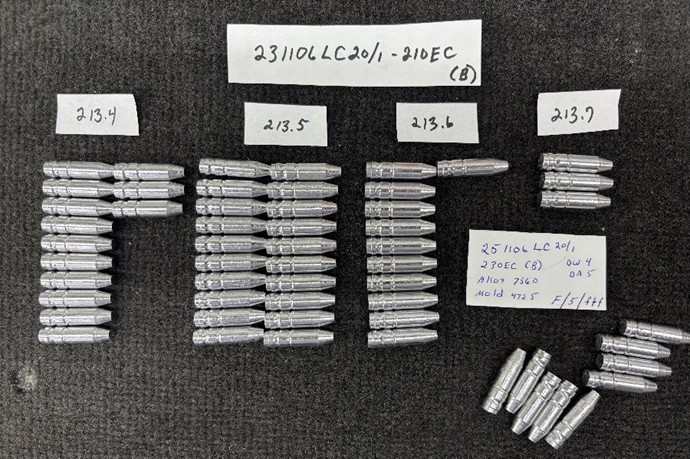
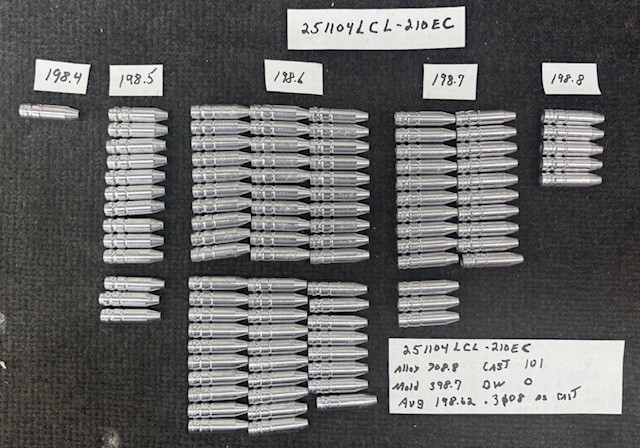
Summary:  Casting 20-1 went better than I thought.   The roof didn’t cave in and I walked away from the bench with all my limbs and fingers.  The work was done with RotoMetal 20-1 and ladle cast out of a PID controlled 10# Lyman pot.  The mold was from Accurate.  It’s a single cavity iron mold dropping a ~210 grain bore rider bullet.   

I cast two small lots of ~50 each.  The first was to get a feel for the cadence and to see how the mold and alloy behaved.  The second lot was an attempt to see if I could cast to be what I consider match quality 20-1 bullets. 

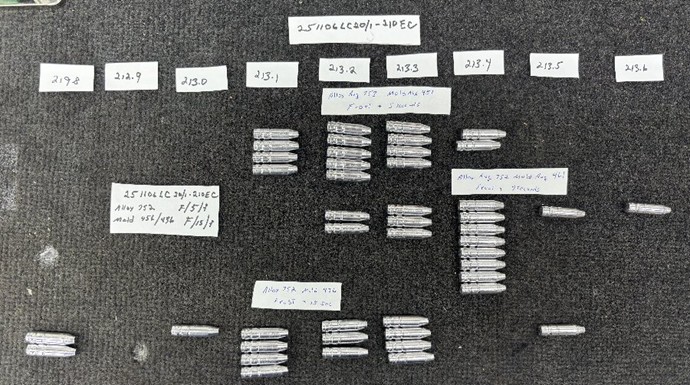
The first lot was cast with an average alloy temp of 752.6 (+/-14) and an averaged mold temp of 447.6 (+/- 18.5).  I started with a high alloy temperature based on recommendations from Ric, Bud and others.  Mold temperature was dependent upon the cadence.  I used the counts of 5, 10, 15 between frost and sprue cut as the variable and just tracked mold temperatures based on that.  The sprue cut felt a little squishy (compared to Linotype) with all three cadences but there was no tear, no smear.  The weight distribution (ES) was greatest with the 15 count and the mold temperature was falling off as well.  With the 15 count the appearance was textured such you could barely see the seam from the mold.  It filled out fair but the base wasn't sharp.   The 5 count lot had a lower weight distribution, a better appearance and a sharper base, so I used 750 degree alloy and a 5 count for the starting point on the second lot. 

The second lot was about 50, 60 pieces.  The mold temp was controlled with a 5 count before the sprue cut and the speed to ladle refill was quickened.  I sped up the return to ladle intentionally in order to increase the mold temperature and improve appearance.  The mold temp averaged 472.5 (+/- 7.5) for this group.   A clear warning needs to be given about mold temperature; at this temperature a brass mold will warp.  To repeat myself, I’m using an iron single cavity mold.  Iron gains heat slower than brass and aluminum but retains heat the longest (over aluminum & brass).  Brass mold can be damaged with this high of temperature. The rejection rate with this second lot was 11%.  Rejections were based on weight and appearance.  Overall appearance improved with the 470 degree mold although I could now see the mold face seam, but it’ll never be mistaken for a Linotype bullet.  Bases came out flat and you could feel the gas check snap onto the base.  So there was enough fill on the base to look and feel right.  I considered them as being match grade. 

Learnings:

  • The 20-1 alloy cast a nose diameter .0009 smaller than the 20-1 alloy.  I didn’t expect it to be this great.  My expectation was that it would only show about .0003 shrinkage.  The as cast weight difference showed Linotype at 198.62 grains & the 20-1 at 213.51.  With a 7% weight gain my initial thoughts of running the same load I was using with Linotype have changed.
  • To see how soft the bullet was, I press checked (Lyman 450 using their gas check seater) using nominal pressure on the ram to simply crimp the check on the bullet.   After measuring 10 samples, before and after, I found that the Lyman had bumped the nose with the 20-1 alloy from an average .3018 to a 10 bullet average of .3079.  A gain of .0061.  To be clear this was same day casting and same day adding the check.  In comparison to casting and sizing Linotype the same day, my last lot of Linotype had the nose size increase from .30208 to .30296 (10 bullet average), showing a gain of ~.0009.   Interestingly enough, with the 20-1 I had expected the nose to crinkle but it surprised me how the base went big as well, going from .3108 to .3150.  A gain of .003.  But the bullet growth (nose and base) wasn’t a uniform bump.  Measuring before and after adding the gas check was added, showed the nose of individual bullets (again within the 10 bullet sample group) varied from .3050 to .3087 with an ES of .0037.  All measurements were averaged based upon measurements at 12:00, 3:00, 6:00 and 9:00.   

As a general practice I normally cast, size & lube Linotype with this mold on the same day because I need the .001 bump.  My experience is that if you let Linotype set a couple days there will be little dimensional change.  For #2 I usually wait a week.  I don’t know how long it’ll take 20-1 to set before it’ll be hard enough to size.  I don’t even know if it's possible to but gas checks on 20-1 or 25-1 on alloy bullets?  When the dust settles I’ll be putting the gas check on with the Lyman 450 gas check tool, applying lube in the same “as cast” sizing die and eventually push sizing it with the Lee die.  The bullet drops at about .311 and I am sizing to .3098 so there isn't a lot of stress put on the bullet.   

The next cast I’ll repeat the 750 alloy temperature, go to frost, take a 5 count and expect to keep the mold around 470.  I believe that an alloy temp of 725 and a quick cadence could keep the mold temp up to make good bullets without the dross buildup and I'll play with that some.   

I’m prejudiced in believing that, within normal operating temperatures, manipulating the mold temperature as a variable has twice as much affect on bullet quality as changing the alloy temperature.  Within a reasonable operating temperature range, 20 degrees difference on the mold has the same effect on bullet quality as 40 to 60 degrees on the alloy. How fast you return the mold from sprue cut to the spout on a bottom pour or how much overflow you put onto a ladle cast can change temperatures quickly and significantly.  As everyone already knows it's keeping the same cadence throughout the casting session so as to produce similar bullets.

Load development will be interesting.  As I said, the initial thought of starting out at 1700fps might have to be set aside and I’ll have to start working from about 1400 fps and going up from there.  I’ll honestly tell you that load development with 20-1 alloy is a black box to me.  And maybe a bore rider is a poor choice to learn with.   

All thoughts contrary about what I did or the assumptions I made are absolutely welcomed.  I would appreciate it if some of the PB BR shooters would chip in.  They’re running in the 1450 to 1600 fps range and shoot some tiny groups.  Thanks for listening, Bill Cook.
Attached Files

  • Liked by
  • RicinYakima
Close