Alloy Hardness Testing

  • 1K Views
  • Last Post 06 August 2025
  • Topic Is Solved
Wm Cook posted this 30 July 2025

I’d appreciate some help figuring out what kind of alloy I’m working with. 

First, I have to confess that I have no experience blending my own.  For the past 30 years the only alloy’s I’ve ever used was from RotoMetal, and that it was limited to either #2 or Linotype.  Back in the 90’s I bought 20lbs of Pb and a pound of tin that until this year hasn’t been touched. That said, I can see how making/blending your own could add to the cast shooting experience.  At the very least it would give those afflicted with a neurotic obsession another variable to probably waste our time with. 

So here's the story.   I just bought an old Lyman 61.  It's the old one that held 11lbs.  I already have the Lyman Mag 20 and another newer model Lyman 61.  Considering it's age the new/old Lyman that I just picked up is in good condition.  Best guess is that it was infrequently used as a furnace to cast sinkers.  At the time that model was sold without a mold shelf so I have to build my own. 

The question about understanding alloys came about because the furnace was filled with a mystery alloy and I’m trying to figure out what it is and how I can use it in the new found interest I have with alloy's hardness effect on accuracy. 

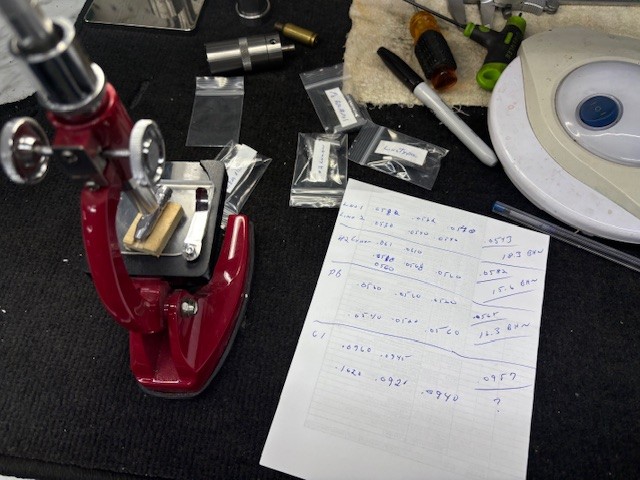
The only tool I have to check hardness is the Lee hardness tester that I’ve had since the mid 90’s.  Approximately four to six measurements were taken from bullets for each;  Linotype, #2 Lyman, pure Pb (all three from RotoMetal) and another 5 or so from the mystery alloy that came with the new/old Lyman.  For what it's worth here are the numbers I got from using the Lee.  The results of the testing was a muddled mess.  If anyone has any suggestion where I go from here, I would appreciate it.     

  • 18.3 BHN - Linotype (RotoMetal)
  • 15.6 - BHN - #2 Lyman (RotoMetal
  • 16.5 BHN - Pb (RotoMetal)
  • Off the chart soft, nearly two times softer than the #2 alloy - Mystery alloy
Attached Files

Order By: Standard | Newest | Votes
pat i posted this 30 July 2025

My WAG is that if it was used for sinkers and jigs it's whatever the guy could find that'd melt so no telling what it is. Again a WAG guess is a lead WW mix but again no telling. I'd donate it to someone who casts for fishing and move on.

Attached Files

  • Liked by
  • Bud Hyett
MarkinEllensburg posted this 30 July 2025

Using the same mold cast ten bullets with each alloy. Compare the weights. Being softer it should weigh heaver if it is lead. if it is lighter it is likely to be zinc or a zinc alloy. Cast sinkers or give to someone who does if that stuff is lighter than expected and soft.

All the good stuff, SB and SN will make your bullets lighter and harder. 

Attached Files

  • Liked by
  • Bud Hyett
  • John Carlson
Lucky1 posted this 30 July 2025

The 16.5 for pure lead seems to baffle me at this point. But then, I know my LBT tester makes me scratch my head sometimes.
Unknown lead ends up going out the muzzle of my smoothbore because it obviously doesn't care as long as it is the right size.

Scott Ingle

Attached Files

Waleone posted this 30 July 2025

Best way is to find a nondestructive testing company near you and have a positive material identification test done. I have no idea what that would cost, but you will get an accurate report of exactly what is in your alloy. Probably not worth it if all you have is a pot full.

Wayne

Attached Files

  • Liked by
  • Bud Hyett
Aaron posted this 30 July 2025

If you are loading for handguns, binary alloys are the way to go. The 20:1 mix for example is easy. Use 10lbs of pure lead and toss in 1/2 lb of tin. Same with the other binary alloys. For handgun loads (velocities) binary is the way to go. Just ask Elmer.

For rifle loads near or slightly over 2000 fps, I use purchased Lyman #2 from Roto. I know what it is and the #5 ingot makes a lot of pills. These bullets, coupled with an appropriate lube, work just fine even in the plain base version.

Of course you are going to hear you should powder coat them and not worry about the BHN. I am not a bullet painter so others may have some advise for ya there.


With rifle in hand, I confidently go forth into the darkness.

Attached Files

  • Liked by
  • Waleone
  • sluggo
delmarskid posted this 30 July 2025

The Lee tester gives me night sweats. I went back to my thumbnail and a dull screwdriver.

Attached Files

  • Liked by
  • Bud Hyett
  • pat i
Aaron posted this 30 July 2025

Nothing beats the Saeco Lead Hardness Tester. But boy are they expensive.


With rifle in hand, I confidently go forth into the darkness.

Attached Files

Wm Cook posted this 30 July 2025

According to the Lee tester the Pb was harder than the #2 which we know is wrong. It’s wrong by a factor of 3 if the assumption is that the RotoMetal that I had from the 90’s didn’t change characteristics. But Pb is an inert material isn’t it? With a hardness of 5. Maybe it’s me. Maybe the Lee tester is crazy wrong. Or it could be a combination of the two.

I do have about 5.4oz of Sn left and that with the Pb I have mixed 20-1 will get me some samples to play with.

I found this while I was noodling around. I scanned it but haven’t studied it. I’ll pick through it later. Bill.

https://www.missouribullet.com/technical.php

Attached Files

Wm Cook posted this 30 July 2025

And how in the heck can adding just a measly 5.4oz of Sn to 6.75lbs of 5BHN Pb, double the hardness of the 20-1 blend bringing it to 10BHN.

Trust me, I’m not gun shy about learning anything about handloading, accuracy or benchrest competition but this is one closet door I may leave closed.

I think I’ll be better off buying “pre-mixed” from RotoMetal. Thanks!!!

Attached Files

Wilderness posted this 31 July 2025

Bill - I expect that I'm Odd Man Out - I don't get excited about lead hardness testers, mainly because I believe there is a more repeatable system of determining alloy. This is by weighing bullets and comparing with other bullets of a known alloy. The density of the alloy reveals the "non-lead" component of the metal - for our purposes antimony and tin.

Tin and antimony are less dense than lead, and are of similar density to each other. Working off bullet density/weight can therefore define "non-lead", though it can't tell you how much is Sn and how much is Sb. As it happens, this may not matter if hardness is the parameter of interest.

Going on Dennis Marshall's explanation in the NRA "Cast Bullets" book, we find that tin (Sn) alone contributes limited hardness, while antimony (Sb) contributes most of the hardness we seek. Tin combined with antimony however, so long as tin % is less than antimony %, forms the intermetallic compound SnSb which has similar hardening value to antimony alone. The conclusion from this is that tin and antimony can have a nearly equal hardening effect so long as Sn% is less than Sb%. This leads to the proposition that non-lead % is an adequate description of an alloy from a hardness standpoint, again subject to Sn%<Sb%.

As for your unknown "lead", my approach would be to make some bullets from it and weigh them, then compare with bullets from the same mould made from a known alloy, such as commercial #2 or Linotype. Pure lead is a bad comparator since it's hard to get a bunch of decent bullets for the comparison.

For the relationship between bullet weight change and non-lead change, Lyman #46 has a table of bullet weights for various alloys across a number of moulds. A single example may suffice. Bullet #457193 is shown at 439 gns in Lead and 407 gns in Linotype - 16% increase in non-lead decreases bullet weight by 7.3%.

For my hunting bullets for example, #U321297HP casts 164.5 gns from my linotype, or 173 gns from range pickup hardball, and somewhere towards 180 gn from really soft stuff. I have determined that the hardness I want coincides with a bullet weight of 170 gns and I blend to achieve that weight. My friend with the tester says they are 16 BHN.

To test softer metal I used a WRACo .32-20 mould - range pickup hardball was 108.5 gns, dead soft range rubbish was 112.5, and what I wanted and blended to was 110.5. I'm guessing, based on what is supposed to be in hardball, that my non-lead was about 4%.

If I was into heat treating bullets, which I am not, I might view hardness testers differently.

You are only as good as your library.

Attached Files

Wm Cook posted this 31 July 2025

Thanks Bill, that helped a lot. That corrected the myth I held that lead was lead and alloy testers were definitive. Especially appreciated was the explanation of the ratios of Sn, Sb and how they interact.

“Lyman #46 has a table of bullet weights for various alloys across a number of moulds”

First off thanks for the tip re the Lyman chart. I don’t remember seeing it but I’ll put my hands on it today. I have a 200g 311299 that’s in the weight class I’m working with. For the heck of it I’ll be able to compare Lino v #2 v 20-1.

Second; Lyman is giving users an option in how to understanding alloy hardness. That hardness may be somewhat subjective rather than objective. Their chart gives the caster another measuring tool to judge, not calculate, the alloy hardness by.

The SAECO hardness tester may be all its often said to be and will provide consistent reliable readings. Of course the option always is to buy premix from RotoMetal.

Thanks to everyone. I think I now know more than I did yesterday. Bill.

Attached Files

  • Liked by
  • RicinYakima
  • Glenn R. Latham
shootcast posted this 31 July 2025

Wm

I have played with blending and used the formula that you found. It seems logical until you read the Lyman manual. Take any listed load. Lyman states the alloy used and pressure generated. They also state that in working up these loads minimum to maximum that no leading occurred. Many pressures go way over the formula for hardness. Hopefully somewhere between min & max you find and accurate load. Something that has always puzzled me is obturation. Why is this brought up as important when most casters size overbore. The bullet must be squeezed down in order to pass though the barrel.  With every blend of alloy or hardness even pure lead. There is a diameter and a pressure that will work best for your firearm. You technique and so forth. The challenge must be finding it. 

Attached Files

  • Liked by
  • pat i
gnoahhh posted this 01 August 2025

Knowing/determining alloy hardness is one thing, and all well and good in and of itself, but what's more important IMO is knowing what's in it so that replication is repeatable in the future. Without said replication/repeatability, bullet performance isn't predictable from batch-to-batch.

Attached Files

  • Liked by
  • fc60
Wm Cook posted this 01 August 2025

Yeah, you’re absolutely right.

I lied when I told Wilderness I would put my hands on Lyman’s 46th. If fact I do not have it, but it’s ordered & I should have it next week. But in the most recent Lyman cast book I found an excellent article on metallurgy. Haven’t finished it yet, but it looks well worth reading.

You know, all this flies in the face of what’s used in CBA BR competition. I know jacket BR (at least to a large degree) is “primate see, primate do”. To my knowledge that comment originated with Dave Sinclair. I’m not directly comparing that to most everyone pushing over 1600fps using Linotype, but some may be impressed with the consistent drop weights & pretty bullets Linotype gives and follow along with the crowd. And it eliminates a lot of work.

Then again, velocities over 2000fps requires Linotype. I think.

As a side issue, I really don’t appreciate the rapid wear Linotype has on the leade of the barrel. Thanks, Bill C.

Attached Files

pat i posted this 01 August 2025

Then again, velocities over 2000fps requires Linotype. I think

Heat treated WW, either quenched from the mold or oven treated depending on intended velocity, will get you there pretty easily. I've never shot a linotype bullet although I have 300 pounds of it around here somewhere.

Attached Files

  • Liked by
  • Glenn R. Latham
  • Aaron
Wilderness posted this 01 August 2025

Bill - this is the table from Lyman 46.


You are only as good as your library.

Attached Files

  • Liked by
  • Aaron
Aaron posted this 02 August 2025

Then again, velocities over 2000fps requires Linotype. I think
Heat treated WW, either quenched from the mold or oven treated depending on intended velocity, will get you there pretty easily.

Yup. Fact. I've run Heat Treated Wheel Weights to 2400fps.


With rifle in hand, I confidently go forth into the darkness.

Attached Files

  • Liked by
  • pat i
Aaron posted this 02 August 2025

That chart above is also in the Lyman 47th Reloading Handbook, Page 111. Great reference material those old books and manuals. Study that chart and I am sure you will generate 20 questions on alloy weight and size.


With rifle in hand, I confidently go forth into the darkness.

Attached Files

BJung posted this 05 August 2025

Find a jewelry shop or someone online with a spectrometer. 

Attached Files

Wm Cook posted this 05 August 2025

To wrap this one up, for me at least, it’s not practical to determine the hardness of an unknown alloy that I have in hand. My needs can be met with premix alloy from Rotometal and by keeping some Pb and Sn on hand.

The fact that the Lee gave such sketchy results was unsettling and I’ve got no plans to try the SAECO which leaves me little choice but to buy premix.

At this point I need to keep it simple using broad brush strokes. Example; If a known mold, powder, charge looks good with Linotype, how does that compare to 95-5-5 or 20-1 / 25 to one.

I think a head to head comparison of accuracy between three alloy blends would be of value to me.

Today I found RotoMetal has alloy’s on Amazon and after tomorrow I’ll have enough tin & lead on hand to start with. Thanks, Bill C.

Attached Files

  • Liked by
  • pat i
Show More Posts
Close