A Trip to the Range

  • 348 Views
  • Last Post 11 February 2026
Wilderness posted this 11 February 2026

I’ve been watching the wind forecasts, and Monday was the day.

The purpose of the trip was to check on my subsonic #311008 .30-30 loads – 4.3 gns Red Dot, Winchester Large Pistol primers and softish alloy, maybe 10 BHN. Bullets are seated gently into the rifling of my 1949 Marlin 336A, COL 2.480”. Loaded cartridges were aged a week to allow bullet to case neck bonding to settle.

After I’ve cast and culled the bullets, I true them up by running them dry through the Lee .311 sizer. As cast, they are .314" across the halves, but .312" and .316" at extremities. They actually come out of the Lee .311 sizer at .3115”. A bit of resistance helps flatten the bases, and a bump in the lube sizer completes the job.

I lube with the Lyman 450. I have the choice of .312” and .310” dies. Lube is 2500+. This exercise was to compare .310” and .3115”, although the .310” bullets were actually lubed in the .312” die and then sized nose first in the .310” die.

Sights are Lyman 66 LA and 17A, the latter with .200” element. Target at 50 meters has 8” black bullseye with 2” white centre. Sight was set for 100 meter zero, hence the high POI.

Starting with a clean barrel, two foulers were fired. The first, as expected, was a little fast at 1080 fps. The second was 1040. Both would have made it at least into the edge of the groups.

Shots were fired alternately, .310” into left target, .3115” into right target. This was to avoid any possible effect from cumulative lube buildup over the course of the shooting.

Five shot average velocities were effectively identical, with the 10 shots averaging 1049 fps, SD 8.

Groups likewise were close, 0.89” and 0.95”, 10 shot composite 1.10”. That’s too close to call, so I’ll leave the bullets at .3115”.
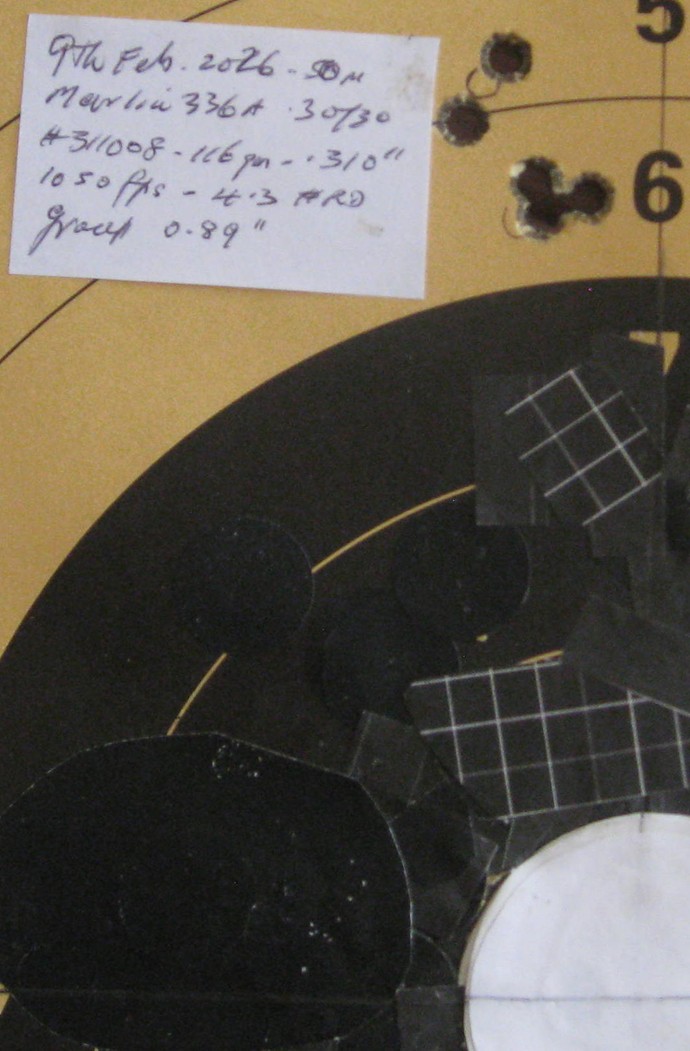
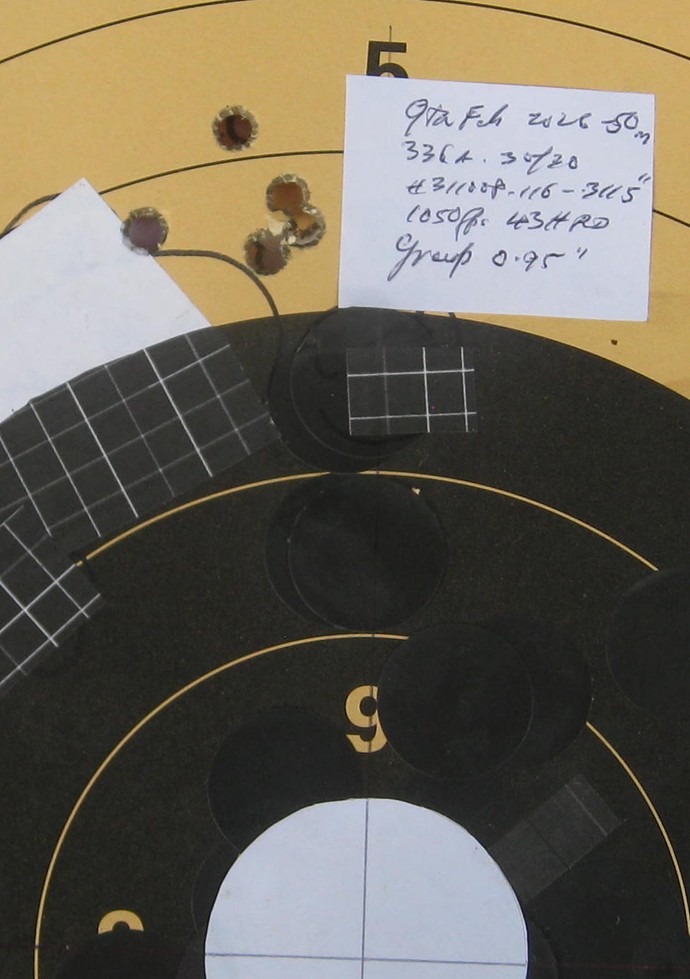


I have long considered #311008 subsonic to be my most accurate load for the Marlin. I use them for LAS Chickens and for our local Lever Action competition – paper targets at 100, 50 and 25 meters. Fellow shooters can’t quite believe that you can get such good results from very light loads of shotgun/pistol powder in .30-30.

You are only as good as your library.

Attached Files

Order By: Standard | Newest | Votes
sghart3578 posted this 11 February 2026

Outstanding!

Attached Files

Urny posted this 11 February 2026

That is great shooting and an excellent report.  Thank you for that.  

Attached Files

beemer posted this 11 February 2026

That's a good load. I have a Lee mold that I cut the gas check shank off to use in the 32 Colt I once had. It is about .311 and weighs 100 grains. I have been looking to do the same as you, now I have too.

I have a 1949 336A, one of my favorite rifles. I have shot .310 and .311 in my rifle, if there is any difference in accuracy I can't shoot good enough to tell. The rifle has a .309 bore, I actually reamed the throat a little as it was very short. I turn the outside of the case neck for this rifle, a .311 would drag in the neck area when chambered. It doesn't take much, leave about 1/4 of the neck untouched.

Read somewhere that the early 30-30 Marlin barrels were left over blanks from the 1903 barrel's they made in WW2. 

You mentioned case neck bonding, this is something I have wondered about. Can you tell any difference in fresh loaded and letting them set.

Attached Files

  • Liked by
  • Wilderness
Wilderness posted this 11 February 2026

Beemer

When you come to do your light loads, I believe that velocity is important, so use the chronograph. Make sure all shots are well below 1100 fps. This is about avoiding the transonic effect. A bonus is that your 200 meter groups will hold a similar angular spread to the 50 meter groups.

I haven't slugged the Marlin, but I do know that the shoulder is a bit forward, and chamber length is a whopping 2.150". I neck turn also, but only skim off the high spot plus catch the odd thick neck. This was to ensure compatability with .312" silhouette Ram loads. Necks are reduced to .010" thickness on the thick bit.

Re the case neck bonding I have only one certain instance of it affecting velocity and POI (Benchmark powder) and a maybe (very small difference) with the very light loads. There is certainly an observable effect when you try to pull bullets on older cast bullet ammo versus fresh loaded, or when you test by bumping bullets in a few thou more - no resistance fresh loaded but resistance then sharp crack on older ammo. "Older" can be as little as a few days. Type of lube can influence the outcome.

I did some investigating of neck bonding and published on Cast Boolits.

 https://castboolits.gunloads.com/showthread.php?428729-Cast-Bullet-Adhesion-in-Case-Necks

You are only as good as your library.

Attached Files

  • Liked by
  • muley
Close