.222 Rem Cast Recommendations

  • 660 Views
  • Last Post 01 February 2026
  • Topic Is Solved
Wm Cook posted this 25 January 2026

We're in the winter doldrums here in Missouri and it looks like the weather won't break for another couple, three weeks.  My critical projects are pretty much cued up and waiting on range time so I have some time to kill.

Back in early 2022 I was well into a jacketed bullet project using a Savage 10FCP-SR before I heard about the CBA and cast benchrest competition.  I was too far down the path on the first project before I figured out that I couldn't live without a rifle dedicated to cast accuracy.  So I bought a Savage FCP-HS (Production Class legal) and I've been shooting cast with that ever since then.  I finished the jacketed project in .222 Rem and, side by side, the two rifles are almost twins.  Both ride the bags the same.  Both have H-S Precision stocks.  Both are wearing Sightron's.  I shot twins back when I was shooting PPC competition and having two matching or nearly matching rifles as in this case is a real luxury. 

Since I was too far along to reverse course with the first project I finished that up with an H-S Precision stock, an after market trigger, glass bedded, other odds and ends and a 8 twist Shilen chambered in .222.   But since it came on line I've only shot a grand total of 255 jacketed rounds through it.  Its not seeing much use.  It shoots jacketed great and in competition I should be able to agg in the high .3's with it.  It just wasn't meant to compete against PPC's.  It was built to give me a rocking chair range rifle that was honest enough for me to compete against myself.

Having some time on my hands I'm starting to think about trying cast with it and having two rifles that are competitive in the Nationals.  I see a few folks shooting two classes in the Nationals so I guess that's a possibility.  I'd be shooting in the Heavy class with the .222 and getting my butt throughly kicked but that's ok.  I'd be shooting for the fun of it. 

The heaviest .22 molds I have are the Lyman 225425 FN 55g, NOE 225 FN 61 and the SAECO 60g #221 round nose.  My notes show that at some point I had figured out the starting point for the bullet to bore fit for the NOE and the SAECO.  I also looked at starting load data (Lyman #4).  Matching up what powders Lyman recommended and what I had on the shelf I was thinking about starting with Unique, 5744, N110 and Titegroup. 

I would appreciate it if some one could recommend some molds in the 60 to 80 grain range that are still being produced and sold.   I had been waiting for NOE to cut some more .22 for the past year but that never came about. 

Bottom line;

  • Does anyone cut heavy .22 molds?  I would like to find something in the 70 to 80 grain range.
  • Are there any powders that you might recommend? 
  • Are there any do's or don't regarding velocity expectations?
  • Is it possible to shoot two classes in the Nationals? 
  • How does bench rotation work in the Nationals?

Any and all help would be appreciated.  Thanks, Bill C. 

Attached Files

Order By: Standard | Newest | Votes
OU812 posted this 25 January 2026

Try your current moulds with soft alloy and 5 to 6 grains of Titegroup powder. The throat of your barrel is probably not eroded enough for larger bullet fit. I would enlarge and polish the lead using steel wool and lapping compound.

Attached Files

Wm Cook posted this 25 January 2026

Thanks, but wouldn’t a bore rider design offset any concerns about freebore length accommodating a longer (thus heavier) bullet like the NOE 225-72 RN B1?

Come to think of it, aren’t all heavy .22’s bore riders?

Thanks, Bill C.

Attached Files

MP1886 posted this 26 January 2026

You're correct about the borerider, prividing it slips into the bore and not loosely.  Thing is you said the rifle is a 222, it may not have a fast enough twist for a 72 grain bullet you mentioned. 

Attached Files

lotech posted this 26 January 2026

The only .22 mould I have is the Lyman you describe and I've had it for forty or more years. I've yet to develop an interest in cast bullets in .22 centerfires, but did try a few loads with the Lyman design you described in a .22 Hornet and a Sako .222 years ago. I sized bullets of app. Lyman #2 alloy (57 grs,) at .225" and used 2400 and IMR4759 for loads developing app. 2200 and 2400 fps respectively. 

Unless you're wanting to shoot low velocity loads, I'd work with 5744 first, even with the heavier bullets you intend to try. Your 8" twist barrel may be optimal for such bullets. 

You might check the Accurate moulds catalog; they might have something close to what you are looking for. 

Attached Files

Wm Cook posted this 26 January 2026

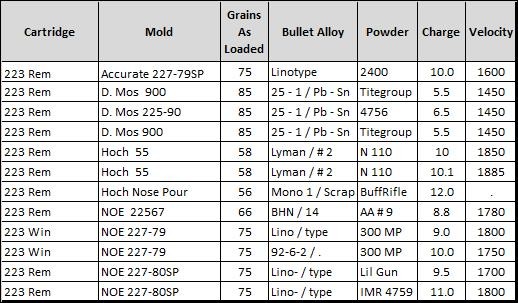
Thanks for the link.  I had found their 65 grain but the 75 that you linked to was what I was looking for.  Anyone have any notions about powders and starting loads, velocities?  From the last 5 years of Nationals I got the following.  Thanks, Bill.

Attached Files

Lucky1 posted this 26 January 2026

Hi Bill, I'm the Hoch user in the previous post. My experience was that the N110 was far easier to meter and use in the 223 than Buffalo or 5744. We have also moved to the Noe227-79 to buck the wind a little better. I know you can't order a new one yet but it seems like they are trying to restart; or a used one could show up. The 72 grain NOE has not worked very well in any small bore of mine. It's baffling because it looks like a mini 299. The link to the bore rider from MP does look good and I might even try it. Good luck!

Scott Ingle

Attached Files

Wm Cook posted this 26 January 2026

Thanks Scott. I ordered the 75g MP and true to my past purchasing experience with MP, I received my DHL shipping notice this morning and it’ll be delivered the day after tomorrow.

John’s (MOS) 79 grain was my first choice and I had been waiting for it become available for the past two years. I was hoping that they might start accepting group buys, but even if they did I’d expect we’d be hard presses to find 20 shooters that would need that particular mold. And that nose punch must be even harder to find.

The chances of that turning up used will be next to zero.

Even though I have about 5lbs of 5744 left on the shelf I’ve held off using it. It shot good with my .308 but there’s lots of unburnt kernels that peppered my chronograph. And to boot, both that and Buffalo are out of production. That leaves N110 that’s both available and affordable. I got a jug of that to shoot 200 grain bullets in my .308 with success. I believe John shot the Titegroup in 22 & 23.

If the heaven above is willing, I might be working on velocities with the MP mold next week.

Scott, if you’re still following this thread, what alloy would recommend. I’m set up to cast 20/1, #2 and Linotype.

Thanks again for the help. Bill C.

Attached Files

Tom Acheson posted this 26 January 2026

Not knowing the specifics on the 222 Rem., I’ve spent two match seasons shooting a 22 BR. The barrel is a 1:8 twist Lilja. The only bullet I’ve used is an NOE 227-79 SP weighing about 81-82 grains. The “best” two powders for accuracy were SR 4756 and WST. However, I also tried these…. Tite Group, 4227, 5744, 4198, 300 MP snd even some old W680.

Too bad Accurate molds doesn’t make .22 molds. (I did need to size the bullet noses small enough to enter the Lilja bore.)

FWIW

Tom

Attached Files

MP1886 posted this 26 January 2026

Notice the twist of Tom Acheson barrel in 222 Remington to shoot the long bullet he used. 

Attached Files

Wm Cook posted this 26 January 2026

“I did need to size the bullet noses small enough to enter the Lilja bore.”

And that might be the fly in the ointment since this is a new Shilen barrel. Just checked and I didn’t buy any of Al’s nose sizing equity for the .22. Just another reminder of NOE’s importance.

I use a nose sizer on my .308 & it’s the only thing that allows the rider to fit in the bore. All of my cast .30’s drop ~ .001 out of round. The out of round portion of the bullet dropping at .3035 won’t chamber unless I put them through the .300 NOE sizer.

The .222 is a one in eight so that’s not a problem. Thanks, Bill C.

Attached Files

Lucky1 posted this 26 January 2026

Bill, I gravitate to #2 or 20-30% monotype plus range scrap. I don't have a lot linotype on hand so I go to other choices. John didn't think linotype was necessary so I felt better. He does use Titegroup which I can't get to shoot well like he does. You are right about the nose guide on the NOE but Al had another bullet use that profile so I got one later. Otherwise it is push the base first. Another note: 223s are the only bullets I sort by weight. It seems to make a difference where a grain means a percent difference. I get an occasional wild one so I'm going to make sure the gas check is absolutely square. By wild one I mean a couple of inches from the other 9. There is an article on, 'why the 223 makes me cry' or something like that. I sympathize with that. I have also had fair results from AA9 and TAC too. Easier to measure compared to Buffalo. Let us know how the MP mold turns out on the range. It looks good on paper so hoping for the best.

Scott Ingle

Attached Files

John Carlson posted this 27 January 2026

The article on shooting 22cal cast is "Why Grown Men Cry".  And yes, I have the same rifle John A has, I've plagiarized his loads, but I've never approached the performance he has achieved.

John Carlson. CBA Director of Military Competition.

Attached Files

OU812 posted this 27 January 2026

Lots of members would be willing to send you free bullet samples if you requested. Always strive for 1/2" groups during testing so that shooting consistent 1" groups will be easy.

Attached Files

Premod70 posted this 28 January 2026

Having messed with a .223 Remington, a close cousin of the .222 Remington, I will throw my 2 cents in the discussion.

My Winchester 70 has a 1-9 twist so I settled on NOE's 227-79SP mold for a match bullet. As usual the smaller the diameter of the bullet the more pickier one has to be for a consistent bullet. Once casting was mastered as best as I can I lubed all the bullets grooves with LBT sized to .225 and proceeded to work up a load. I tried every IMR powder from 4227 to 4831 and found 3031 shot the best at 2040-2060fps. After match prepping the brass and seating depth I shot groups of ten and could never get one that didn't have a flyer or two.

After doing a visual of the bore's fouling between the test groups I saw more powder fouling than I thought was good for consistent accuracy. In my opinion the smaller the bore the more critical the residue remaining has for a good bullet passage on being fired. Having read about hydraulicing and it's effects on the bullet I tried reducing the numbers of grooves I lubed and at the base groove I did see a little improvement on the flyer's distance from center. At the first match the flyers were there and the scores suffered. I finally contrived a wash of lube mixed with mineral spirits and gave it a try hoping no leading would be in the bore. Success was made but to no great degree but enough to justify shooting another match but as my eyes weakened I put the rifle aside and went back to the seeable thirty caliber. If I ever get my cataract removed to see the target I will certainly give the .22 another try,

Dale Flinchum

Attached Files

Lucky1 posted this 28 January 2026

I agree with Dale and the rest. Those stinking fliers in a 10 shot group are aggravating. Also lubing less as well. And 1900 to 2000 fps was kind of my sweet spot too. But the thing that made 223s possible to even try was getting a Target vision or equivalent so you can see those teeny bullet holes; especially at 200 or days with much mirage. A scope just doesn't cut it sometimes.

Scott Ingle

Attached Files

  • Liked by
  • John Carlson
John Alexander posted this 01 February 2026

Some miscellaneous comments on shooting 22 cast bullets.

They aren't some other kind of animal. The same principles that work for 30 and 45 work for 22.

22 bullets don't have to be perfect. I never sort by weight, bullets with small wrinkles seem to shoot aa well as unwrinkled.  I am in the midst of a long running experiment that seems to indicate that even the hallowed base of the bullet can be less than perfect without making a difference you can prove with groups. If this turns out to be true, I'm sure it's true of other calibers as well.

Long bullets are easier to shoot well than short bullets. You don't see 110 grain 30 caliber bullets at matches for a good reason.

55 grain 22 bullets have the same sectional density and thus the same possible BC as 110 grain 30s. 

I competed in the 1980a with a custom 72 grain bullet that shot as well as any of the current HR competitors are doing with any caliber.  (much later NOE made a similar mold.) I often won aggregates at 100 yds at the nationals, but if there was any wind at 200, and there always was, my wind coping skills weren't up to the task. The custom 75, 80, and 85 grain pointed custom molds I used later seemed to reduce that disadvantage -- a lot. One problem is that most custom mold makers can't, or won't, make a 22 mold, much less a pointed nose  22 mold.

The advantages 22s do have over larger calibers, easier to shoot, less punishing recoil, less muzzle blest, less twisting of the rifle, etc, are all pretty much nullified by more rifle weight so 22s are probably never going to be a good choice for heavy or unrestricted class guns.

John


Attached Files

Close