
I have slug measuring .31325" after slugging it through my SKS. The best measurement is .314". I chamber cast the SKS also. The chamber measured .32670". The next widest was .32600". Should I size my cast bullets to .314" or .326"?
What bullet diameter should be used
- 133 Views
- Last Post 4 hours ago

Aaron
posted this
14 hours ago
I would suggest .314 which is an available commercial die.
With rifle in hand, I confidently go forth into the darkness.
Attached Files

Idahocaster
posted this
14 hours ago
Maybe size the bullets as large as will easily chamber in a loaded round.
Attached Files
- Liked by
-

-


Duane Mellenbruch
posted this
13 hours ago
As you increase the diameter of the driving bands of the cast bullet, you might be aware of the need to expand the case mouth to avoid squeezing down the cast bullet when seating and crimping. An M type of expander plug of the appropriate size would be suggested, after you find the best fit of the bullet to groove in the barrel.
Attached Files

Wm Cook
posted this
9 hours ago
I'm easily confused so I apologize if this is off track but the OP was about sizing the cast bullet. I believe the question is asking for what size die should be used in the lube sizer and maybe not nose sizing. But first off a hats off to Bjung for chamber casting the chamber of an SKS. That task is a pain in the butt.
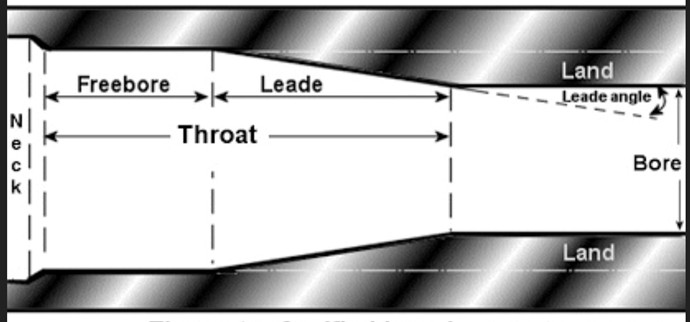
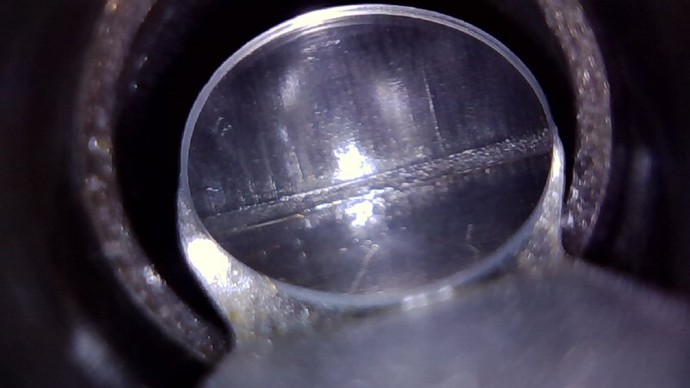
Determining what dimension to size the driving bands is driven by the free bore dimension you should be able to get from the chamber cast (attachment 1). for the 7.62, in theory, that could be anywhere between .310 and .315 depending on how loose the cut was. If the bullet is sized larger than the free bore diameter (lets assume the cast made shows a free bore of .312 and you size it to .315) you'll scrape alloy off the driving bands as the bullet leaves the case and enters the free bore (attachment 2). There's no hard rule on this as far as I know but a tight squeeze fit to free bore (I believe J Carlson runs his driving band all the way to the lands in his competition loads) is warrented. To a degree, measurements in the hundredth of the thousandth can be rabbit hole. Most cast bullets are out of round. Between cross mold seam and in line seam you can see as much as .0015 difference. Mold/alloy temperature and alloy type can give you room to tweak the final dimensions of the bullet. This is more a topic for bore rider designs where the goal is to maximize the bearing surface.
The ~.313xx bore diameter would be a focal point if the mold were a bore rider design. My guess is that since bullets are more of a lighter weight for the 7.62, so bore riders may not be the norm for you. More common to the 7.62x39 is that the bullet will have an olgive to kiss up against the lands. Ogives can be secant which is an elongated shallow curve as with VLD bullets (not for a 7.62) or a tangent ogive which is a shorter rounder nose that has a with a clear tangent point where the ogive meets the full diameter of the shank and the lands typically contact right near that tangent point.
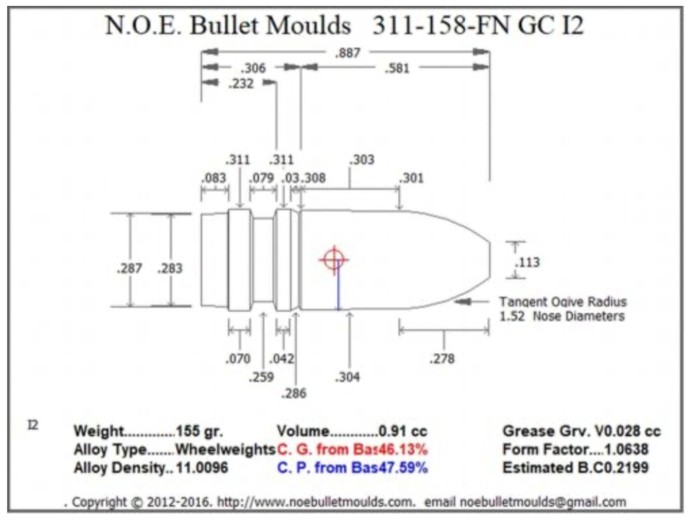
I believe the most renown mold design for the 7.62 was C.E. Harris's 52A (early 70s) that was cut by NEI (appox 150g). Since then Lee produced a "Buck Rogers" similar to this with a longer pointy nose that may or may not run through your magazine. Probably will. It didn't fit my Ruger Mini 30. A second option is NOE 158g which has a blunter nose and feeds well in most anything (attachment 3). Of the two I would recommend the NOE. In the perfect world you would cast some of whatever mold you use, lube the nose and lightly tap it into the muzzle leaving the driving bands exposed to pull it back out to see how much bite the lands have.
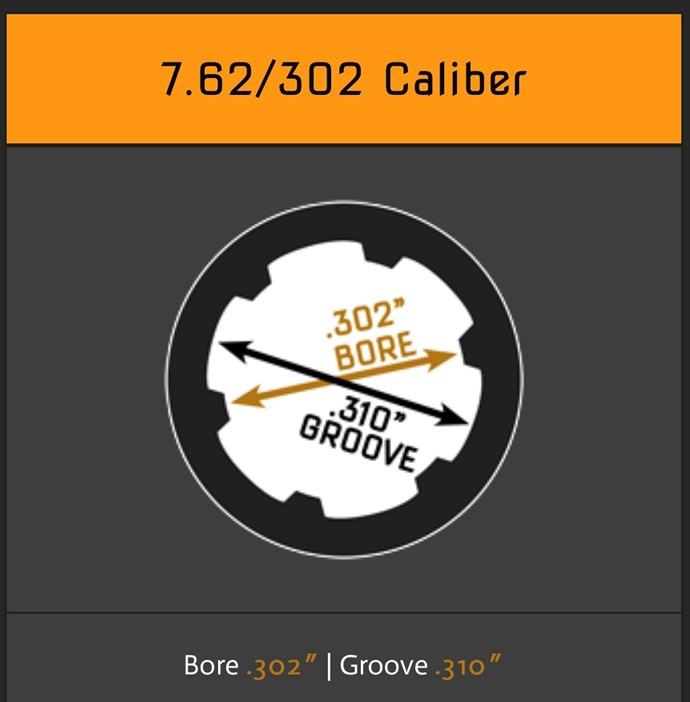
Determining cartridge over all length with a semi is doable as well. Seat a bullet with a modest grip on the bullet. If you're using bushings just go a couple thousandth larger than normal, if full length sizing just partially size the neck enough to grip the bullet. Seat the bullet .030 or .050 long and close the action smoothly to force the bullet back into the case after it reaches the lands. Do this a couple three times and if everything looks copasetic and it fits your magazine you have a starting point for your cartridge over all length. Function through the action may be more important than jockeying COAL trying to shoot MOA with an SKS but at least you have a variable to work with (attachment 4).
I'm not sure what the .32670 / .3260 measurement refers to. Possibly the diameter of the chamber where the brass neck resides? Hope I didn't distort your question greatly. Bill C.
Attachment 1
Attachment 2
Attachment 3
Attachment 4
Attached Files

pat i
posted this
5 hours ago
Size it .314. If what you're saying is the chamber neck measured .326 on your chamber cast I suspect something's wrong. I'd expect .344 or something in that range.
Attached Files

MP1886
posted this
4 hours ago
The standard measurement for the neck area of the chamber for a 7.62x39 is .399. How is it your's is .326? Are you sure the .326 isn't the freebore? How are you measuring all this? The best way to measure it is with a pound cast using pure lead.
Attached Files
Categories
- All Categories
- General Polls
- Contact Us w/ Forum Issues
- Welcome to The Cast Bullet Association Forum
- General
- Bullet Casting
-
Guns and Shooting
- AR Platform
- TC Contenders & Other Single Shot Handguns
- Shotguns
- Informal Matches & Other Shooting Events
- Gunsmithing Tips
- Gun Cleaning & Maintenance
- Optics
- Benchrest Cast Bullet Shooting
- Military Bench Rest Cast Bullet Shooting
- Silhouette Shooting
- Postal Match Cast Bullet Shooting
- Factory Guns
- Black Powder Cartridge
- Hand Guns
- Lever Guns
- Single Shot Rifles
- Bolt Action Rifles
- Military Surplus Rifles
- Plinkers Hollow
- Muzzleloaders
- Hunting
- Reloading
- Buy, Sell or Trade
- Other Information & Reference
Search
This Weeks High Earners
-
 Ed Harris
12
Ed Harris
12
-
 Idahocaster
7
Idahocaster
7
-
trapdoor4570 6
-
 Aaron
5
Aaron
5
-
Lucky1 3
-
Proneshooter2 2
-
CajunRebel 2
-
gnoahhh 2
-
beagle6 2
-
 Bud Hyett
2
Bud Hyett
2


