Internal Ballistics & Accuracy

  • 926 Views
  • Last Post yesterday
Wm Cook posted this 3 weeks ago

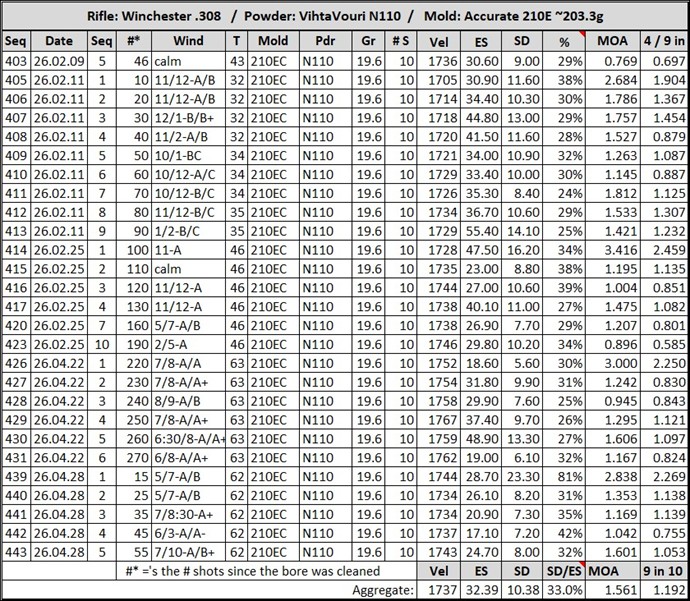
I'm always working on ways to shrink my group's.  To give you an idea of where I am, the last 27 groups had an aggregate of 1.561.  Thinking that there's always room for improvement I started to work with the data I collect. 

One thing led to another and I found myself looking at extreme spread, standard deviation and thinking about all of the things that happen under the heading "internal ballistics" when a half filled case of powder starts to burn.  

The question is whether anyone has ever studied, and has data on, things such as the powder's position within the case and its correlation to accuracy. Another would be bullet to bore fit. Plus …….???   Thanks, Bill Cook.

Attached Files

  • Liked by
  • Wilderness
Order By: Standard | Newest | Votes
Aaron posted this 3 weeks ago

I believe one would go insane attempting to codify all of the variables.....which are themselves....variable. Our PMI at Quantico gave us the formula we needed to keep our sanity. It's hit probability and based on only three things. 

1. Precision equipment

2. Shooter capability

3. Ammunition

A highly trained shooter (me) has a xx% chance of a precision strike at xx range, with xx ammunition (match ammo) and a precision platform. We had to know our platform capability, we had to know the limits of our training (capabilities), and we had to know what ammunition we were issued to dope the rifle properly.

When you know with 95% probability that you can place a bullet on the tip of a nose at 600 meters with Winchester commercial match ammo, who gives a heck about internal ballistics or powder grain orientation within the case?

If it shoots well, keep on doing what you are doing.


With rifle in hand, I confidently go forth into the darkness.

Attached Files

  • Liked by
  • RicinYakima
Wilderness posted this 3 weeks ago

Bill - take this with a grain of salt, since it was last century and not at the level of precision you seek.

This was with lever action .32-20 and .30-30 rifles with loads of mostly shotgun powders taking up a minor part of the powder space. For the competition I was shooting I had the option of elevating the muzzle before shooting.

Records are long buried, but what I do remember clearly is a lift in velocities (both cartridges) of about 100 fps when powder was shaken back against the primer by elevating the muzzle. Powder-forward and powder-level gave about the same velocity, so it was only the powder-back condition that was different. POI was higher for the higher velocity.

For what I shoot now, I go with powder more or less level, as determined by feeding from the magazine.

For near full loads even, e.g. in .218 Bee, I have noted some velocity and POI effect.

By contrast, my Ruger 77V .308 seemed to be nearly immune from POI changes with (intended) velocity change. Perhaps this is why some bolt action users claim that SD has no bearing on group size, but it [Edit: Or at least ES] certainly matters for the Levers.


You are only as good as your library.

Attached Files

  • Liked by
  • Glenn R. Latham
  • MarkinEllensburg
Larry Gibson posted this 3 weeks ago

Wm Cook

Excellent compilation of data.

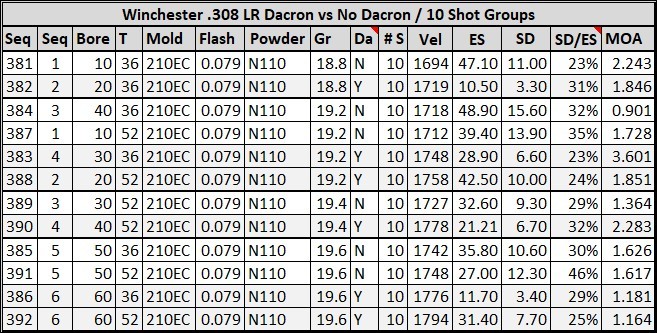
I've been chronographing loads since the early '70s with Oehler chronographs.  I came to the conclusion after many such chronographed test, both jacketed and cast bullets in rifle cartridges, there is a direct correlation between the SD and ES.  Given all other things being equal, the best and most consistent accuracy will be when the SD is in the range of 25- 45% of the ES.  Your data confirms that. 

Back 18 or 19 years ago after I had been measuring pressures and othe internal ballistics via the m43 PBL I had a conversation with Dr. Oehler regarding such.   He asked if I had seen any accuracy anomalies with groups where the SD was really low out of the % range.  I said I had and most often with 10 shot tests having low SDs and a much higher ES there usually was 1 or 2 shots out of the group.  He said that's because the low SD out of the 5 range is telling you something is wrong with the load.  He advised not to chase the SD god but look for the % balance between the SD/ES when corroborated by the group size.  And so, thousands of tests since then have confirmed Dr. Oehler's advice.  

I would reiterate what Aaron lists.  A small balanced SD/ES is no guarantee of accuracy.  A small SD/ES cannot make a silk purse out of a sow's ear.  If the rifle is not capable, if the shooter is not capable and, in particular a quality bullet is not capable then the SD/ES will not make for an accurate load.  For example; in my Savage m12 Competition rifle with a 29 1/2" Palma barrel with 13" twist I shoot a Sierra 150 gr MK right at 2900 fps accuracy is sub moa [last group was 2.25"] for 10 shots at 300 yards.  The last 10 shot test had an SD of 15 fps and an ES of 57 fps.   Substituting a 150 gr M2 Ball bullet give the same velocity, basically the same SD/ES but a group size at 300 yards of 10 - 12".  The difference simply being the quality of the bullet.  

Ergo, if we have an accurate rifle, if we have a load compatible with the rifle, if we have a quality bullet [the quality of the bullet is most affected by exterior ballistics] and we can shoot then searching for an SD that correlates properly to the ES is well worth the effort. 

Your Seq 439 definitely demonstrates when the SD/ES are out of balance the accuracy suffers.

LMG

Concealment is not cover.........

Attached Files

Ed Harris posted this 3 weeks ago

Excellent summary Larry! This discussion would make a great FS article.

73 de KE4SKY In Home Mix We Trust From the Home of Ed's Red in "Almost Heaven" West Virginia

Attached Files

  • Liked by
  • John Carlson
Wm Cook posted this 3 weeks ago

I would reiterate what Aaron lists.  A small balanced SD/ES is no guarantee of accuracy.

And I would agree with both you and Aaron.  Data can be misleading and this may be a case in who's reading the numbers and what side of the fence they want to be on.  For the record I never considered small SD/ES necessary for accuracy.  I've been loading with the intention of shooting one hole groups for 30 years and this is the first time I've come across this.  I'll try my best to explain.    

  • 1) (see chart below) The aggregate of all 27 groups looks clean and there's not much to dispute.
  • 2) I consider the first group on each of the four trips to be an anomaly and contaminated the overall data gathered.  These four "first group" numbers had a MOA of 2.985 where the remaining 23 groups had an average of 1.313 MOA.  With such a disparity I drew the conclusion that something was corrupting the first group on each trip.  There is no other conclusion to be drawn but to believe it was the shooter, not the load.  There explanation may come from sloppy chambering of the rounds in the initial 10 - 15 shots fired.  So for now allow me to discard the first group from each trip and drill down on the remaining 23 groups.  I believe that there 23 groups are enough data points gathered that it could still be considered statistically valid.  I think.  There are those of you out there that could tell me if I am right
  • 3) The remaining 23 groups had an MOA of 1.313 and it looks clean enough.
  • 4 & 5) Breaking down the 23 groups into those that had a single digit SD (12 groups) and those that were double digit (11 groups) brought out something that, with the number of groups shot, appears to show that there was a probably of 3 out of 4 groups would shoot under 1.250 and that those that shot double digit SD (10 - 14.1SD) there was only a one in 4 chance of being under the 1.250" high bar I've set to be competitive in Production Class.  The only argument to the contrary is that there is insufficient data to draw such a conclusion.  And that may be the case.

Since I have never subscribed to low SD/ES = low MOA I find myself conflicted by drawing these conclusions.  The only argument I can make is that there is insufficient data points and more groups need to be shot.  Or if there is enough data to show that this rifle with this powder, bullet and shooter requires a low SD/ES and my work needs to turn to shrinking SD/ES to see if the theory is true.  At the tail end of this post I'll attach some work done this week looking at powder position within the case and its effect on SD/ES.

As I said, I have never seen the correlation between SD and accuracy.  I have shot hundreds and hundreds of groups in single digit that were more pattern than group. That said, its only been in the past few years that I've focused exclusively on cast accuracy.  Shooting cast accurately is a challenge.  

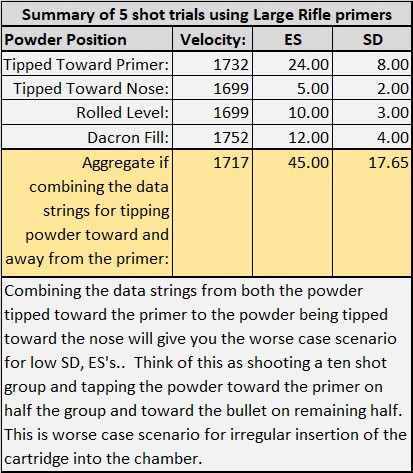
The following looks at powder position within the case.  Tipped toward the nose, tipped toward the primer, rolled level and using Dacron.  These are only 5 shot snapshots and it would be a stretch to make much of them.  The exception is if one combines the string data trom "tipped toward the nose" and "tipped toward the primer".  Combining those two are the only practical way to show careless feeding of the cartridge into the chamber. Taking the ES/SD of that combined string gives a SD/ES of .392. Not managing powder position in the case with this shooter, rifle, powder, bullet can negatively impact accuracy.

I can see this as a root cause for some of the results from the first groups fired on each of the trips.  It can happen, You have three or four shots left in the group, the condition are starting to wane and you hustle up and sacrifice precision loading.  My preference is to tap the powder to the primer and insert into the chamber but consistency in doing that in a precise manner is weak.  My next trip will fall back to what I had been doing in 23 and that is rolling the cartridges flat on my bench matt.

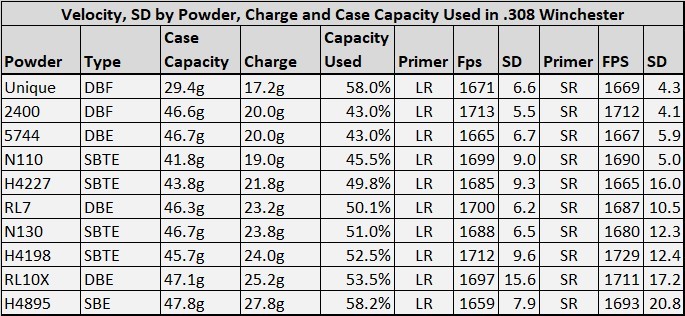
The subject of case capacity utilization comes up when you talk about powder position within the case.  Here's the data I have on the powders that are either commonly used with the .308 / 200 grain bullets or potential powders that fall in that burn range.

Attached Files

Larry Gibson posted this 3 weeks ago

As I reiterated what Dr. Oehler stated was not to "chase the SD god".  Simply striving for the lowest SD is, indeed, chasing the SD god.  That bottom chart chases the SD god and tells us nothing because it does not list the ES nor the number of shots and group size with each powder.

The chart with 5 shot tests positioning the powder differently for each test gives a good "snapshot' of correct proportion of SD to ES.  However, it also does not list any effect the powder position had on groups size and thus leaves little to conclude.  

The first chart provides us with excellent information.  Especially noteworthy are lines 3, 4 and 5.  They show an excellent correlation between the proportion of SD to ES as related to group size.  Does this mean that simply looking for the lowest SD will get ust there?  Absolutely not.  What will get you there is looking for a correct proportion of SD to ES that consistently gives small groups.  Again, the proportion of SD to ES with 10 shot tests should be in the 25 to 45% range.  The aggregate percentage of SD to ES of lines 3, 4 and 5 are right in the middle of the correct proportion.  If all the groups were shot with the same load [I'm assuming so as only the load at the top of the chart in the first post is mentioned?] then line 3 in this chart is the most meaningful data.

That said, along with the obviously quality cast bullets, the rifle used and Wm Cooks shooting ability to cast, load and shoot is why the groups aggregates are excellent.

LMG


Concealment is not cover.........

Attached Files

  • Liked by
  • RicinYakima
  • Wilderness
OU812 posted this 3 weeks ago

I can't constipated. Have you tried TiteGroup powder?

Attached Files

Wm Cook posted this 3 weeks ago

Much appreciated Larry.

“ However, it also does not list any effect the powder position had on groups…”

The btm chart wasn’t intended to associate anything with accuracy. It’s old data from a few years ago when I was starting to look at the case capacity for various powders and how LR differed from SR primers. No groups were shot for that chart or on the powder position (tipping forward and back) chart. All work was done in the shop.

What happens between the time the powder starts to burn and when the bullet leaves the muzzle is a fascinating subject. I’m not equipped for it but it would be a pleasure to get a greater understanding the effects of case capacity, burn rate, where and how much pressure builds in the barrel and their effect on barrel harmonics.

Vaughn commented in his book that barrel vibration was the largest contributor to rifle inaccuracy and, assuming you already have your other bases covered, I believe that to be true. Understanding that and continuing to log range time are my pastime. Thanks again. Bill.

Attached Files

Glenn R. Latham posted this 3 weeks ago

I wonder if the issue with the first group of the day being poor might have something to do with the rest and bags "settling in."

Glenn

Attached Files

  • Liked by
  • John Carlson
Wm Cook posted this 3 weeks ago

It could be the front & rear rest settling in and that’s on the table. I’ve been using this equipment or something identical to it for over 30 years, but you might be right.

I take the normal precautions like leveling the front rest, squaring the front rest to the target, aligning the front & rear rest, water under the rubber front rest bench protectors and under the rear bag, firmly seat the butt in the rear bag, tighten the ears on the front rest, baby powder etc etc.

Or It could be that the shooter’s fulfilling a self proclaimed prophecy and is expecting the first group to shoot big and its sloppy bench practices.

Just like with all the babbling I was doing about SD, I’ve never experienced anything like this. I don’t think they’re related so I set the first group anomalies on the back burner for a bit. But I have to defend the data. Those first four groups are twice as big as the other 23 groups. On a positive note I’m consistently bad on those first groups.

John Carlson mentioned that he taps the bullet on the action to settle the powder towards the primer. I’ve been trying to ingrain that as a principle to my bench practice when chambering but I’m inconsistent. When conditions hold after the first 5, 6 shots I slip up once in a while and start to slam and throw the cartridges into the chamber. Shooting jacketed BR for so many years has me nearly hardwired, when conditions are right, to dump the rounds down as fast as I can. The more I learn about shooting cast for accuracy, the more I’m thinking I need to do the opposite.

I thought Larry had a good idea about shooting four groups, one each, tipped to the primer, tipped away from the primer, rolled and one with Dacron.

The next trip is booked with other things like shooting another aggregate with the same load as I had been shooting and four targets with SR primers. The latter is just to finish up some work I started a couple years back.

The next couple three trips out will be interesting. Thanks, Bill C

Attached Files

fa38 posted this 3 weeks ago

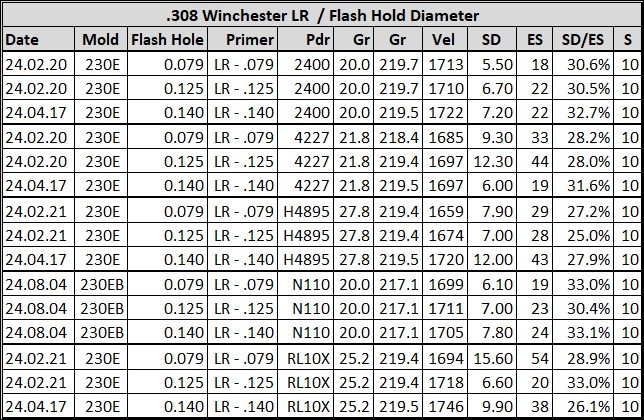
Did the ratios remain the same with the addition of dacron or enlarging flash holes?


Attached Files

Larry Gibson posted this 3 weeks ago

"Did the ratios remain the same with the addition of dacron or enlarging flash holes?"


Yes, the ratio range of SD to ES would, and has for me over the years, remained the same.

LMG

Concealment is not cover.........

Attached Files

Wm Cook posted this 3 weeks ago

This is the only work I've had with enlarging flash holes.  No targets were shot with the top chart, simply shop data.

Same, same with Dacron.  As we all know, one target means nothing.  I've been taught to repeat, repeat, and repeat in order to shake out the debris.   As a side note I'll add that I later found that the 19.6g load was the minimum charge to get it to group up.   Thanks, Bill. 


Attached Files

MarkinEllensburg posted this 3 weeks ago

No offense intended but shooter error is a reasonable cause for the first groups being poor. It sounds like you have more experience than I do shooting for precision. I have found that some of my best groups in a match have been in the warm up. It is possible that in my case there is a sweet spot in the warm up cycle of the rifle I shoot. It being a hunter class rifle and a carbine at that. As the barrel moves past warm to hot, accuracy may suffer. More likely shooter error causes loss of accuracy.

Great discussion Bill.

Attached Files

Larry Gibson posted this 2 weeks ago

That's very true Mark, given you are shooting an accurate load.  If you have an inaccurate load that throws flyers [maybe not by much but still throws them] then who knows.  That leads us back to having a an accurate rifle, quality bullets and being able to shoot before we can ascertain whether or not the SD/ES has any real effect.

The primary question asked was "is whether anyone has ever studied, and has data on, things such as the powder's position within the case and its correlation to accuracy."  It appears Wm Cook meets the three criteria, and his collected data has merit demonstrating a proper proportional SD/ES does effect accuracy.  That is, as you mention, if we can rule out some shooter error.   An interesting thread.

LMG

Concealment is not cover.........

Attached Files

  • Liked by
  • MarkinEllensburg
  • RicinYakima
Tom Acheson posted this 2 weeks ago

Intersecting variables, lacking specific definition… Match grade bullets Accurate rifle “Good” shooter

Every rifle is unique just as every shooter is.

I just shot a 200-yard match this past Saturday. Plain base cast bullets in a CPA single shot. If I failed to keep the same pressure of the rifle butt against my shoulder, the hit expanded the group size.

If I focused on the consistent pressure detail, the POI of the shot was closer to the others.

So I’m a believer in bench technique being at the top of the list, over all of the other minutiae. We can get those other details under control but without very consistent shooter behavior, things will never be as satisfying as they could be.

And, the one detail most of us, either intentionally or errantly, resist acknowledging….is ourselves.

My first CBA match was 1997. In my first 20-years of match shooting I used a Rem. XP-100, probably the most difficult CBA match gun category…due to the extreme difficulty in maintaining consistent grip pressure, shot after shot.

There is only one winner, the rest of us are just runners-up.

Tom

Attached Files

Wm Cook posted this 2 weeks ago

...shooter error is a reasonable cause for the first groups being poor....

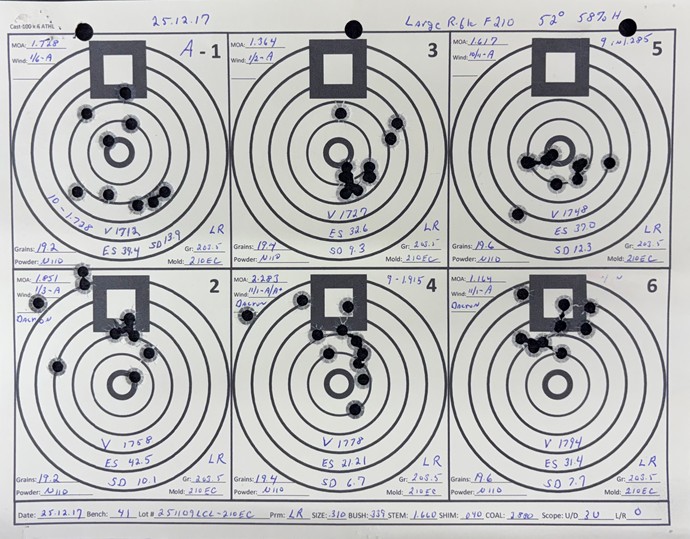
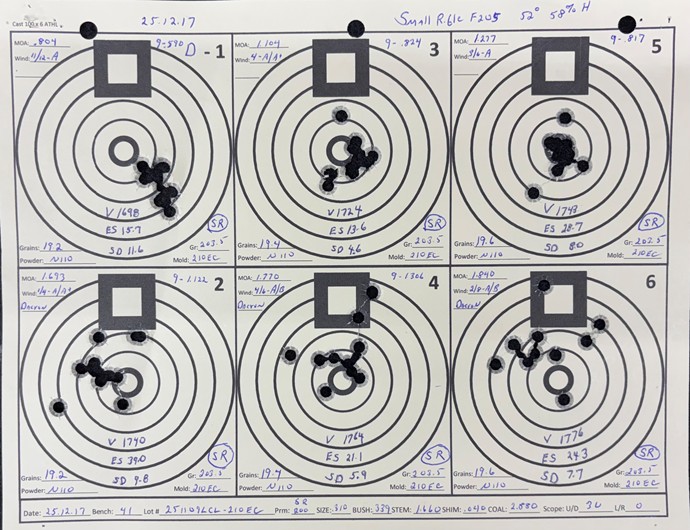
You're right Mark.  The 27 groups were from four range trips.  Of those four trips the first group from each had an aggregate of 2.985 and the remaining 23 groups averaged 1.313.  The previous attached target was identified as "A" meaning it was the first target/group set shot after my normal practice of putting two shots in the berm to foul a clean barrel.  Mark, at least for now, I can only blame the shooter.  Then again, maybe I have a very rare barrel and it's a one in 10,000 that needs 10 shots to settle down.  Being rare it's probably worth a great deal of money.  PM me if you're interested in buying.   

Attached is a target marked as "D" that was shot on the same day.  This target is not relevant to the question about powder position and its effect to accuracy since this was shot with SR primers.  But both were shot on 12/17 last year.  On this target (D) you can see that the first group on this target (actually the 9th group shot that day) actually "grouped" and didn't "pattern".  My records show that "D1" was shot after the barrel was cleaned and two other groups had previously been shot.  My records show that D1 were shots number 21 - 30 since the bore was cleaned.   Since February I've only cleaned the bore once (~270 shots) and I've seen no degradation of accuracy or improvement on the first group phenomena.  

As I said, I'm mixing apples and oranges here since this last target was shot with Palma SR brass and here I was comparing Dacron to No Dacron at the time.  And I'm clueless where the ES of 15.7 and the SD of 11.7 came from on this group.  It looks like a clerical error to me.  Is it even possible to have a SD of 11.7 with a minute ES of 16?  Like the above target (attached a few post back) the top row is without Dacron and the bottom row is with Dacron. 

Regarding the target that I've attached.  Here's another useless SWAG.  I believe that the lower intensity SR was compromised by the Dacron, where as the LR primer with its stronger primer blast was able to burn off the powder more rapidly giving the LR primer 46fps greater velocity, or in other words, more efficient use of the available energy.  Thanks, Bill C.


Attached Files

  • Liked by
  • MarkinEllensburg
Larry Gibson posted this 2 weeks ago

Another observation of mine after chronographing thousands of test groups since '73 shot out of match rifles, hunting rifles, military rifles, single shot rifles, lever action rifles, semi auto rifles and bolt action rifles is this; once the ES gets below 50 fps with a proportional SD within the correct range all the other variables such as bullet quality, shooter ability, conditions and firearm quality manifest in small group to group sizes.  When under that range of ES/SD measurement thinking one load is better simply because the SD is smaller can be wishful thinking.  When the ES/SDs are under that range then we must look to group sizes over multiple test groups to determine which load may be "best". 

I've found, with many rifles, when different such loads that produce excellent but similar accuracy the ES/SD can fluctuate back and forth.  Bottom line is once you get the EA/SD of different loads down to similar levels even the target cannot tell which is the "best" load.  Chasing the ES/SD is beneficial only with sufficient test sample [3 - 5 shots do not cut it nor does just one test] only down to a certain level with each firearm and load.  After that a difference of a few fps either way with the ES or SD is meaningless.

LMG

Concealment is not cover.........

Attached Files

  • Liked by
  • RicinYakima
  • MarkinEllensburg
Wm Cook posted this 4 days ago

The original data set in the OP had 27 points of data.  As explained above ad nauseam  the first group from each of the trips had an unexplainable aggregate of 2.985.  Eliminating those four groups left 23 groups with an aggregate of 1.313.  Of those that shot under 1.250 (arbitrary threshold for being competitive) 3 in four had a chance of beating 1.250 if the SD was single digit.  Those that had a double digit SD had a one in our chance of having a MOA less than 1.250.  If enough data points are collected, and in this case there were not, a conclusion could be reached that single digit SD is correlated to accuracy.  

A subsequent range trip had two objectives.  One was to shoot single digit SD's and the other was to isolate the reason for the first group shooting big.  

Results:

  • Internal ballistics and its relation to accuracy:  All rounds fired (15 ten shot groups, various charge loads, SR primers, LR Primers etc.) gave an average SD of 5.75 with a aggregate of 1.720.  Not one double digit SD was recorded.  Of the 15 groups only one in eight shot a MOA under 1.250, overturning the premature conjecture that single digit SD has an effect on accuracy and supporting the concern that there was insufficient data to make a judgement on.  
  • The first group determination to pattern:  Six of the 15 groups I shot this last trip used the standardized load that was used to collect the original 27 groups shown in the opening post.  N110, 203 grain Accurate 210E, LR primers.  Of those 6 groups not one shot under 1.250.  The aggregate for those 6 groups was 1.890. What was different between the original data set with its 27 groups and this range trip was that I loaded at the range.  This imposed a 15 to 20 minute lag time between each 10 shot group which more realistically represented match conditions. 

This will be hard to explain but I'll try.  Shooting consecutive multiple 10 shot groups without letting the barrel cool (ambient temperatures ran from 30's to 60's) shot a smaller MOA than either the first group from each of the four original trips or any of the groups that were loaded at the range on this last trip.  There are a finite number of variables that could have contributed to this; the powder, the lube or the barrel.  For now I'm going to set N110 aside and work with 4227 or 4895.   

I'd like to start a post discussing powders and their unique behaviors.  I've seen dramatic effects on accuracy when certain conditions are met which, I think, can be directly attributed to powder and its conditioning of the barrel. 

  • 1)  N110's seems impervious for the need to clean the barrel.  Using N110 and the 19.6 load, the aggregate of shots 220 to 270 (since bore cleaning) had a 5 group aggregate of .943.  Just to emphasize, these were ten shot groups shot consecutively from a warm barrel.
  • 2) After 50 shots of N110, using 5744, shots 51 through 60 shot a 1.066 group.  Immediately following the 1.066 group the next group, again using 5744 and an established load, was stopped after 5 shots when I saw it was already exceeding a 3.000 group.  From my previous experience with 5744, groups start to pattern somewhere between 30 and 40 shots. 

Thanks for listening, Bill C.  

Attached Files

Aaron posted this 4 days ago

Excellent data compilation! A lot of theory can be gleaned from it. Great discussion too. Fantastic thread and input. Thanks!

With rifle in hand, I confidently go forth into the darkness.

Attached Files

Show More Posts
Close