
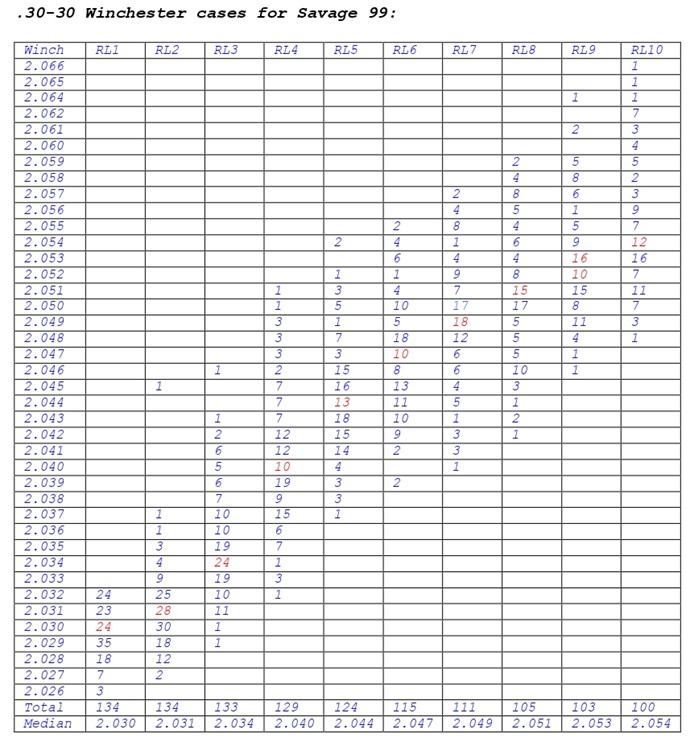
I was a while ago given a batch of once fired Winchester headstamp .30-30 brass. Out of interest, I have been monitoring case length through successive reloads.
A requirement for this observation was that there be no case trimming. Nor were cases crimped or belled. Neck expansion for cast bullets was with the Lyman M Die. Case mouths were deburred. Apart from crimping, mouth evenness, or OCD requirements, there should be no need to trim .30-30 cases. Most .30-30 chambers are excessively long to the point where a case could never grow to that length without breaking. My Savage chamber is 2.120” and my Marlin 336A Rippletop chamber is 2.150”.
Cases were fired in a Savage 99 first with full power jacketed loads (748 & LVR), then with full power cast loads – 175 gn HPGC bullet at 2200 fps (748 then LVR). You can see the transition to LVR cast (lower pressure) where the stretch becomes a little less.
For the first reload, cases were shot with headspace circlips to ensure that cases would in future headspace on the shoulders, not the rims. Median case growth for the forming shot was just .001". I suspect that lengthening of the case in general was offset by shortening of the shoulder area from the blowout. Thereafter cases have been partially sized in the Lyman FLS die to the point of a slight nip when the action is closed. Backing off the die is only slight, gap between shell holder and die being .025” (feeler gauge). Neck sizing only was not an option with full power hunting loads.
Case loss thus far (after nine reloads) has been from lost-in-the-grass plus some pin holes and small splits in the shoulder. There has so far been no external sign of incipient case separation, though I am watching several cases that are developing the tell tale internal circumferential shadow. This is a hunting application, so some accidental case loss is inevitable.
I check my cases before reloading, including getting bright sunlight down inside the case. I also keep a Marbles Broken Shell Extractor in my kit, though I have not used it on my own rifles for at least 40 years. If you watch for the signs, and cull as necessary, you don’t get broken shells. Culling a whole batch strikes me as profligate when the problem shells can so easily be identified and dealt with as they appear.
Measuring case length is tricky, especially if the mouths and heads are a little uneven. Three successive measurements can give three different answers. I measure with a vernier using the snap gauge method. This gives the same answer every time. If a case passes 2.051” but hangs on 2.050”, I call it 2.050”.
I have noticed that some cases lengthen at a more rapid rate than others, and this also is quite variable – a few cases in the batch may not grow at all for one shot, while others grow .010” or even more. This lengthening is also uneven – perhaps .010” on one shot and nothing on the next.
From previous observations I am expecting the cull rate on my cases to pick up from about the mid 2.065” range, and I’ll be surprised if any make it much past 2.070”, though that might be quite a few reloads for the cases at the bottom of the table.
Herewith results so far.
You are only as good as your library.
.jpg?width=20 "Urny")


