
I have discovered that laoding concentric cast lead ammo to be more difficult than jacketed. Mainly because of cast bullets being less concentric than a jacketed swaged bullet. Is there a way to size cast bullets more concentric without swaging in form die? I hear that sizing a cast bullet in steps will help create a more concentric cast lead bullet that will not bind when chambered. Or maybe not sizing at all ? This would work best with plain base bullet, because a Gas Check bullet must be partially sized to crimp on check. Wouldn't a perfect fitting plain base bullet be more accurate, because of no sizing involved?
Concentric Rounds
- 13K Views
- Last Post 25 September 2014

onondaga
posted this
12 September 2014
You make statements that are very debatable and don't lead anywhere.
"I have discovered that laoding concentric cast lead ammo to be more difficult than jacketed"... A poor job can be done with either kind of bullets. Collet Neck sizing brass corrects concentricity as well for either.
"Mainly because of cast bullets being less concentric than a jacketed swaged bullet. Is there a way to size cast bullets more concentric without swaging in form die?"..... Cast bullet concentricity does not have to be poorer than jacketed. Good quality molds and sizing dies are available. Cast bullets sized correctly for the chamber throat will be sized again by the chamber leade and bore. They won't get a poor wobbling start if they are sized to a slip fit to the chamber throat.
” I hear that sizing a cast bullet in steps will help create a more concentric cast lead bullet that will not bind when chambered."....If you have bullets that bind in the chamber, they have been sized and loaded incorrectly. You can correct that with bullets sized to a slip fit and loaded carefully.
Or maybe not sizing at all ? This would work best with plain base bullet, because a Gas Check bullet must be partially sized to crimp on check."... Not sizing at all is fine if the bullets drop the correct size for a slip fit. Gas checks are sized to the same size as the bullet is sized with push through dies. If checks are only crimped and smaller or larger than a partially sized bullet, you should expect seating and concentricity problems.
"Wouldn't a perfect fitting plain base bullet be more accurate, because of no sizing involved?” ....Perfect fit is perfect fit whether sizing is involved or not.
None of my answers or comments are new news in cast bullet use. You seem like you may be hoping to make a decision or hoping for an answer to a question that you have not asked. What do you really want to do or what are you searching for ?
Gary
Attached Files

fa38
posted this
12 September 2014
The Redding Competition Bullet Seating Dies work very well in reducing case/bullet runout.
Attached Files
onondaga
posted this
12 September 2014
The basics important to concentric case/bullet relation for cast bullets can actually be done well with any reasonable dies. Case mouth chamfer, de-burr, and flare are the basics for seating cast bullets well.
Those done well and gentile seating will self center bullets to the case by the mouth flare and not tip or shave the cast bullets.
The Lyman “M” dies have features to mouth flare and expand case mouths that can also help with concentricity.
Brass cleanliness particularly helps me too. The Frankford Arsenal Neck Lube kit I use has a set of caliber nylon brushes that scrub powder fouling and tumble polishing grit out of case necks and apply powdered mica. The bullets slide in without a hitch better, but the kit does not lessen the importance of chamfer, de-burr and mouth flair.
Most seating dies have followed the example of Lee and don't push on the nose tip of bullets but have a tapered hole that engages the ogive to seat bullets. Nose pushing seating dies can and do effect concentricity by allowing bullets to tip right at the start of seating and they don't center up on the ogive like Lee seating dies originated.
Press setups that don't lock up but float the die heads, turrets and dies allow self centering better than zero wiggle presses do. Dillon tool heads float if you don't lock them tight with their pins, Lee turrets float, Lee dies float on “O” rings, Coaxial presses float dies. The presses with these features improve concentricity of bullets to brass. The presses that lock up tight and brag about zero wiggle DO lock manufacturing error into any concentricity error they are locked into.
My opinion is that Lee Turret presses and Lee dies set correctly snug and not locked up but floating on “O” rings produce the highest concentricity achievable, bar none, regardless of price or famous name brand.
Gary
Attached Files
OU812
posted this
12 September 2014
<user=562>fa38 wrote: The Redding Competition Bullet Seating Dies work very well in reducing case/bullet runout. The Redding only accepts .3085 diameter bullets and redding will not machine die to accept larger diameter .3115 bullets. Forster will machine their inline 308 Winchester seater to accept the larger .311 seater stem (303 british). My main question was “how do you size a lead bullet more concentric with less tilt"? Here is Forster seater 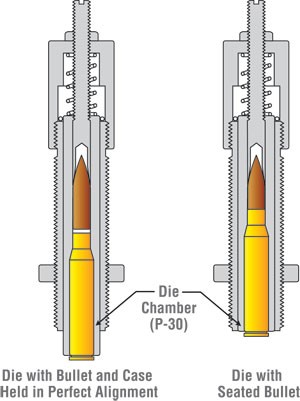
Attached Files
onondaga
posted this
12 September 2014
"My main question was “how do you size a lead bullet more concentric with less tilt?”
My best answer to that is; you will have to design a cast bullet sizer that works better than the push through bullet sizing dies in the Lee Lube and Size Kits that base push cast bullets through a polished tapering self centering die to size them. Also realize that cast bullets are too soft for reliable concentricity measurements with rotational concentricity measuring tools and that the feel of chambering contact slide for the bullets is a more valid test for cast bullets.
Bear in mind that there are no studies that show zero error in cast bullet concentricity is any improvement on bullets that just fit the throat well with a contacting slide on chambering so they can start off well without a wobble when fired. You are likely grasping for an unreasonable and unreachable goal with cast bullets. They respond, measure and work differently than jacketed bullets do.
The perfect alignment shown in your diagram is not valid for cast bullets. That setup will not allow case mouth flare in the seating die for self centering of bullets upon seating. Cast bullets respond differently than jacketed bullets during seating and require different brass preparation for the concentric seating of cast bullets. If the die pictured allowed case mouth flare, it would work well for cast bullets but the die would then be horrible for jacketed bullets and allow brass to tip off center when case mouths are not flared to fill the die and center the brass. This is a part of the science of jacketed bullets that does not work with cast bullets.
Gary
Attached Files
fa38
posted this
12 September 2014
I think the answer to a concentric bullet is to size the bullet and then run it thru a bump die in the shape of your bullet.
Then to load that bullet you should do case prep. Neck turning, button neck sizing, flash hole reaming, primer pocket reaming and straight line seating.
When I do all that stuff half the time I still can't hit what I want or shoot that small group.
Attached Files
OU812
posted this
13 September 2014
<user=562>fa38 wrote: I think the answer to a concentric bullet is to size the bullet and then run it thru a bump die in the shape of your bullet. Then to load that bullet you should do case prep. Neck turning, button neck sizing, flash hole reaming, primer pocket reaming and straight line seating. When I do all that stuff half the time I still can't hit what I want or shoot that small group. Here is a 30 caliber sizer that would work very well with bore rider designs. I just wish I had a lathe to make one.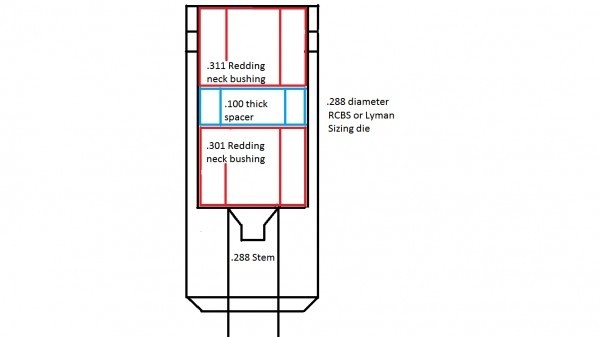
Attached Files
OU812
posted this
13 September 2014
Today I placed my order for the Forster inline seater (308 Winchester)that will be machined to accept the .311 seating stem. This Forster option was less expensive than the Wilson .312 inline seater option.
Belled cases fit my Redding inline seater, so I see no reason why they will not fit the Forster. I will let you guys know how well it works.
Forster inline seater die................... $59.00 Machining to accept .311 seater stem $10.00 Shipping.......................................... $8.00
Attached Files

R. Dupraz
posted this
13 September 2014
I use a Redding FL sizing collet die, Lyman M die and a Wilson St. line seater that I lapped out to accept .311” bullets, when loading for my .308's.
After trying all kinds of different tools, including the Lee collet die, the above continues to produce the most consistant and smallest loaded round run out of anything else with cast bullets. Given of course proper case prep and a true bullet from a quality mold.
Attached Files

Ken Campbell Iowa
posted this
13 September 2014
just a thought on oval castings ... recently john a. reported that he got better accuracy after beagling a certain mold. aren't ” beagled ” castings more out of round than closed mold bullets ? what might that mean ?
does it mean that round castings are not the major consideration ?
tests tests tests where art thou ?
ken
if beagles are good, would pitted balls be better ?
Attached Files

Brodie
posted this
13 September 2014
The bullet -as fired- can be out of round as will chamber. If it fills the throat and enters the bore straight it will come out as round as the barrel has been bored and rifled. Don't forget whatever you put into the barrel is going to be greatly changed ( if groove size or larger) by the bore (including the rifling and groove size as well) . In other words if the bore is round then the bullet will exit round. This is why bullets that “fill the throat and neck” of the chamber give the best accuracy. This is all assuming that they are started into the chamber in a reasonably straight manner, and the chamber being bored correctly controls that. Brodie
B.E.Brickey
Attached Files
OU812
posted this
13 September 2014
just a thought on oval castings ... recently john a. reported that he got better accuracy after beagling a certain mold. aren't ” beagled ” castings more out of round than closed mold bullets ? what might that mean ?
does it mean that round castings are not the major consideration ?
tests tests tests where art thou ?
ken
if beagles are good, would pitted balls be better ? IMO out of round is better than tilted. A cast bullet that is sized tilted will never seat strait.... no mater what inline seater you use.
Attached Files
onondaga
posted this
13 September 2014
If you have the capability to detect that bullets you size are tilted from sizing, consider sizing with tooling that doesn't do that. The inexpensive Lee bullet sizing dies have never done that to me when I size my oversize cast bullets to throat size for 14 different rifles in an assortment of calibers.
Gary
Attached Files
OU812
posted this
14 September 2014
I use a NECO gauge to measure single bullet runout. Runout at sized band can be between .002-.003. A good jacketed bullet will have near .0001
The Lee sizers work pretty good (not perfect), especially since I modified the stem. I also size bullets upside down thru my RCBS Lubramatic I usually get between .001-.010 runout at front drive band with my seated rounds using lousy Hornaday inline seater. I believe the Forster inline seater will work lots better. I am also going to try seating some unsized bullets to see if concentricity improves. BTW I always measure empty case runout before seating bullets. Neck turned cases usually measure between .0005 -.002 at shoulder. The majority are .0005-.001. I use a Redding full length bushing die with .338 bushing and .310 expander (about .001 neck tension) . Cases are cleaned beforehand using wet stainless pin media in RCBS tumbler. Then tumbled in corncob media to dry and polish. Cases are Lapua brand from same lot.
Attached Files

John Alexander
posted this
14 September 2014
Ken and Brodie have a good point. Beagled, and therefore out of round bullets, will shoot better that round bullets if they fit better. We naturally think that round bullets must be important but there is little evidence to support the claim.
Bullets that are swaged (bumped) in a die cut with the same reamer that cut the throat are very round and shoot very well but that is probably because the fit is so perfect. A lot of matches have been won with out of round (beagled or imperfectly aligned mold blocks or both) over round bullets that didn't fit as well.
John
Attached Files
OU812
posted this
14 September 2014
Ken and Brodie have a good point. Beagled, and therefore out of round bullets, will shoot better that round bullets if they fit better. We naturally think that round bullets must be important but there is little evidence to support the claim.
Bullets that are swaged (bumped) in a die cut with the same reamer that cut the throat are very round and shoot very well but that is probably because the fit is so perfect. A lot of matches have been won with out of round (beagled or imperfectly aligned mold blocks or both) over round bullets that didn't fit as well.
John Who can make me a good bumping die? I have original 308 minimum SAMMI reamer...will this work? Or do I need a throating reamer?
Attached Files
OU812
posted this
14 September 2014
Never mind. My last question was a stupid one.
I may order a custom .310 diameter throater with 1 degree angle per side to rethroat my chamber. This throater should work a little better with tapered bullets.
Attached Files
John Alexander
posted this
14 September 2014
We spend a lot of energy, time, and angst about the loaded round being concentric. But does loaded round concentricity have any effect on cast bullet accuracy? I don't think we know and I am skeptical. I would like to see some tests where your most concentric rounds are fired in alternation groups with rounds that are otherwise identical but not concentric. Until some such testing is done I don't think we know that getting the loaded round concentric has any effect on accuracy.
It seems likely to me that if the bullet is snugly fitted into the throat and bore (for bore riding bullets) how concentric the round was before being chambered probably isn't of any importance. Until I see testing results that shows that concentricity is important my concentricity tester will stay in the back of the drawer. If testing shows that concentricity helps I will become a believer. There is some indication that concentricity may be important for jacketed benchrest but even there experimental results are few and far between. It seems to be mostly a matter of faith not fact. And cast bullets are a whole nuther game. John
Attached Files

norm
posted this
14 September 2014
Question for shooters who check loaded round concentricity? What do you do with the rejects ? The ones with excessive runout.
Attached Files
onondaga
posted this
14 September 2014
When I was enthralled with match shooting and peri-anally checking concentricity with my home made Starrett roller jig accurate to .0001", the rejects were taken down with a kinetic bullet puller and components were re-sized and re-polished then re-checked. they were not used again for match rounds but just saved for varmint hunting.
Gary
Attached Files
Categories
- All Categories
- General Polls
- Contact Us w/ Forum Issues
- Welcome to The Cast Bullet Association Forum
- General
- Bullet Casting
-
Guns and Shooting
- AR Platform
- TC Contenders & Other Single Shot Handguns
- Shotguns
- Informal Matches & Other Shooting Events
- Gunsmithing Tips
- Gun Cleaning & Maintenance
- Optics
- Benchrest Cast Bullet Shooting
- Military Bench Rest Cast Bullet Shooting
- Silhouette Shooting
- Postal Match Cast Bullet Shooting
- Factory Guns
- Black Powder Cartridge
- Hand Guns
- Lever Guns
- Single Shot Rifles
- Bolt Action Rifles
- Military Surplus Rifles
- Plinkers Hollow
- Muzzleloaders
- Hunting
- Reloading
- Buy, Sell or Trade
- Other Information & Reference
Search
This Weeks High Earners
-
 Wm Cook
9
Wm Cook
9
-
 John Alexander
6
John Alexander
6
-
 RicinYakima
5
RicinYakima
5
-
 Idahocaster
3
Idahocaster
3
-
 Tom Acheson
3
Tom Acheson
3
-
Lucky1 2
-
ohiochuck 2
-
Jeff Michel 1
-
 Aaron
1
Aaron
1
-
 delmarskid
1
delmarskid
1


