
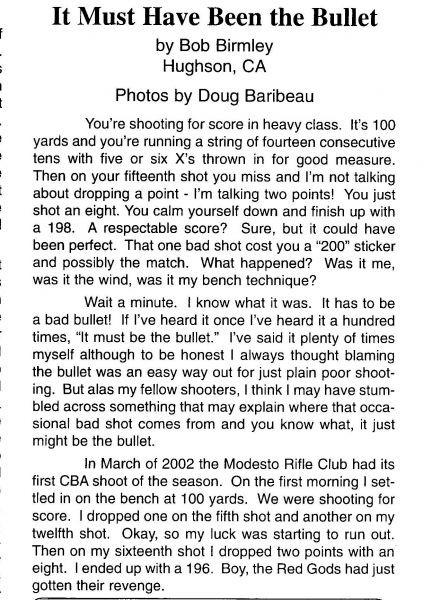
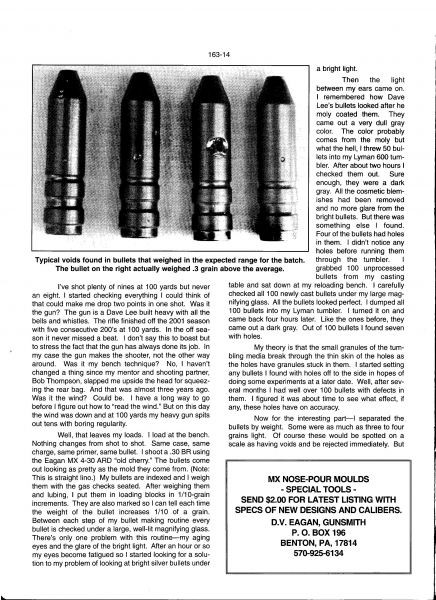
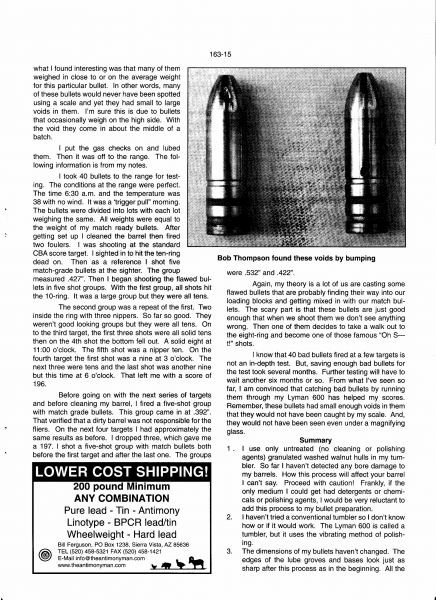
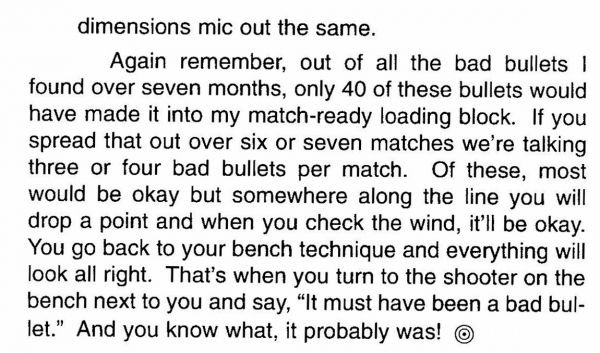
1 I don't know how to make these pages larger, will; send them to anyone who asks. It looks like Mr. Birmley figured out the voids/fliers/solution business 11 years ago. 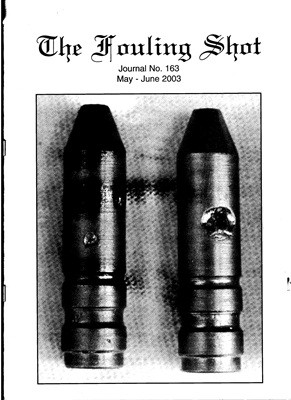
CBs, FLYERS, ACCURACY, HISTORY
- 5.4K Views
- Last Post 20 June 2014
joeb33050
posted this
11 June 2014
Attached Files
joeb33050
posted this
11 June 2014
WEIGHTS OF LEAD SPHERES OR HOLES/VOIDS AND A CALCULATOR. WEIGHT OF LEAD SPHERES dia ” wt(gr) 0.01 0.032 0.02 0.096 0.03 0.324 0.04 0.769 0.05 1.501 0.0625 2.932 0.08 6.149 0.1 12.011
Attached Files


John Alexander
posted this
11 June 2014
Joe,
Great idea to dig up and post Bob's old article. It is well worth rereading. I remember sending him an email complimenting him on what I thought was the best Fouling Shot article that year. Another reason for reading it again is because it is an excellent example of a carefully run test with results that may be useful in improving our scores. We would be closer to one hole groups if more shooters took the time to run similar experiments and reported the results so we could all benefit. It would also be great if another shooter would run a similar test to see if they also found similar air voids just below the surface. I wonder how common they are and what perhaps can be done in the casting operation to minimize or eliminate them? As I typed that I realized that shooter could be me. I have the same Lyman tumbler and plenty of bullets. Where is the best place to get some crushed walnut media?
John
Attached Files

Ken Campbell Iowa
posted this
11 June 2014
also of great interest would be someone with an ” accurate ” ( g ) lead bullet rifle to put little voids into bullets with a drill press and see if they add to the dispersion.
hey, how about a national champion ... he even has a book reporting how a certain dr. mann did this a hunnert years ago.
we can always use more data points. are base voids worse than nose voids ?? do the bullets you drill already have voids that confuse the conclusions ?
i could donate some small drill bits !!
this might add some urgency to a bullet bumper project.
ken
oh, we order 50 lbs walnut hulls bulk, pm me i will look up the co. in missouri. we tumble in a cement mixer ( g ) .
ken
Attached Files
joeb33050
posted this
12 June 2014
TUMBLING ARTICLE TFS 163, May-June 2003 This is my take on the article. Tumbling cast bullets in granulated walnut shells does not change dimensions or accuracy; but does affect finish and show holes/voids. Four of fifty, then seven of one hundred tumbled bullets showed holes/voids. Call it 8%. Bullets were tumbled until “well over 100” bullets with holes/voids were found. Let's say that 1500 bullets were tumbled with 8% = 120 having holes/voids. Of the 120?, maybe 80 weighed off enough to be rejected. 40 weighed OK but had visible holes/voids. The 40 were shot. Some were way-out flyers. Most grouped reasonably well but with larger-than-perfect-bullet groups. Holes/voids cause larger groups and sometimes cause way-out flyers. Tumbling identifies bullets with holes/voids; eliminating these bullets increases accuracy. From this I conclude: Bullets have holes/voids. Holes/voids cause larger groups and fliers. We know how to identify bullets with holes/voids. Swaging to repair bullets with holes/voids is much more difficult and expensive than tumbling. We need to know more about the effect of tumbling on accuracy. Until we know that, both swaging and use of harder metals makes little sense. We may know the answer to lurching over the accuracy hurdle, we just don't know that we know. Weighing bullets doesn't eliminate holes/voids. Tumbling is a better/easier alternative to weighing.
Attached Files
John Alexander
posted this
12 June 2014
Good summary Joe. Among other things the Birmley article firmly established that we can't find all, or even most, air voids by weighing bullets. Note Bob's loading drill that DIDN'T find the bubbles.
“My bullets are indexed and I weigh them with the gas checks seated. After weighing them and lubing, I put them in loading blocks in 1/10-grain increments. They are also marked so I can tell each time the weight of the bullet increases 1/10 of a grain.” In his last sentence before the summary Bob reminded us: “Remember, these bullets had small enough voids in them that they would not have been caught by my scale. And, they would not have been seen even under a magnifying glass.” We may be able to find some voids by weighing, but in Bob's tests tumbling was far more effective. He also found that that the tumbled (and sorted to eliminate surface voids) bullets shot well ”€œ- so tumbling apparently didn't hurt accuracy. If voids are a general problem it seems to me that we should at least test the effectiveness of swaging as a way to eliminate or diminish them especially if Ken, or somebody else, can figure out an affordable way to do it. John
Attached Files

fa38
posted this
13 June 2014
I used to moly coat my plain base cast bullets by tumbling them in a rock tumbler with some steel that looked like shot. I had some surface holes show up just like the picture in the first post.
I also took some of the bullets and ran them thru a lube sizer. The bullets not tumbled were not sized, just lubed with the sizing die and showed no evidence of the die touching them.
The bullets that were tumbled and sized showed a small shiny ring at the base of the bullet. The tumbling action bumped this area up enough so that the sizing die removed some of the moly coat giving evidence of the bumped up ring. I measured the ring and it was maybe .001 over the rest of the bullet base ring.
I think those bullets would fall base first in the tumbler into the rest of the bullets and the steel shot and gradually bump up that way.
The moly bullets were a real mess to handle. I stopped doing it because of the black crap (moly) all over your hands and I could never tell if it made a difference in accuracy.
Just thought I would relate my experience with tumbling.
Attached Files
joeb33050
posted this
13 June 2014
I just sent an e-mail to Bob Birmley asking for info on bullet tumbling in the intervening 11 years.
Attached Files
joeb33050
posted this
15 June 2014
Joe,Nice to hear from you. The following is how I got rid of the voids but first let me stress, all the bullets used in my test were lino. I have never tumbled any lead that is softer. Now for the rest of the story. At the time I wrote the article I was using a Lee bottom pour pot. I thought I was getting the voids by not using the correct casting technique so I got a Lyman bottom pour and tried it. I continued to get the voids. This went on for several months. I then decided to try ladle pouring. Much to my surprise I found that my voids were cut in half so I started experimenting with different casting techniques using the ladle. After several months I ended up using a 20 pound Lee pot and the little Lee ladle, the one that looks like a soup spoon with a wooden handle. It didn't take long before I had a good system worked out. I would dip the little ladle to the bottom of the pot, pour it in my mold leaving a sprue about the size of a nickle. Bingo! No more voids. I continued to tumble bullets for probably another year. All surface voids were gone. I became so confident in the quality of my bullets that when I changed over to 1-20 lead for my plain base gun I have yet to tumble a bullet and that was about four years ago. My conclusion is that it was solely my casting technique that caused the problem. I still weigh my individual bullets and I can keep them within 1/2 a grain. The reason i do this, I shoot my bullets in 1/10 of a grain increments. In other words, 107.5; 107.6 etc. No more fliers.Hope this explains how I solved the problem of voids.Good Shooting,Bob
Attached Files
John Alexander
posted this
16 June 2014
So if I understand what has been said in Bob's article and on this thread I think we can draw some conclusions.
Improper casting techniques sometimes cause air voids near the bullet surface.
Most of these air voids CANNOT be detected by weighing -- no matter how carefully the weighing is done.
These air voids apparently cause a slight loss of accuracy that can be noticed in rifles shooting five shot groups in the .5 MOA area.
Tumbling can expose many and maybe all of these near surface air voids.
Tumbling didn't seem to hurt accuracy.
Proper casting technique with a good sized sprue puddle can eliminate the near surface voids and Bob was confident enough that it did that he no longer tumbles his bullets.
Joe: Thanks for recycling Bob's 11 year old article. Sometimes a worthwhile report is soon forgotten and we revert to what we thought we knew before the report and it's like the work was never done.
John
Attached Files
joeb33050
posted this
16 June 2014
So if I understand what has been said in Bob's
Improper casting techniques sometimes cause air voids near the bullet surface.
Most of these air voids CANNOT be detected by weighing -- no matter how
I think Bob found that ~2/3 of the bullets with voids could be detected by weighing.
These air voids apparently cause a slight loss of accuracy that can be noticed in rifles shooting five shot groups in the .5 MOA area.
Tumbling can expose many and maybe all of these near surface air voids.
Tumbling didn't seem to hurt accuracy.
Proper casting technique with a good sized sprue puddle can eliminate the near surface voids and Bob was confident enough that it did that he no longer tumbles his bullets.
Joe: Thanks for recycling Bob's 11 year old
John
Attached Files

cheatermk3
posted this
16 June 2014
Would a vibratory-type (case cleaner)work or does one need a roll-type tumbler?
I haven't been able to figure out how to enlarge the images so I can read the articles Joe posted.
Attached Files
joeb33050
posted this
16 June 2014
Would a vibratory-type (case cleaner)work or does one need a roll-type tumbler?
I haven't been able to figure out how to enlarge the images so I can read the
Attached Files

Paul Pollard
posted this
16 June 2014
Try this link.
Attached Files
John Alexander
posted this
16 June 2014
Would a vibratory-type (case cleaner)work or does one need a roll-type tumbler?
I haven't been able to figure out how to enlarge the images so I can read the articles Joe posted. Bob did use a vibratory type “tumbler" John
Attached Files
Categories
- All Categories
- General Polls
- Contact Us w/ Forum Issues
- Welcome to The Cast Bullet Association Forum
- General
- Bullet Casting
-
Guns and Shooting
- AR Platform
- TC Contenders & Other Single Shot Handguns
- Shotguns
- Informal Matches & Other Shooting Events
- Gunsmithing Tips
- Gun Cleaning & Maintenance
- Optics
- Benchrest Cast Bullet Shooting
- Military Bench Rest Cast Bullet Shooting
- Silhouette Shooting
- Postal Match Cast Bullet Shooting
- Factory Guns
- Black Powder Cartridge
- Hand Guns
- Lever Guns
- Single Shot Rifles
- Bolt Action Rifles
- Military Surplus Rifles
- Plinkers Hollow
- Muzzleloaders
- Hunting
- Reloading
- Buy, Sell or Trade
- Other Information & Reference
Search
This Weeks High Earners
-
 Wm Cook
9
Wm Cook
9
-
 John Alexander
6
John Alexander
6
-
 RicinYakima
5
RicinYakima
5
-
 Idahocaster
3
Idahocaster
3
-
 Tom Acheson
3
Tom Acheson
3
-
Lucky1 2
-
ohiochuck 2
-
Jeff Michel 1
-
 Aaron
1
Aaron
1
-
 delmarskid
1
delmarskid
1


