
See “The Fouling Shot”, Journal 229, May-June 2014, “Is A Belief In Fliers Holding Back Cast Bullet Progress?”, pg 229-3, by John Alexander.
And the Cast Bullet Association Forum
http://castbulletassoc.org/view_topic.php?id=9394&forum_id=63&page=2
Download pdf below
UNEXPECTED FLIERS
- 17K Views
- Last Post 10 July 2014
joeb33050
posted this
31 May 2014
Attached Files

John Alexander
posted this
31 May 2014
Joe,
Would you please give us a link so we can take a look at “Group Shooting And Mathematics” , “Expected and Unexpected Fliers”
Thanks.
John
Attached Files
joeb33050
posted this
31 May 2014
When shooting groups, there is always one shot, a flyer, that determines group size. With five shot groups that flyer turns a smaller four shot group into a much larger five shot group. That's generally just arithmetic antagonizing the shooter.
When we shoot a set of groups during an experiment, we're trying to estimate the average group size for a given shooter/equipment /conditions system. Sometimes that flyer is so far out that we wonder if it should be included in the calculations.
Some flyers are expected, are just part of the normal variation in bullet hole location. Other flyers are unexpected, a bullet hole very far away away from the others.
Here's how to tell an expected flyer from an unexpected flyer.
Measure the group including the flyer.
Measure the group without the flyer.
Divide the group sizes, with flyer/without flyer; and get the “ratio".
For five shot groups:
If the ratio is greater than 1.6, we're 95% sure that the flyer is unexpected.
If the ratio is greater than 1.8, we're 99% sure that the flyer is unexpected.
For ten shot groups:
If the ratio is greater than 1.4, we're 95% sure that the flyer is unexpected.
If the ratio is greater than 1.5, we're 99% sure that the flyer is unexpected.
Attached Files

Ken Campbell Iowa
posted this
31 May 2014
there are no ” normal ” fliers.
there are no ” abnormal ” fliers.
there are just fliers .. unless they all go into the same hole.
even if i cross-fire on the wrong target, it is still just a flyer.
all impact deviations are caused by physical forces. the forces vary, and thus also the impacts .
did i ever mention my sweet-shooting 280 remington ?
ken
Attached Files
joeb33050
posted this
31 May 2014
The above has been revised, due to my arithmetic mistake. There are THREE unexpected fliers.
Attached Files

Tom Acheson
posted this
01 June 2014
Looking for love in all the wrong places....
just a short comment.....BENCH TECHNIQUE!.....none of us are 100%!
Tom
Attached Files
John Alexander
posted this
01 June 2014
there are no ” normal ” fliers.
there are no ” abnormal ” fliers.
there are just fliers .. unless they all go into the same hole.
even if i cross-fire on the wrong target, it is still just a flyer.
all impact deviations are caused by physical forces. the forces vary, and thus also the impacts .
kenAs the jailer said to Cool Hand Luke -- What we got here is a failure to communicate.
In order to communicate we need a definition of “flier." If we define “flier” as any shot that doesn't go through the same hole as the first one then Ken's statements are all true unless we believe in supernatural forces.
However, that's not how I believe I hear shooters using the term, and common usage is how a definition is usually determined in English -- whether we like it or not.
Based on what I think I hear, the common usage of the word flier seems to be: flier -- a bullet hole significantly out of the cluster of the other bullet holes in the group.
Joe, it's your thread so please define flier for the purposes of this thread since this discussion is coming apart like a defective flywheel.
John
Attached Files
joeb33050
posted this
01 June 2014
Sure.
Sometimes, one bullet is way out of the group. We can call this a flyer or outlier or stranger or wide shot or abnormal flier or normal flier or ..... I call these “fliers".
If we're shooting, say, 2” groups, and one shot in one group is twelve feet northeast of the target, not called by the shooter; this is a flyer. If, on the other hand, one shot in one group turns a 2” four shot group into a 3” five shot group, this is also a flier.
I decided, after a lot of tries, to call fliers either “expected fliers” or “unexpected fliers". This is an english translation of statistical measures.
Here, unexpected fliers are either 95% or 99% probable. If only 5% of shots are further from n-1 shot center than the shot in question, then that shot is a 95% probable unexpected flier. If only1% of shots are further from n-1 shot center than the shot in question, then that shot is a 99% probable unexpected flier.
The article gives us a quick and easy way to make an educated guess about whether a given shot is part of the normal expected variation or is unexpectedly far out.
These definitions are mine, apply only here, are intended to represent mathematical matters in English-always problematical.
Attached Files

HuskerP7M8
posted this
02 June 2014
Hi Joe,
Would it be possible for me to somehow get a copy of “The Fouling Shot" article being discussed here?
Thanks, Landy
“In God we trust; all others must bring data.” “Without data, you're just another person with an opinion.” “If you can't describe what you are doing as a process, you don't know what you're doing.” “It is not enough to do your best, you must know what to do, and then do your best.” W. Edwards Deming (October 14, 1900 - December 20, 1993)
Attached Files

cheatermk3
posted this
02 June 2014
Been trying to follow these “flier” threads--
Shooting five five-shot groups is really one 25-shot group?
Seems to me that unless you use the same case for all 25 shots, it's really 25 1-shot groups.
Unless you use the same 5 cases for all 25 shots.
of course in competition having a 15 minute time limit in which to fire 10 record rounds makes loading at the event problematic. Ignoring any work-hardening of the cases, still using only a set of 5 cases, ID'd and loaded and fired in the same rotation for all 25 rounds(in say a load evaluation test) still only gives you 1-five shot group for each case.
Nobody I shoot with in competition would only bring 5 cases to a match so of course we make all our cases as alike as we can, and call it good--right?
But I'm sure someone along the line has done this sort of testing--the point being that even if we're controlling all the variations at the chamber end of the bore, and to the extent we can the condition of the bore, we can't observe what is happening from the moment the pin hits the primer and the spark sets off the sequence of events we call firing a round, until the moment the bullet leaves the bore.
So maybe “fliers” come from the bore itself being aligned with a different point on the target for each successive round of a given string of shots.
I believe that this, for whatever the reason, is the cause of “gross", or “unexpected” fliers.
But maybe I'm overstating the obvious? After all the underlying cause of this mis-alignment may be internal, like barrel harmonics, but I don't see many barrel tuners on the line either.
Landy, I got my Fouling Shot no.229 Friday so you should have yours soon.
Attached Files

jhalcott
posted this
02 June 2014
Some years ago I had planned a Saturday ground hog hunt with a coworker. I got home Friday to discover NO ammo available for the expected hunt. Quickly loading 25 rounds in 5 round batches of incremental powder charges and a rush to the range to test them resulted in a good feeling. I loaded 50 of the best shooting(most accurate) of the test. The next day I could NOT hit a ground hog in 5 tries, my coworker had MUCH better luck! When I retested that ammo it was terribly inaccurate! 3 inch groups plus. My rush at the range had to be the problem. This same thing can happen to any one NOT taking proper care at the bench.
Attached Files
John Alexander
posted this
02 June 2014
Hi Joe,
Would it be possible for me to somehow get a copy of “The Fouling Shot" article being discussed here?
Thanks, Landy
Landy, I have sent you a PM. John
Attached Files
John Alexander
posted this
02 June 2014
Joe, You wrote: “that for five shot groups, if the ratio is greater than 1.6, we're 95% sure that the flier is unexpected. If the ratio is greater than 1.8, we're 99% sure that the flier is unexpected."
Its been a long time since I took my last statistics course and I can't even remember where I parked the car at the grocery store so I don't know what went wrong but these rations seem awfully low. Especially when we have three of them in one 25 shot group.
Of course five groups is a pretty small sample and anything can happen so I went back in my notes and found a 59 group string of five shot groups for match grade jacketed bullets for which I had recorded both the best four shot group as well as the five shot group.
I found that 32% of the groups had a 5-shot group/4-shot group ratio of 1.6 or greater and 20% of the groups had a ratio over 1.8.
Neither 32% nor 20% can reasonable be called “unexpected.” If that is true it would mean that a good case could be made for disregarding the worst shot in a third of the groups we fire. Please go back over your calculations. Something must be wrong. John
Attached Files
John Alexander
posted this
02 June 2014
cheatermk3 wrote"
"Been trying to follow these “flier” threads--
Shooting five five-shot groups is really one 25-shot group?
Seems to me that unless you use the same case for all 25 shots, it's really 25 1-shot groups.
Unless you use the same 5 cases for all 25 shots."
cheatermk3,
Attached Files
joeb33050
posted this
02 June 2014
Joe,
You wrote: “that for five shot groups, if the ratio is greater than 1.6, we're 95% sure that the flier is unexpected. If the ratio is greater than 1.8, we're 99% sure that the flier is unexpected."
Its been a long time since I took my last statistics course and I can't even remember where I parked the car at the grocery store so I don't know what went wrong but these rations seem awfully low. Especially when we have three of them in one 25 shot group.
Of course five groups is a pretty small sample and anything can happen so I went back in my notes and found a 59 group string of five shot groups for match grade jacketed bullets for which I had recorded both the best four shot group as well as the five shot group.
I found that 32% of the groups had a 5-shot group/4-shot group ratio of 1.6 or greater and 20% of the groups had a ratio over 1.8.
Neither 32% nor 20% can reasonable be called “unexpected.” If that is true it would mean that a good case could be made for disregarding the worst shot in a third of the groups we fire. Please go back over your calculations. Something must be wrong. John
John;
I've gone through the numbers again. Nothing much has changed.
A fifth bullet that enlarges a four shot group by 60% is expected to happen only 5% of the time, 95% of the time the enlargement is expected to be less. etc.
I've attached the EXCEL workbook explaining the arithmetic, and hope that someone will review it and point out my mistake/s if they're there.
Attached Files
John Alexander
posted this
02 June 2014
A fifth bullet that enlarges a four shot group by 60% is expected to happen only 5% of the time, 95% of the time the enlargement is expected to be less. etc.
Joe,
I am tied up today and won't have time to look at the EXCEL workbook until tonight or maybe tomorrow and then may not know enough to be of any help. But just the way the sentence above is phrased tempts me to take a shot in the dark. It isn't the fifth shot being out 60% but any of the five being out 60% that we are interested in. I assume you meant to say “any shot” and your calculations are for any shot -- but thought I would mention it.
The string of 59 groups had three groups with ratios of 2.5 or above which is about 5% and more in line with what we might think of as “unexpected.” Of course there is always the possibility that my shooting techniques are so squirrelly that I have more wild shots than the normal bear. John
Attached Files

billwnr
posted this
02 June 2014
Joe,
You wrote: “that for five shot groups, if the ratio is greater than 1.6, we're 95% sure that the flier is unexpected. If the ratio is greater than 1.8, we're 99% sure that the flier is unexpected."
Its been a long time since I took my last statistics course and I can't even remember where I parked the car at the grocery store so I don't know what went wrong but these rations seem awfully low. Especially when we have three of them in one 25 shot group.
Of course five groups is a pretty small sample and anything can happen so I went back in my notes and found a 59 group string of five shot groups for match grade jacketed bullets for which I had recorded both the best four shot group as well as the five shot group.
I found that 32% of the groups had a 5-shot group/4-shot group ratio of 1.6 or greater and 20% of the groups had a ratio over 1.8.
Neither 32% nor 20% can reasonable be called “unexpected.” If that is true it would mean that a good case could be made for disregarding the worst shot in a third of the groups we fire. Please go back over your calculations. Something must be wrong. John
John;
I've gone through the numbers again. Nothing much has changed.
A fifth bullet that enlarges a four shot group by 60% is expected to happen only 5% of the time, 95% of the time the enlargement is expected to be less. etc.
I've attached the EXCEL workbook explaining the arithmetic, and hope that someone will review it and point out my mistake/s if they're there.
Why the heck do some “shooters” spend (waste) so much time finding the probability of a flyer? In my opinion the shooter should search for the REASON for the flyer and either eliminate it or mitigate it. The reason for the flyer will be 1) unbalanced load, 2) not reading wind/mirage correctly, 3) bad bullet (probably internal voids), 4) poor bench techniques or 5) issues with rifle or scope. There's good reasons the jacketed BR crowd is fussy about load data, bench rests and wind flags. The CB bench rest crowd could learn from them. The biggest cause of flyers I see is item #2: not reading the wind or mirage correctly.
Attached Files
Ken Campbell Iowa
posted this
02 June 2014
billwnr sez:
”
Why the heck do some “shooters” spend (waste) so much time finding the probability of a flyer? “
heh heh, a decent question.
but then being -- and doing things --- GOOFY .. is what makes we humans interesting .. and occasionally .. loveable.
we climb mountains because they are there.. we flew to the moon because it was there ...
and now, because FLYERS are there, we are trying to define their meaning .. so far we are in the COMMUNICATING stage ( g ) ...joe is communicating in mathematics ... most of us are just calling them damn fliers ..
but this is all in getting ready to almost prepare to plan how to minimize ... or eliminate ... those pesky fliers ...
there is a time to cut bait ... there is a time to fish ... in defining the flyer problem, we are filling our bait box; hope to get fishing pretty soon ..
ken
Attached Files

Paul Pollard
posted this
03 June 2014
4 Fliers. Shooting for score, only one shot was in the group.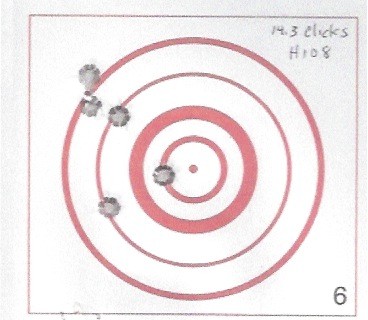
Attached Files
joeb33050
posted this
03 June 2014
4 Fliers. Shooting for score, only one shot was in the group.
Paul;
There is a two step program that would increase your scores.
Get the holes closer together.
Get the center of the group nearer the center of the target.
et us know how it works out.
Attached Files
cheatermk3
posted this
04 June 2014
The group in John's FS229 article was shot with 22lr ammo and measures .258". That means that the two farthest-apart holes in the group (both horizontals) and the one closest to the center of the group,(looks to be a white),are all touching. I haven't seen the actual target(or an image of it) but those 25 shots all went into one ragged hole.
So where are the fliers?
Attached Files
Categories
- All Categories
- General Polls
- Contact Us w/ Forum Issues
- Welcome to The Cast Bullet Association Forum
- General
- Bullet Casting
-
Guns and Shooting
- AR Platform
- TC Contenders & Other Single Shot Handguns
- Shotguns
- Informal Matches & Other Shooting Events
- Gunsmithing Tips
- Gun Cleaning & Maintenance
- Optics
- Benchrest Cast Bullet Shooting
- Military Bench Rest Cast Bullet Shooting
- Silhouette Shooting
- Postal Match Cast Bullet Shooting
- Factory Guns
- Black Powder Cartridge
- Hand Guns
- Lever Guns
- Single Shot Rifles
- Bolt Action Rifles
- Military Surplus Rifles
- Plinkers Hollow
- Muzzleloaders
- Hunting
- Reloading
- Buy, Sell or Trade
- Other Information & Reference
Search
This Weeks High Earners
-
 Wm Cook
9
Wm Cook
9
-
 John Alexander
6
John Alexander
6
-
 RicinYakima
5
RicinYakima
5
-
 Idahocaster
3
Idahocaster
3
-
 Tom Acheson
3
Tom Acheson
3
-
Lucky1 2
-
ohiochuck 2
-
Jeff Michel 1
-
 Aaron
1
Aaron
1
-
 delmarskid
1
delmarskid
1


