
Another corrected attempt. Is the math right? Does anyone have info on throat wear with cast bullets? Thanks THROAT WEAR WITH CAST BULLETS SAVAGE 12 FV 223 REMINGTON The throat on this rifle has enlarged. The 225415 bullet nose measures ~ .2175", the top band ~ .2235. When the rifle was new, the 225415 max OAL was ~ 2.090". After 11 months and ? 2000+ shots, all but 13 with cast bullets, the max OAL is ~ 2.165". The place where the bore measures .2235” has moved forward ~ .175". 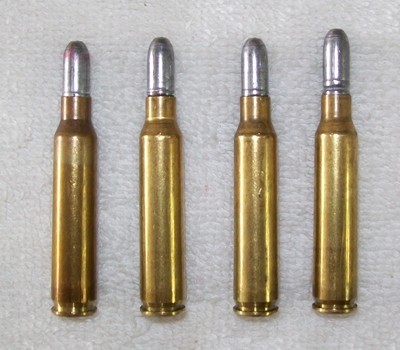
The NEI 71 grain bullets are from John Alexander. The noses measure .220"-.2206". No nose goes in the muzzle, before or after loading in a case. file:///C:/Users/JOEB33~1/AppData/Local/Temp/msoclip1/01/clip_image002.jpgLeft OAL = 2.008", this is the OAL for the ctgs. I loaded, the ctg goes in and out of the gun easily without de-bulleting. This is my definition of correct START OAL. Start here, then make the cartridge a little shorter and try in the gun. Next, 2nd and 3rd ctgs. OAL = 2.0230 Here there is some resistance when chambering, the first band is hitting something and they don't de-bullet on removal. This is about as long as I'd load, I'm more comfortable with a shorter OAL-but-I know that first band is making a seal. There is NO trace of land marks on the noses. Right ctg, OAL = 2.294. This is as long as I can make them without de-bulleting and get them in the gun-with a lot of force. I'd never load this long. There are clear land marks on the nose, hard to measure but ~ .160” long land marks.So, there's no land / nose touching/marking at any comfortable OAL. Then the lands start to touch the nose at ~ 2.294” - .160” = 2.134". SAAMI says the 223 case is 1.760” long and the chamber has ?.015” throat.. Measuring, and it ain't easy, it looks like the lands start to engrave the nose on these bullets at about 2.134", somewhere in there. If I got this right, there's ~. 2.134” - 1.775” = .359” ahead of the case mouth where the bore is bigger than ~.2206". I'm ASSUMING that when new the nose would have been marked much further back, at around 1.775” from the bolt face, and that the bbl was ~ the same size throat and muzzle.
THROAT WEAR WITH CAST BULLETS
- 4.3K Views
- Last Post 31 December 2013
Attached Files


No hard data, but have heard experienced cast shooter's blame throat wear on Antimony.
----J
Attached Files

Another corrected attempt. Is the math right? Does anyone have info on throat wear with cast bullets?
Thanks
I'm ASSUMING that when new the nose would have been marked much further back, at around 1.775” from the bolt face, and that the bbl was ~ the same size throat and muzzle. Joe,The only math error I see is 2.165” - 2.090” = .075". I have seen the same sort of increasing OAL but usually not as fast for light loads. Your assumption that the barrel originally had the same size throat and muzzle is certainly reasonable but may not hold for all barrels. The four Savage 22 barrels I have slugged all had a bit of “choke in the last inch or two at the muzzle. All four also had a “loose” section in the middle where a slug from either end would slide freely before tightening up as it approached either end. That is another story but one that I think may be important. I wish more CB shooters would report how much the OAL at contact advances along with the number of shots and specifics about the load. This is an area where individuals may know how fast this happens but I seldom see it reported. John
Attached Files
What load are you using?
Many different loads, ~ 7/IMR4227 or SR4756 or A#9 were commonly used
Attached Files
This about a Savage 10 in 308 in."10/17/09 314299 No Dot, sized .309", nose .3025"/.303” Max OAL 2.786” with ~ 1/32” of front band out of neck, nose engraved nicely. ~ .1 of bullet is below case neck." Several thousand cast bullets later:"Striker brass, 314299 Dot/NoDot, Max OAL sized .309” is 3.000” with NO nose engraving.” "No nose engraving Dot/No ot sized .312" OAL is affected by nose-bumping during sizing, sizing dia. affects bumping/nose dia. The only sure thing I can see in the above is that lands wore/burned away so that nose engraving disappeared in several thousand cast bullets.OAL delta isn't the best way to measure throat erosion. I have RCBS headspace and OAL measuring tools for 223 and 308, if anyone ....
Attached Files

This is all just numbers unless somebody tells me how it impacts the rifles ability to group it shots.
Attached Files
This is all just numbers unless somebody tells me how it impacts the rifles ability to group it shots.
Well. this is telling me that (maybe) throats wear faster than I ever knew, and that tells me that a nose-rider bullet with a straight nose may soon not be guided by the bore as the lands go away, and that maybe a tapered nose bullet fits longer = more shots than a straight not-tapered, and maybe the single shot multi band tapered bullet might be a better long-term accuracy choice.Or, that tapering/swaging noses might be a better approach, or bumping noses, or.../
It tells me, at least, that max OAL varies as shots are fired; that if, as some claim, OAL affects accuracy, then max OAL should be measured and recorded on occasion-to allow varying OAL and accuracy.
Just because it's accurate today doesn't mean that it will be accurate with the same recipe 1000 shots from today.
Attached Files

Joe, I'm going to ask the obvious question: Are you using a fitted bore guide when cleaning and not a coated rod, but a hard stainless rod? Just checking, as I don't have any clue as to why this is happening. Ric
Attached Files
Joe, I'm going to ask the obvious question: Are you using a fitted bore guide when cleaning and not a coated rod, but a hard stainless rod? Just checking, as I don't have any clue as to why this is happening. Ric
I clean as little as possible, use bore guide and, now, Hoppes SS hard rods. Used Dewey rods for years based on what serious jacketed br guys use. Forgot not to believe anyone for a while.I'm pretty sure that the wear isn't from cleaning, the muzzles aren't noticably worn.
Attached Files

I always tell my assistants that the best winemaking tool is a pencil (wine won't make it fade) and a notebook. Good record keeping is really important, especially with a large number of variables (guns) and advancing age. The highpower guys make a tool:
If you start with a known new barrel, you can make your own by turning a 13" piece of .250” steel rod to exactly .2190” for about for about an inch. The measuring tip should have a clean and fairly sharp, but smooth, edge. Remove the bolt and carrier and gently insert the gauge into the chamber until it goes into the throat. With the rod centered in the upper receiver carefully put a mark on the rod even with the rear edge of the receiver. This is your starting point. As the throat wears the rod will go further and further into the throat. When it goes more than about 1/2 to 3/4 of an inch it is time to start thinking about replacing the barrel. From http://www.frfrogspad.com/ar.htm
or use a Hornaday gauge to keep tabs on the throat erosion in their AR's. 3,000 rounds of jackets is where they start to get concerned and or replace the barrel. The X count at 600 starts to drop and the barrel gets to the reduced course upper.
Dave
Attached Files
Categories
- All Categories
- General Polls
- Contact Us w/ Forum Issues
- Welcome to The Cast Bullet Association Forum
- General
- Bullet Casting
-
Guns and Shooting
- AR Platform
- TC Contenders & Other Single Shot Handguns
- Shotguns
- Informal Matches & Other Shooting Events
- Gunsmithing Tips
- Gun Cleaning & Maintenance
- Optics
- Benchrest Cast Bullet Shooting
- Military Bench Rest Cast Bullet Shooting
- Silhouette Shooting
- Postal Match Cast Bullet Shooting
- Factory Guns
- Black Powder Cartridge
- Hand Guns
- Lever Guns
- Single Shot Rifles
- Bolt Action Rifles
- Military Surplus Rifles
- Plinkers Hollow
- Muzzleloaders
- Hunting
- Reloading
- Buy, Sell or Trade
- Other Information & Reference
Search
This Weeks High Earners
-
 Wm Cook
9
Wm Cook
9
-
 John Alexander
6
John Alexander
6
-
 RicinYakima
5
RicinYakima
5
-
 Idahocaster
3
Idahocaster
3
-
 Tom Acheson
3
Tom Acheson
3
-
Lucky1 2
-
ohiochuck 2
-
Jeff Michel 1
-
 Aaron
1
Aaron
1
-
 delmarskid
1
delmarskid
1


