Target Bullet Weight Variation Limits

  • 270 Views
  • Last Post 37 minutes ago
Bryan Austin posted this 2 days ago

I have never ask this question before.

When you are casting bullets, what do you determine is your lowest acceptable weight and highest expectable weight, in regards to your target weight?

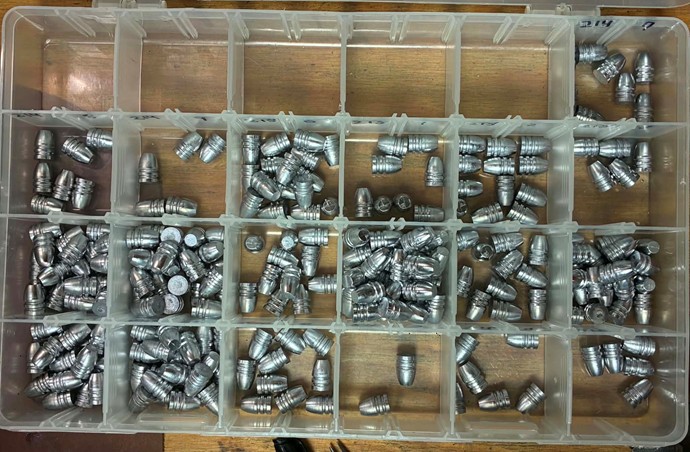
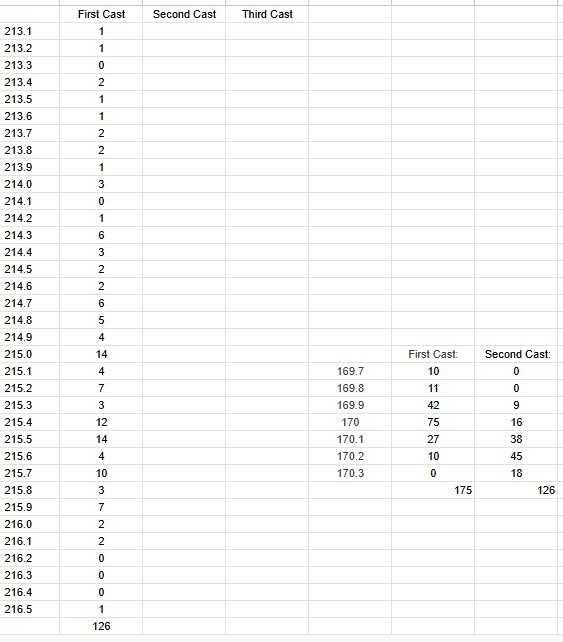
Lets say out of 200 cast bullets, weights range from 213.3gr (coldest cast) to 216.5gr. The main average group is between 215gr and 215.5gr, which only accounts for about 100 bullets.


Photo A,

213.1gr to 215.4gr
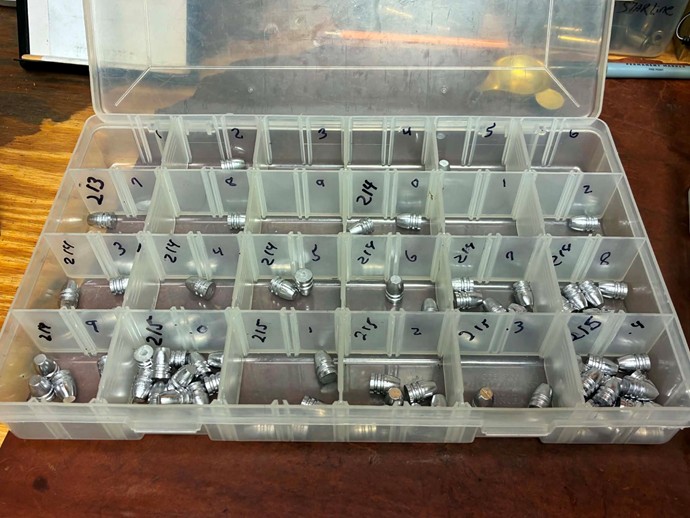
 

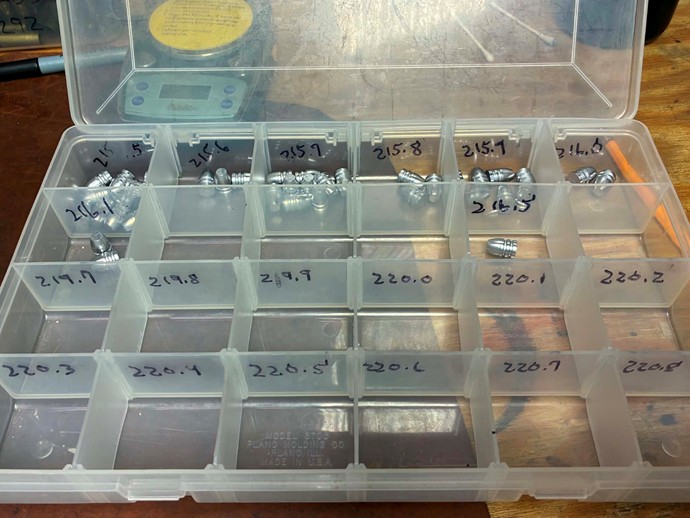
Photo B

215.5gr to 216.5gr

(regrouping from the 220gr bullets back down to the 215gr bullets)
 

I had a handful drop real low due to a bad pour, but did not document accounts. However, one example weighed 211.xgr and looked awesome. You know, the sucker drop!

I decided to cut a few open and found various imperfections that can account as low as 1gr and up to 5grs. from a "target weight" of 215gr.

The obvious flawed bullets we always chunk back into the pot, but how do we know what's inside that cause those outliers?

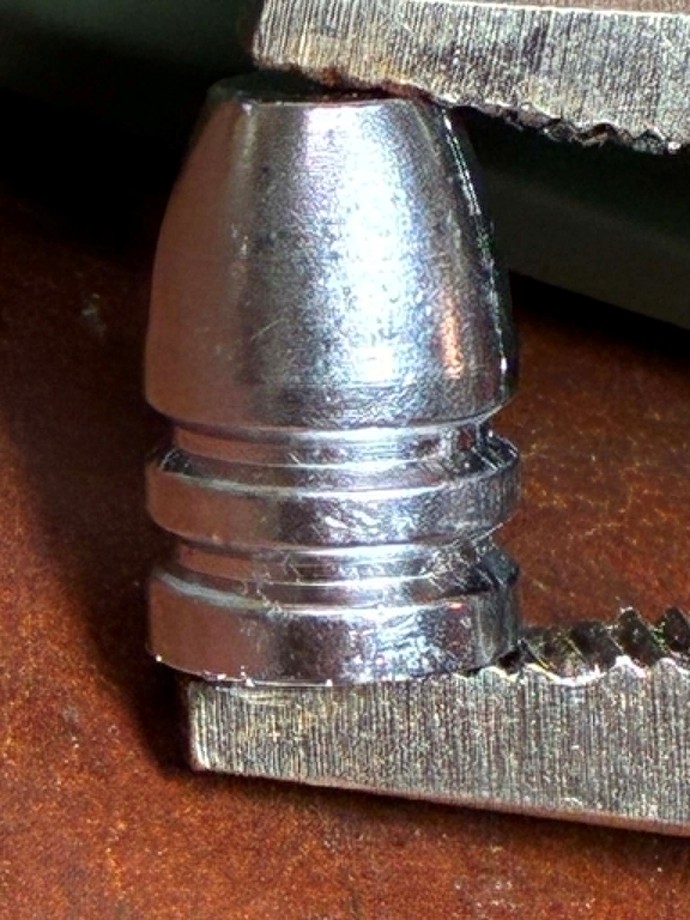
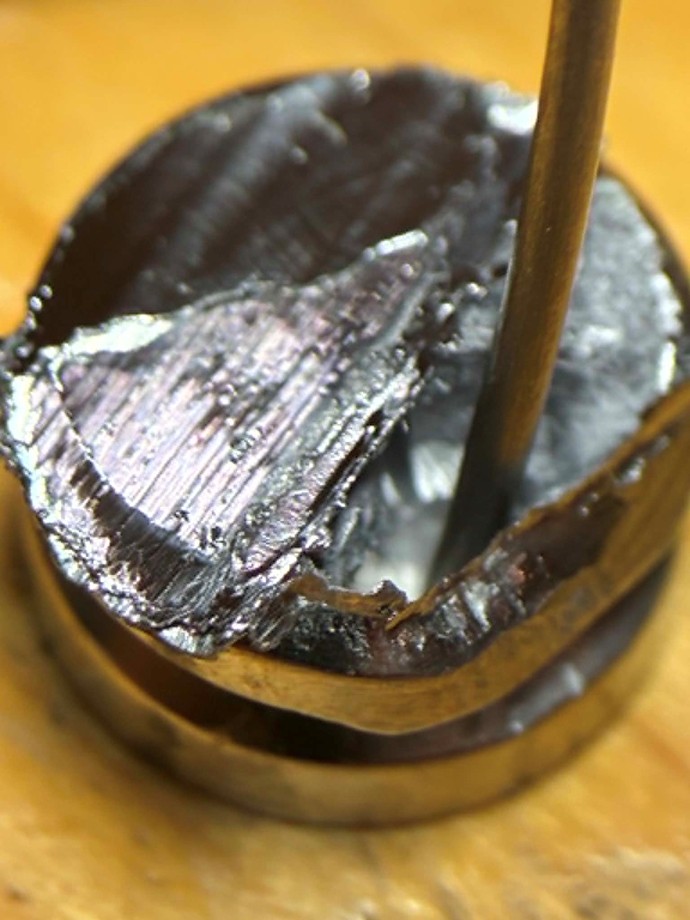
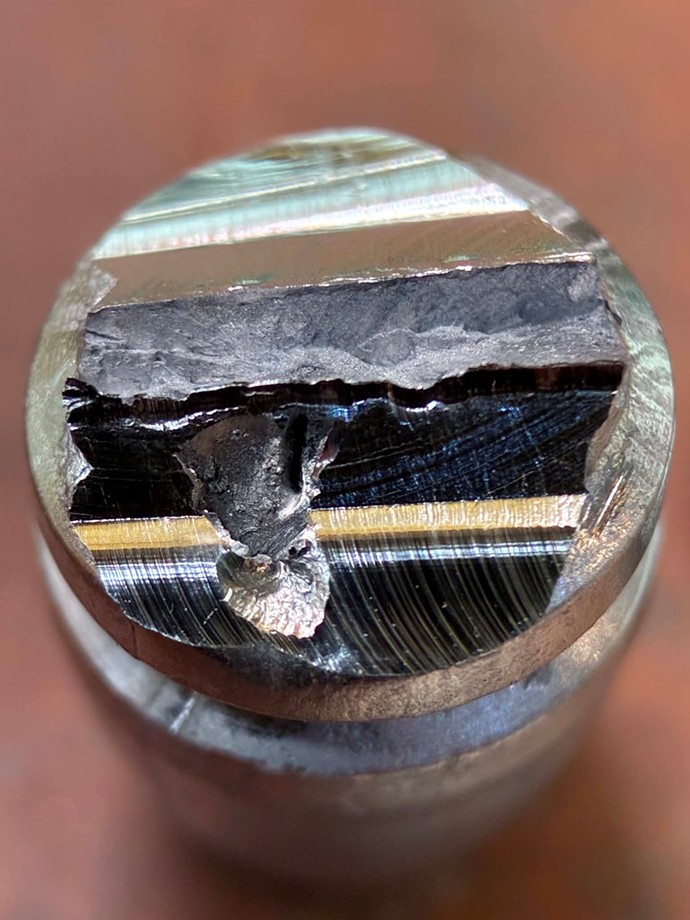
Here is an obvious 4gr underweight bullet I cut open and found the large void in the midsection.

The wire is a piece of .32" aircraft safety wire for size reference.


Looks good, but obviously underweight.
 

The inside!!! Underweight, and off to one side....what a wobbler that would have been!
 

As you guys already know, that is why we weight each bullet if we are looking for performance. So if you start dropping your target weight, how far in each direction is your max weight allowance?

44-40 Website -https://www.44-40.org

Attached Files

Order By: Standard | Newest | Votes
Aaron posted this 2 days ago

A histogram would be useful in this case.

With rifle in hand, I confidently go forth into the darkness.

Attached Files

Wilderness posted this 2 days ago

Bryan

I have to admit I make it up as I go along. It depends on the distribution I get.

I cast in relatively small lots - 200 or 250 is about usual - with single and double cavity moulds. My culling and weighing operations take about as long as the casting itself.

My culling starts while I'm casting - anything suspect or with even slightly rounded base goes into the sprue pile. I figure I'll spend less time making the replacement than I will agonising over a "maybe" later on. When I've finished casting I run through the output with a magnifying glass taking out groove and base imperfections, slag inclusions etc. That leaves a group of visually OK bullets.

I find my more or less average weight by weighing a batch of as many as my 1005 gn scale will take, e.g. 5x170gns or 8x120 gns. I set my balance on the average and then batch up the pile into .1 gn increments based on beam deviation from the "average" setting. It's quicker than it sounds.

With the bullets grouped I can define the "tails" and decide which groups to cull and how many I'm prepared to lose. Any group with less than say five bullets out of a cast of 200 will be suspect  - the "lights" from unseen cavities, defects not picked up in the visual cull, or maybe just the first couple of bullets out of a not-so-hot mould, and the "heavies" from maybe mould not quite closed, hollow pointing pin out a bit, really perfect bullet, or a lumpy sprue.

With the tails taken off, and with bullets in the 110 - 170 gn range, I can end up with a weight distribution in the "keepers" of between half a grain and one and a half grains. I keep them separated in their weight groups so at any one time I'm shooting bullets with as little as .1 gn variation.

I actually think this is altogether excessive, but I do it because I can.

You are only as good as your library.

Attached Files

Wilderness posted this 2 days ago

This is the data I couldn't find earlier - previously published on this Forum. This was two casts of #U321297HP with the same metal. Total weight spread of the "keepers", 0.5 gns for the first cast and 0.4 gns for the second, or 0.6 gns for the group overall. I'm guessing the total of the two casts was about 350 before culling. Keeping just the central 3 or 4 groups from each of these would not lose all that many more, and would hold weight distribution to 0.2 to 0.3 gns within group.

First Cast:                      Second Cast:

 170.3      na                    18

 170.2      10                    45

 170.1      27                    38

 170.0      75                    16

 169.9      42                      9

 169.8      11                    na

 169.7      10                    na

 Below these weights the "groups" were just 1 or 2 bullets each, which went into the culls.

You are only as good as your library.

Attached Files

  • Liked by
  • Bryan Austin
Bryan Austin posted this 2 days ago

This is the data I couldn't find earlier - previously published on this Forum. This was two casts of #U321297HP with the same metal. Total weight spread of the "keepers", 0.5 gns for the first cast and 0.4 gns for the second, or 0.6 gns for the group overall. I'm guessing the total of the two casts was about 350 before culling. Keeping just the central 3 or 4 groups from each of these would not lose all that many more, and would hold weight distribution to 0.2 to 0.3 gns within group.

First Cast:                      Second Cast:

 170.3      na                    18

 170.2      10                    45

 170.1      27                    38

 170.0      75                    16

 169.9      42                      9

 169.8      11                    na

 169.7      10                    na

 Below these weights the "groups" were just 1 or 2 bullets each, which went into the culls.


https://docs.google.com/spreadsheets/d/1zWAgR5SjpzuLLi0uBaVb4ol-R80FCO_GZZePPxxTCo0/edit?usp=sharing


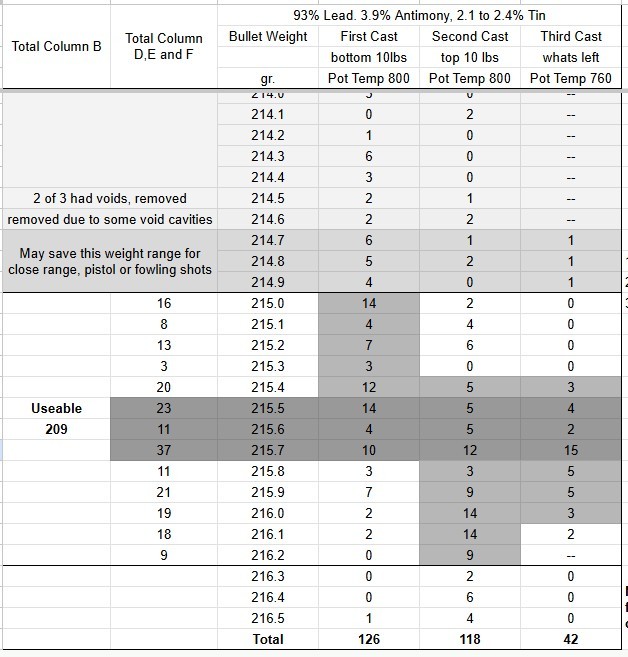
This is definitely a better cast group than what I made. I think mine were spread out much further in weight. I will see if I can get some better cast and keep practicing. Only Perfect Practice Makes Perfect!

Adjusted with tin;

  • 93.7% Lead
  • 3.9% Antimony
  • 2.1 to 2.4% Tin

Your second batch of 126 bullets grouped much lower than my first batch of 126 bullets. Your batch grouped into only 5 different weights, while mine grouped into 30!!! And mine was without culling anything out but initial stupid low weights or visual defects to the naked eye. I think those defects I culled out, not included in the count, was less than a dozen.

My pot temp was very consistent this time. I had to adjust the cadence to keep from over-temping the steel mold. Other than that, I am not sure what my next step is other than keep casting.


I guess my target weight for this mix should be somewhere between 214.7 and 216.0. I will try some more casts next time and try to drop the temp down on the pot back to the 725-750 range when the mold temp maxes out, then change the drop cadence.


44-40 Website -https://www.44-40.org

Attached Files

Tom Acheson posted this yesterday

Weighing each bullet, right or wrong, is something I usually do. While doing the weighing, I often wonder where an out of range bullet would impact, if I had not weighed it and shot it with “several in range” bullets. This assumes all bench techniques are consistent.

While doing the weighing, you are also visually inspecting each one.

Unless a bullet is “radically out of range” I use all of them. After the weighing, bullets in each weight “grouping” are accumulated and stored in a labeled box.

During the match season I work my way through all the bullets, using the lighter ones first at an earlier match and progressing through all of them until at the last match, I’m using the heavier ones.

What matters at a match is that you are shooting a group or a score target, using bullets in a specific “weight range”. The actual numerical weight value is not important at that time. You have other things on your mind.

I don’t want to identify a narrow acceptable weight range and toss all others. That doesn’t make sense (for me), knowing how the bullets will be used. But the few extremely heavy or light bullets are reserved for fouling shots.

Having bullets of a consistent weight is only important “at the moment” during the match.

This weighing is done for .22 80-grain bullets, .41 220-grain bullets, .38 350- grain bullets and .41 420-grain bullets.

The variables of alloy, its temperature and casting cadence are never 100% controllable. We always have some “imperfect” bullets.

This exercise adds extra time to the bullet making activity but removes one variable that we can blame for those pesky flyers that seem to always be with us.

FWIW

Tom

Attached Files

  • Liked by
  • Bryan Austin
  • muley
Bryan Austin posted this yesterday

Thanks Tom, encourageable reply!  

44-40 Website -https://www.44-40.org

Attached Files

Bryan Austin posted this yesterday

Second cast was nearly the same as the first cast!!!

https://docs.google.com/spreadsheets/d/1zWAgR5SjpzuLLi0uBaVb4ol-R80FCO_GZZePPxxTCo0/edit?gid=0#gid=0

44-40 Website -https://www.44-40.org

Attached Files

Bryan Austin posted this yesterday

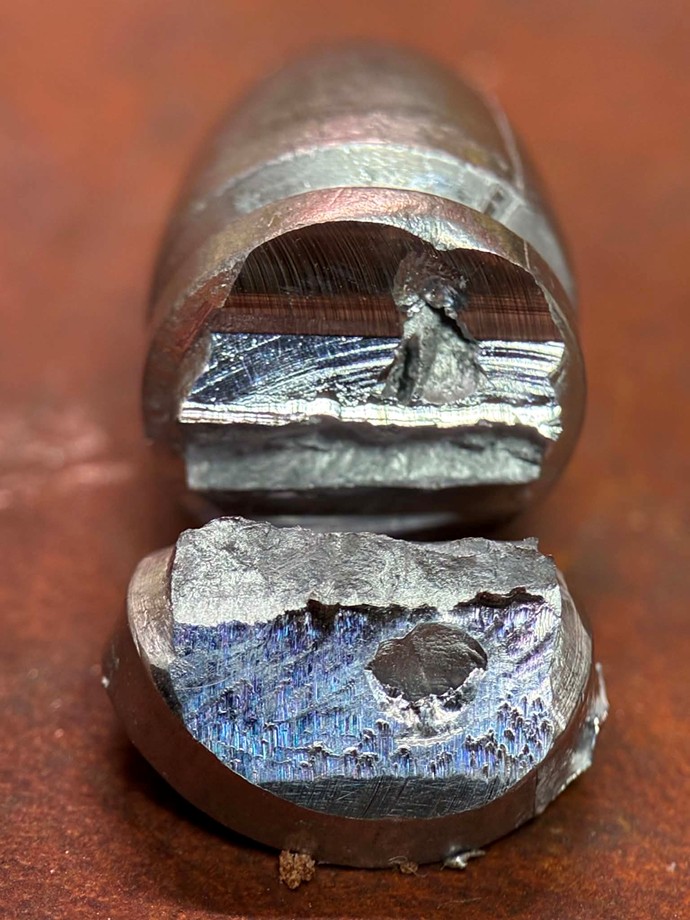
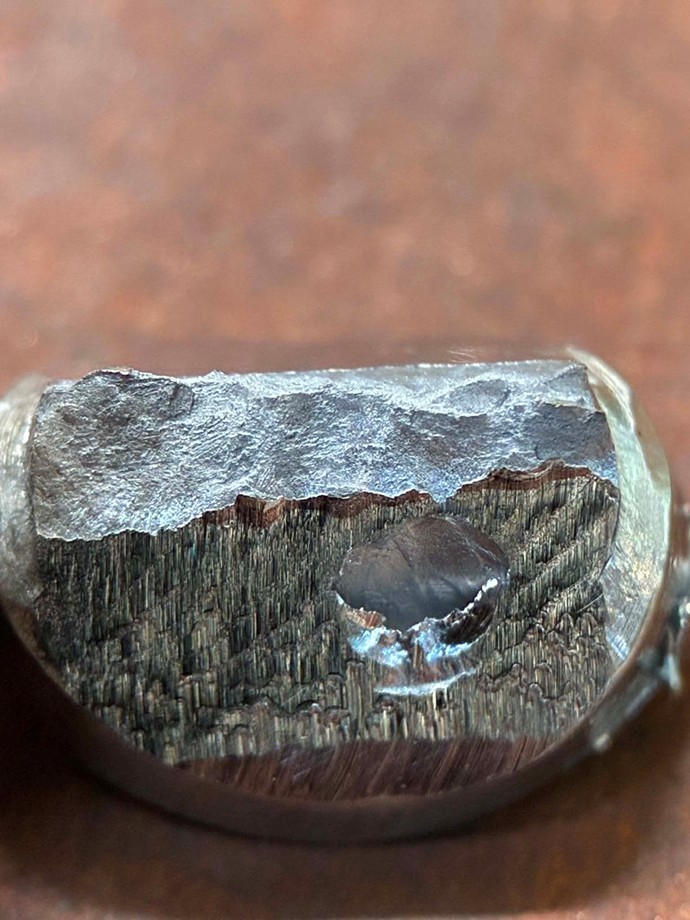
In the weight chart I provided, I decided to cut up a few bullets.


Under weight but visually looked great!

212.7gr, void cavity...probably failed to create a good puddle on top of mold sprue? Base was flat and clean.


All of the bullets that cast 214.6gr and lighter removed due to many voids cavities found inside. I may save the 214.7gr thru 214.9gr bullets for fouling shots.

44-40 Website -https://www.44-40.org

Attached Files

  • Liked by
  • Wilderness
OU812 posted this yesterday

I usually get à smoother visible Bell curve after casting and weighing. If not check for debre between mould halves or incomplète closing of moud halles. You know when your in the zone when casting...cadence and everything seems perfect. GET IN THE ZONE DARN IT.

Attached Files

Tom Acheson posted this yesterday

I’ve had several Hoch nose pour bullets. Back then I wasn’t weighing bullets. Recently I wondered what impact a nose pour vs a base pour mold would have on weight consistency?

Tom

Attached Files

John Alexander posted this yesterday

You were on to something when you wrote the title of your first thread --

PART I - I never was good at casting, so it is time to gett'er done!

I think it is going to be more productive to learn to avoid casting bullets with the huge shrinkage cavities than figuring out the fine points of weight sorting bullets or eliminating the small visual "defects" such as rounded edges and small wrinkles.

I don't know how you cast but I suggest that your adjust your temperature and cadence so that you have a BiG sprue puddle that remains molten for three seconds or more.

When I started casting bullets I weigh sorted bullets as most serious cast shooters do. It seemed so logical. That was slow work with the beam balance scales of the time. So, instead of throwing away the light and heavy bullets I compared the groups of a mix of light and heavy bullets to the groups of my carefully sorted uniform weight bullets.  Time after time the culls shot groups similar to those of good bullets. About half the time the mixed weight bullets produced smaller groups and about half the time the uniform weight bullets shot better.

I suggest that once you solve the shrinkage void problem you try the same comparison. I think you will find the sorting 200 grain bullets into groups of 0.1 or or even 0.5 grain is a total waste of time. But something to do if you enjoy sorting.

The assumption that well-cast bullets are improved by weight sorting is an assumption that should be questioned. I haven't weighed my match bullets for over 30 years. I don't think that has hurt my scores. About a quarter of the shooters who show up for our national match have quit weigh sorting their bullets. Old bad assumptions die hard but this one should be at least retired.

John


Attached Files

RicinYakima posted this yesterday

I agree with most of what John wrote. Until you can make perfectly formed bullets, weight sorting is a waste of time. 

All of my match bullets were cast from linotype. They were all weight sorted to eliminate the 1% or 2% that had a void in the base under the sprue. Since I was weighing them anyway, they were put into groups by 1/10 grain weighed on an electronic scale. 

What I found was the if you shot the lights togather, the mids togather and the heaivies togather, it made no difference. 

Since I shoot 25 round groups, especially to get a "score" target zero, mixing weights have a few more outliers than same weight groups. The question comes down to, do you want to win in a shoulder to should match? Or are you just having fun?

Attached Files

  • Liked by
  • Aaron
Bryan Austin posted this yesterday

I think it is going to be more productive to learn to avoid casting bullets with the huge shrinkage cavities than figuring out the fine points of weight sorting bullets or eliminating the small visual "defects" such as rounded edges and small wrinkles.

I don't know how you cast but I suggest that your adjust your temperature and cadence so that you have a BiG sprue puddle that remains molten for three seconds or more.

When I started casting bullets I weigh sorted bullets as most serious cast shooters do. It seemed so logical. That was slow work with the beam balance scales of the time. So, instead of throwing away the light and heavy bullets I compared the groups of a mix of light and heavy bullets to the groups of my carefully sorted uniform weight bullets.  Time after time the culls shot groups similar to those of good bullets. About half the time the mixed weight bullets produced smaller groups and about half the time the uniform weight bullets shot better.

I suggest that once you solve the shrinkage void problem you try the same comparison. I think you will find the sorting 200 grain bullets into groups of 0.1 or or even 0.5 grain is a total waste of time. But something to do if you enjoy sorting.

The assumption that well-cast bullets are improved by weight sorting is an assumption that should be questioned. I haven't weighed my match bullets for over 30 years. I don't think that has hurt my scores. About a quarter of the shooters who show up for our national match have quit weigh sorting their bullets. Old bad assumptions die hard but this one should be at least retired.

John


John,

I am saving that post for when I work through these variations, then I will continue with it. Your reply is great and hits on everything I am working on. As I said, I never learned to properly cast...just the basics to get clean looking bullets. Now that I am actually looking to tighten my groups....well...it's time!

  • Point 1 - You are correct. I have learned that there is a large shrinking action with this cavity. I used to just make sure the top was covered, meaning having a good base. As long as the shrinking was not enough to distort the base of the bullet, I thought I was good!

  • Point 2 - I also did the weight separation method by shooting all the exact same weight, then working my why up from the lighter bullets to the heavier bullets...and even a few mixed. Groups were fine but it was those few outliers or fliers that just got to me since I felt my trigger pull was fine, and no wind. I think separating them in such weights is a moot point with these lighter bullets is a bit moot, but right now I have to be constant. The reason why I am weighing them is to do exactly when I am doing here, improving my cast bullets. Once I improve my casting, then I can regroup and continue. So for right now, I do not trust my casting.

  • Point 3 - My next test for myself is to separate at the drop, bullets that have good puddles, and bullets that the puddle wasn't so great. Separate those to check the shrinkage.

  • Point 4 - The third cast will be from only the bottom third of the cast melt. I don't think I kept my melt stirred enough...maybe more or less tin was mixed with one of the  parts more than the other? I have no idea. 

You may not remember but my all of my 300 yard targets targets this year are shot using bullets cast from raw Catalina sailboat keel lead. So all you say above has merit. Many of what I cast had visual flaws (and the void cavities), but the 44-40 bullets at 1,350fps still grouped 10 shots inside 12" at 300 yards...and mainly 16" at 300 yards.

Rather than casting 250 bullets and only keeping 170 closely weighed not so great bullets...I'd like to be able to cast 200 and keep 190 awesomely cast bullets.

44-40 Website -https://www.44-40.org
Attached Files

Bryan Austin posted this 23 hours ago

I agree with most of what John wrote. Until you can make perfectly formed bullets, weight sorting is a waste of time. 

All of my match bullets were cast from linotype. They were all weight sorted to eliminate the 1% or 2% that had a void in the base under the sprue. Since I was weighing them anyway, they were put into groups by 1/10 grain weighed on an electronic scale. 

What I found was the if you shot the lights togather, the mids togather and the heaivies togather, it made no difference. 

Since I shoot 25 round groups, especially to get a "score" target zero, mixing weights have a few more outliers than same weight groups. The question comes down to, do you want to win in a shoulder to should match? Or are you just having fun?


Yeap, we discussed this a while back and is why I started paying more attention to my cast bullets. When I can separate the bullets and get different results...it means I have casting issues....that we already knew. Then it is about why! That is what these topics are about. Then it is about improving...which is what these topics will show...well...hopefully excited As you already know, I have been casting for a long time now...I just want to move up to Level 2!!!

I do not shoot competition, I just shoot against myself and improve were and when I can with what I have on hand to use...i.e. what lead can I get, when I can. It is just about maxing out what I have and learning, before moving to the next step. This is what I have been doing all along with everything I do. That in and of itself is my hobby. Divide the hobby into Levels, and figure out which level you want to accomplish in order to enjoy said hobby! 

In Natural Horsemanship that I so enjoyed there are four levels;

  • Level 1 - (Partnership/Rapport): groundwork, safety and trust. 98% of horse owners are not even on this level in my opinion
  • Level 2 - (Harmony / Respect): Expands groundwork and introduces riding skills and horse language. Being able to look at your horses energy, expressions and body language and know what his/her thoughts are.
  • Level 3 - (Refinement / Impulsion): Involves liberty work, higher speeds, and greater distances without ropes.
  • Level 4 - (Versatility / Flexion): Brings everything together for high-level precision, connection, and readiness for performance.

All I wanted to do was get to level one, I ended up completing level 2 before I was no longer be able to own and take care of a horse. I miss it dearly.

To add to that and even go further;

The Four Savvys

  • On Line: Groundwork using a rope and halter.
  • Liberty (no rope etc): Unconnected groundwork playing loose in an area like a pasture.
  • FreeStyle: Riding with loose or single reins and focus on confidence.
  • Finesse: Advanced, precise riding with direct contact.

This is basically a Lever 4 person that has mastered all four Savvys! Stacy Westfall was awesome, 20 years ago (when I was involved)...and mastered all of it!

?si=hw_YE9uzrT_Nqv7U

Didn't mean to get off topic, but that is was this is all about....and right now it is about casting, not shooting!

44-40 Website -https://www.44-40.org

Attached Files

  • Liked by
  • Aaron
Bryan Austin posted this 23 hours ago

 GET IN THE ZONE DARN IT.

I am working overtime Brother....working on itt!! excited

44-40 Website -https://www.44-40.org
Attached Files

  • Liked by
  • Aaron
Aaron posted this 21 hours ago

Aside from the 3-5gr voids, is chasing 2 tenths of a grain worth the effort? I posit that primer/propellant/seating grip/barrel temp/ and other mitigating factors will affect velocity and accuracy more than that .2gr variation. The weighing exercise and data collection is a fun thing to do but doubtful that anything but identifying large defects is useful. 

I'm not trying to be a wet blanket and believe me when I say my scale gets used, but 10 years teaching Statistical Process Control for the phone company, taught me a few things about data and the effort/cost of collecting it. You have very useful data so far and you have identified a bimodal casting process. While bimodal, the range between the modes is infinitesimal when viewing continuous data like weights. Unlike discrete data like "cracked, crazed, not round" continuous data can fall anywhere between zero and infinity. Time, Cost, length, Weight are examples of continuous data. With the very small differences among the population (except the clearly different void weights), pursuit of precisely the same weight is not worthy of the time, nor can it be feasible due casting variations like alloy temperature, mold temperature, alloy metal burn off, casting cadence, and other variables.

Realizing that other variables besides a few grains of bullet weight have more of an input into my bullet velocity and target printing, I weigh the produced bullets to cull the ones with invisible voids. Then I put some Southern Rock in the headphones and get to lubing, sizing, and loading the bad boys. I find that Lynyrd Skynyrd produces the best bullets with Led Zep a close second!

A good casting run will normally get me bullets at X with a plus or minus 2 grain variation. Shoot em. I use the 5 grain variants for friends to shoot and then curse their lack of marksmanship. sealed


With rifle in hand, I confidently go forth into the darkness.

Attached Files

  • Liked by
  • RicinYakima
  • John Carlson
Aaron posted this 21 hours ago

What I found was the if you shot the lights together, the mids together and the heavies together, it made no difference. 

Absolutely !!!!

With rifle in hand, I confidently go forth into the darkness.

Attached Files

  • Liked by
  • RicinYakima
Bryan Austin posted this 21 hours ago

Aside from the 3-5gr voids, is chasing 2 tenths of a grain worth the effort? I posit that primer/propellant/seating grip/barrel temp/ and other mitigating factors will affect velocity and accuracy more than that .2gr variation. The weighing exercise and data collection is a fun thing to do but doubtful that anything but identifying large defects is useful. 

I'm not trying to be a wet blanket and believe me when I say my scale gets used, but 10 years teaching Statistical Process Control for the phone company, taught me a few things about data and the effort/cost of collecting it. You have very useful data so far and you have identified a bimodal casting process. While bimodal, the range between the modes is infinitesimal when viewing continuous data like weights. Unlike discrete data like "cracked, crazed, not round" continuous data can fall anywhere between zero and infinity. Time, Cost, length, Weight are examples of continuous data. With the very small differences among the population (except the clearly different void weights), pursuit of precisely the same weight is not worthy of the time, nor can it be feasible due casting variations like alloy temperature, mold temperature, alloy metal burn off, casting cadence, and other variables.

Realizing that other variables besides a few grains of bullet weight have more of an input into my bullet velocity and target printing, I weigh the produced bullets to cull the ones with invisible voids. Then I put some Southern Rock in the headphones and get to lubing, sizing, and loading the bad boys. I find that Lynyrd Skynyrd produces the best bullets with Led Zep a close second!

A good casting run will normally get me bullets at X with a plus or minus 2 grain variation. Shoot em. I use the 5 grain variants for friends to shoot and then curse their lack of marksmanship. sealed

Well right now my focus is casting bullets, not shooting them. To answer your question NO, it is not worth chasing them, but it is worth learning all of the steps, regardless. The point there is the objective at the time.


So right now I am familiarizing myself what the casting steps, making small corrections as I go....and my current situation is applying enough heat, venting and a large enough puddle to create a properly filled cast bullet. Something I never cared about before because it was not needed...not that it is needed now...but that I want to learn it.

44-40 Website -https://www.44-40.org
Attached Files

  • Liked by
  • Aaron
Bryan Austin posted this 11 hours ago

It paid off so far, thanks guys for the help thus far.

This evening I cast about 45 bullets in about an hour and a half. I took my time, weighed each bullet when cast and dropped the sprue back in after each cast (single cavity). Started the temp out high then gradually backed off as the mold took shape and began to cast heavier bullets. 

Out of the 45 or so, I kept 39...maybe I cast a few bad ones as well that went straight back in the pot. goofs! I know I threw back at least 5 high weights I should have kept for the tally.


  • Constant temp adjustments to maintain pot temp...as someone mentioned why earlier.
  • Making a nice even large puddle on top, pending weights as we go. Some small puddles to keep weight down, some large puddles to keep weights up.
  • Kept pour spout clean before each drop
  • I think a PID, and I will be set to cast more consistent bullets.

I don't have any more tin to mix, I will have to buy some. I may have enough to squeeze out a few more tomorrow.

44-40 Website -https://www.44-40.org
Attached Files

  • Liked by
  • Aaron
  • Wilderness
Aaron posted this 11 hours ago

You are rolling now!!

With rifle in hand, I confidently go forth into the darkness.

Attached Files

Show More Posts
Close