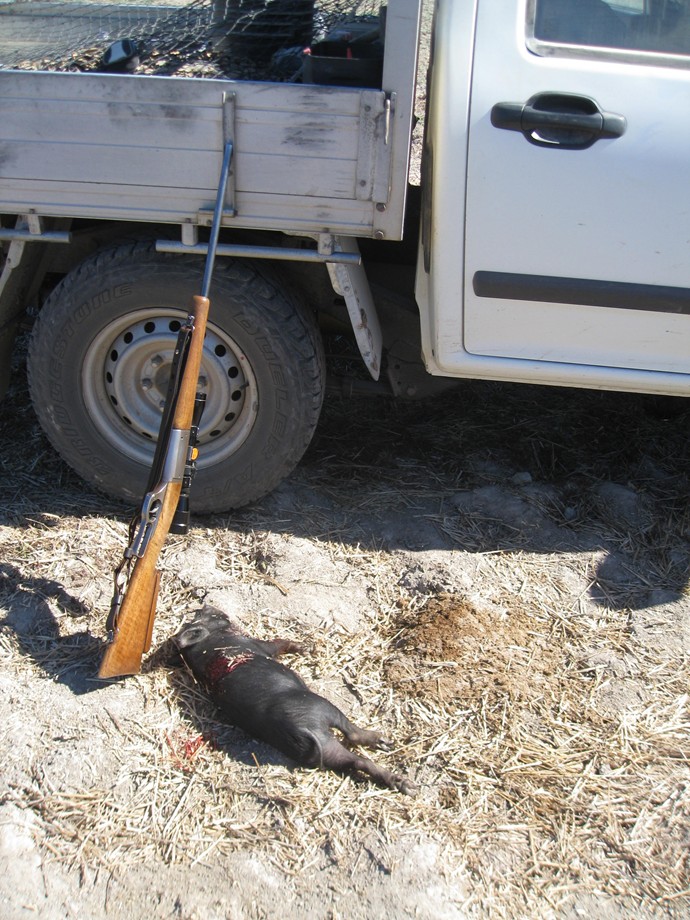
Herewith some more examples of kills with my cast hollow point .30-30 bullets. This is leading to a comparison of hollow depths for terminal effectiveness.
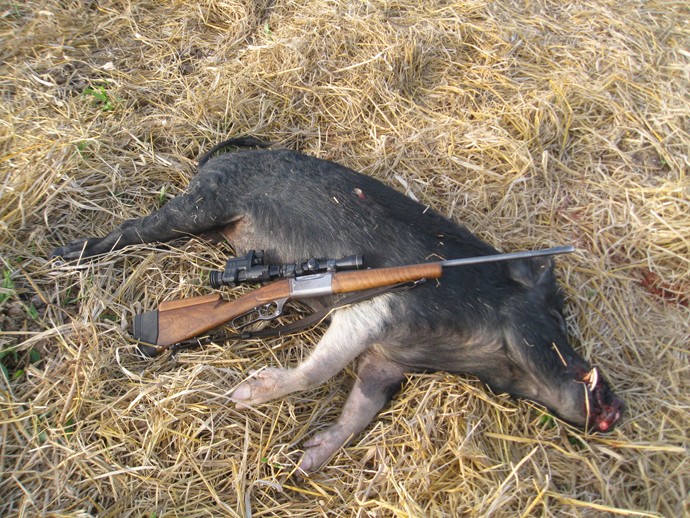
This young boar came to a carcase at night and was shot at 100 meters. Length is 58” snout to butt of tail. This was a shoulder hit with mid-ribs exit. Hog ran 68 meters. A little higher and further forward would have been better.
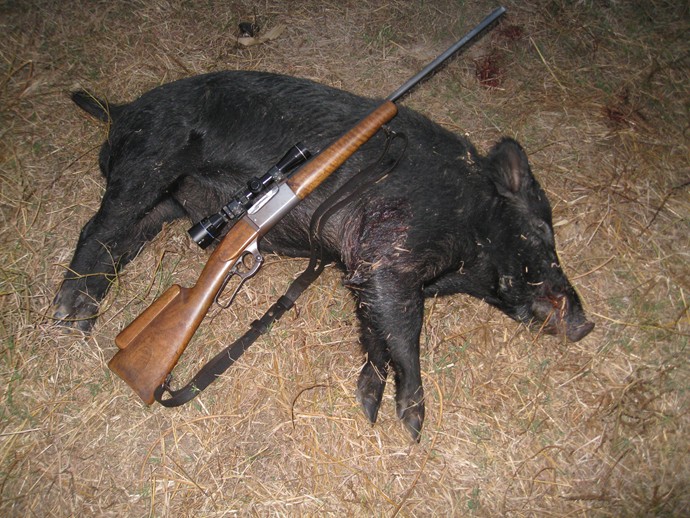
The rifle is my Savage 1899 .30-30 with Leupold 2-7 scope and Oneleaf NV100 night vision device (NV setup is shown in the second pig image). Bullets are cast #U321297HP (yes, .32 Special), about 16 BHN, sized to .312” and noses rounded. Weight with gas check is 175 gns. Hollow tapers from .114” to about .080”, is .500” deep and takes out 10 gns of bullet weight compared to a solid.
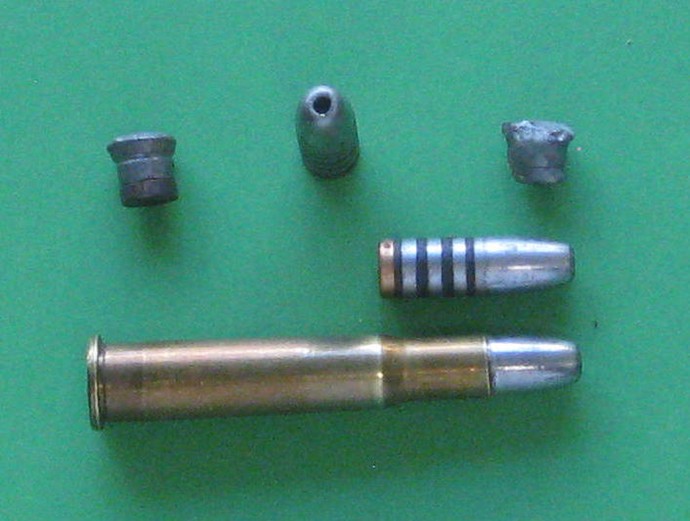
Current ammo is loaded to about mid 2200s with LeveRevolution. These bullets shed their noses in the pig, but the bases penetrate a long way, and usually pass right through. Hardness is chosen to ensure penetration through the shoulder of a mature boar, then into or through the off shoulder. The broken noses ensure internal damage on rib shot sows and immatures.
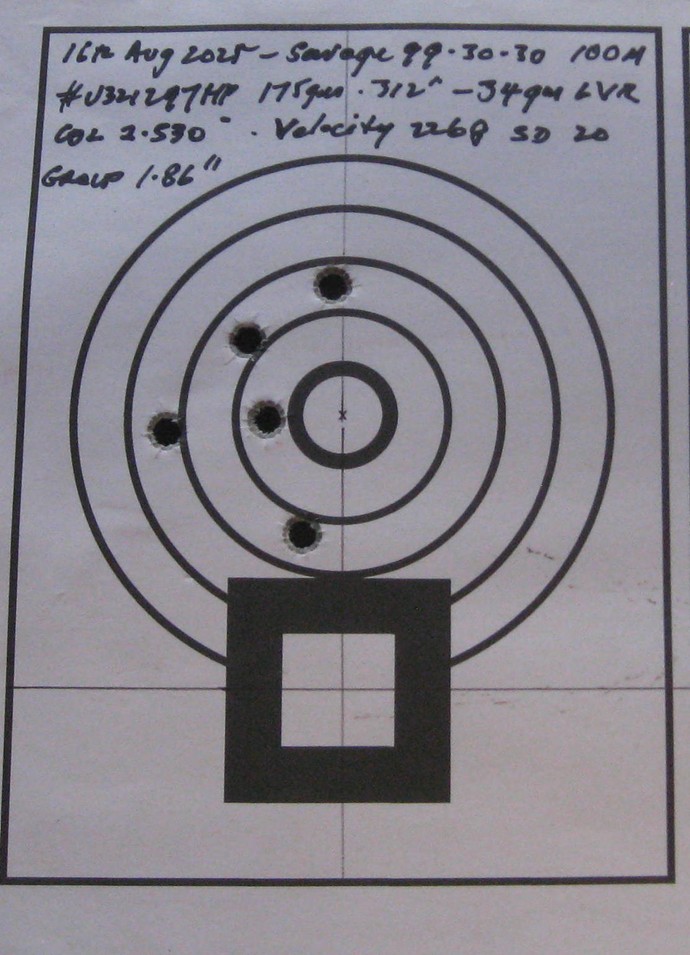
Groups (5 shots) have averaged about 2.5 moa, but are sometimes better, and are certainly adequate for pigs at 50 – 100 meters. Groups seem to be improving as I seat bullets further out, though at the expense of less reliable feed from the magazine.
A second engagement was at the same carcase a few nights later. The “blind” (Isuzu Dmax) was set back 100 meters from the bait. The mob came in about 8.00 and contributed two to the tally. Then at 8.20, 11.30 and 1.15 three singles came in and were dealt with. The last was a barrow, this time in rather lean condition. Length of the barrow was 63” and tape measure weight 212 lbs. Tusks look good. The hit seemed too far back, though ranging forward (no obvious exit), but the pig went straight over.
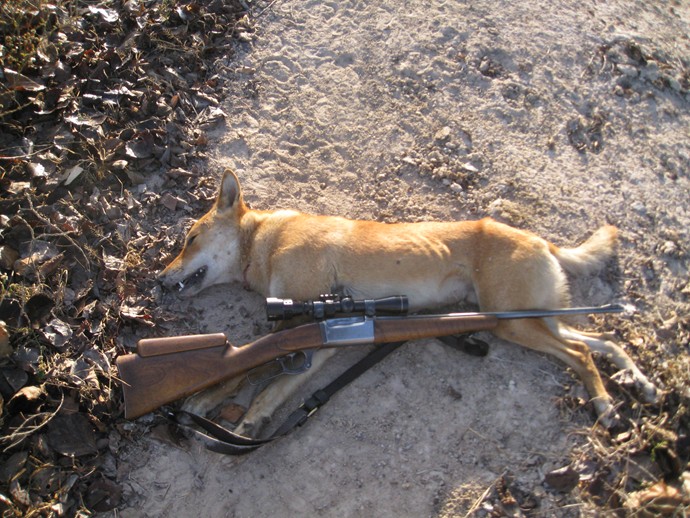
Then a dog (Dingo) interposed himself on the series. He was shot as he came in to a waterhole early one morning where I was waiting for pigs. He was facing me at 60 paces. The bullet entered the neck (see blood spot) and there was no exit. Effect was instant with just a couple of tail twitches.
Mostly I have been content with my bullet hardness and hollow, but at times I think I would like a little more penetration on the big fellows. Recently I discovered a spare hollow pointing pin, tapering from .107”, .330” depth, removing only 5 gns of bullet weight.
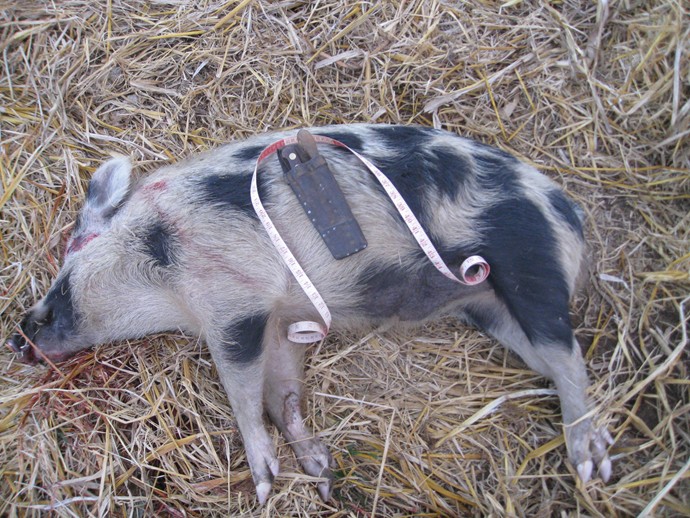
For a third engagement I used the shorter hollows, still 16 BHN, now 180 gns. This young boar (56” snout to base of tail) came to a carcase at night. The bullet broke both shoulders and exited, leaving an almost invisible .30” hole. The image shows the exit side. Pig went down with some kicking. Unexpectedly, he later came good, though with two broken shoulders he wasn’t going anywhere. This result would suggest the extra penetration has come at the cost of not enough shrapnel inside the hog.
The finisher, again with 5 gr hollow, was a straight on frontal shot, entering beside the head, not exiting, and producing a definite “lights out”.
A second test of the 5 gn hollows was on pigs coming to a (different) carcase at night. Shooting was at 90 meters. Result was five pigs with four shots. Pigs were smallish sows and sub-adult boars. One pig dropped to the shot, three ran but fell within 30 meters and a fifth, the recipient of a second-hand bullet, was found about 200 meters away. My feeling was that these bullets with 5 gn hollows were not providing the knockdown I normally see.
Since then I have shot several small sows in daylight with the 5 gn hollows and have remained unimpressed.
The recipe for .30-30 remains: BHN 16 at 2200 fps, hollow half bullet length, hollow diameter about one third bullet diameter, weight removal by hollow 10 gns or 6% of bullet weight.
Larger calibres at lower velocity will require softer alloy. Not sure about hollow dimensions for non .30 calibre.
You are only as good as your library.